'How long will we turn a blind eye to the Maoists?'

Association For Protection of Democratic Rights member and civil rights activist Sujato Bhadro has his hands full these days.

Bhadro, along with other APDR members, are busy appealing to the state government to release People's Committee Against Police Atrocities leader Chhatradhar Mahato [ Images ]. They are also trying to chart out a course of negotiation between the Maoists and the state government.

Bhadra had written an open letter to the Maoists in the wake of the Lalgarh crisis, eliciting a response from their leader Koteswar Rao alias Kishanji.

In a conversation with rediff.com's Indrani Roy Mitra, Bhadro discussed why Mahato's arrest is unjust, how the Lalgarh crisis can be resolved and how political parties are using the impasse to gain mileage.

Why are you demanding Mahato's release?

His arrest is an unjust act that violates human rights. There is no plausible charge against him.

But there is a murder charge against him. Prabir Mahato, a Communist Party of India-Marxist worker, was abducted from Dharampur in Lalgarh and murdered on June 14.

Is there any evidence that Chhatradhar murdered him? The state government has no concrete proof.

Remember what Chhatradhar's counsel Koushik Sinha told the media recently, 'Chhatradhar Mahato was not named in any First Information Report in the Prabir Mahato abduction and murder case. But the police added his name as one of the co-accused. The court ordered the production warrant on Monday and police produced him to show his arrest.'

Why do you think the state government is trying to implicate him?

To shift the people's attention from the main issue: That the Left Front has not done anything for the tribals of the area is an open secret that may cause the Front substantial damage in the forthcoming polls. Hence, this nautanki (charade).

How do you think the Lalgarh crisis can be resolved?

Only through negotiations. Security forces can flex their muscles but cannot achieve peace.

There are two ways to deal with the crisis: By improving the living conditions of the tribals and also by inviting both the PCAPA and Maoists for talks.

No one is advocating unconditional surrender to their demands, but what's the harm in listening to what they want?

You don't support the violence perpetrated by the Maoists, right? Your open letter to them clearly said so.

Not at all.

In fact, in the letter, I had said, 'Why only you, many philosophers throughout ages have clearly maintained that justice could be established through violence only. For example, Sartre has written: Violence is acceptable because all great changes are based on violence (The Aftermath of War page 35). He forgot to add that history itself had shown that a society created through violent means could not live for long'.

Whether anything good can be achieved through violence is also very much doubtful. The concept 'end justifying the means' rejects the notion of justice and morality; and the result is that 'the means outweigh the end'.

Therefore, you think the solution lies in negotiations?

Remember, in 1985, a treaty for peace was signed with the Mizo National Front and the MNF was given the opportunity to govern the state.

Don't we know what happened in Nepal? How long will we turn a blind eye to the Maoist issue? We have to strive to bring these people into the democratic system.

Coming back to Lalgarh, do you think a civil movement is needed to improve the state of the tribals in the area?

Of course. We at APDR are always trying to influence the intelligentsia to speak for the tribals. People need to take to the streets to uphold the causes of the tribal population.

Just as public opinion had swayed the country during the Rizwanur Rahman death case and the Nandigram [ Images ] killings, people of this state need to uphold the tribal issue. We cannot afford to be apathetic to such a grave problem.

What is the state of human rights in Bengal?

Human rights are being violated in Bengal every minute, may be now, even as we talk.

On March 5, 2008, five APDR members -- Sidhartha Sengupta, Bijaya Chandra, Prasanta Halder, Arup Dutta, Ratna Bhoumik -- were detained for 17 hours at the Nandigram police station on false allegations raised by Communist Party of India-Marxist cadres that they were Maoists.

What type of a democracy are we living in?
READ MORE - 'How long will we turn a blind eye to the Maoists?'

Growing Indian Maoist Menace, Train Hostage Drama: Who is Responsible?

IND27281B
Today one of the most elite and prestigious trains of India Rajdhani Express was held hostage for almost 5 hours. Some 200 people who surrounded the train and abducted the driver were no terrorists but yet they did manage to spread word of terror. The abducted driver was later released and Central Reserve Police Force (CRPF) rescued of 1200 stranded passengers. No one was seriously injured or killed and no one was arrested either
It is believed that these 200 local people belonging to the interiors of Jharkhand were part of Maoist group demanding release of their leaders who have been recently arrested during crackdown on Maoists operations in some states (mainly West Bengal).
Naxalite and Maoist movement has been gaining ground in the interiors of India mainly due to flawed development policies. Developmental projects like dams, mines, heavy industries have displaced thousands of people all over India who have been forced to live in slums in the cities. It is only activists and Maoists groups who have managed to reach out to farmers and poor tribals living in interiors of India and hence have found good haven and fertile ground for their revolutionary dreams.
If only administration and politicians had kept their promises of providing basic infrastructure like health,  primary education and right to livelihood to millions living in far flung villages this Maoist menace would not have grown into a big tree which if uprooted now will certainly shake the whole country. Its better to cut the roots  and let the tree to die out naturally to uproot this menace completely.
Via NDTV
READ MORE - Growing Indian Maoist Menace, Train Hostage Drama: Who is Responsible?

‘Idle arms’ reach Bengal Maoists

Guwahati, Oct. 26: The Centre has alerted some of the northeastern states about flow of arms through and from the region to Maoists, particularly in neighbouring Bengal, and asked the security apparatus to mount a vigil to break the supply chain.

A source today said intelligence feedback indicated that arms were reaching the Maoists from the Northeast. “It is a trickle now, but if not checked immediately, the volume can grow in future,” a source said.

Apart from the region being strategically placed for arms movement from Myanmar, particularly through Mizoram and Manipur, there was also a sizeable quantity of “idle arms” available in these parts, the source said.

According to him, the surrendering militant outfits are not declaring all their weapons. “While they hold back some, rest are even sold to those who require these weapons. And at the moment, the Maoists are the nearest customers,” he said.

The source said the Maoists were in need of sophisticated weapons given the large areas covering several states in which they are operating and would tap every possible source for it.

“They (Maoists) are now looking for more lethal weapons like the AK series rifles, grenades and rocket launchers, besides hand guns, which are available in the Northeast and some of which are lying idle with surrendering militant groups in the region. They (the Maoists) are at present banking mainly on SLRs and .303 rifles, some of which were looted from police armouries. The shortage of modern weapons is, however, made up by the large number of cadres the Maoists can deploy for carrying out raids — at times several hundred of them take part in these operations together. The sheer number is intimidating,” he said.

The Maoists, however, will find it increasingly difficult to carry out raids with such large number of cadres once security forces dominate the areas.

“They (the Maoists) would then be more easily noticed and tackled. They will have to resort to classic guerrilla operations with smaller bands of cadres, but with more sophisticated weapons,” the source said. He said apart from firearms, the Maoists were also surveying the markets for explosives like RDX, which are available with Northeast militant groups.

“The explosions the Maoists carry out now through remote-controlled IEDs in the rural areas targeting security forces are not RDX-based. But once they move into more urban areas where planting remote-controlled IEDs or land mines is difficult, they will require explosives which cause greater damage from smaller quantities,” he said.
READ MORE - ‘Idle arms’ reach Bengal Maoists

Assam police may visit Gujarat to probe jihadi' e-mail

GUWAHATI: A Special Task Force (STF) team of Assam Police may visit Ahmedabad to investigate a jihadi mail received by a young Gauhati High Court lawyer. The mailer had offered the lawyer $5 million for recruiting militants and taking guerrilla training in Afghanistan.

On Saturday, STF sources said they were in touch with their Gujarat counterparts to locate the mobile number mentioned in the email. The STF had earlier said that the number (+91 9824907080) was from somewhere in the western state. "We are in constant touch with Gujarat police. If necessary, will visit the state for probe," STF sources added.

Lawyer Ajoy Hazarika, 32, had filed an FIR with the STF here on Tuesday, requesting for investigation about the origins of the email that had been sent to him on October 15. "I am acting on behalf of a group looking to recruit believers to attend military training in Afghanistan, and to continue the holy jihad. After martyrdom, your families will be compensated with $5 million," the email had stated.

However, STF sleuths are yet to trace the Internet Protocol address of the mail's sender. STF additional SP Manabendra Roy told TOI, "Our probe is on to trace the IP address. But we are yet to make any breakthrough."

The email, with its subject as "military recruitment and training in Afghanistan" had been sent to Hazarika from the ID buygloballeads@aol.com. The sender had asked the "devout believer" to contact him via one of the six e-mail addresses provided in the mail. It had also given a mobile number and a website: http://www.buygloballeads.com.

When checked by TOI, the website proved to be an internet marketing company which specializes in high quality email leads in Net business opportunities. The company, however, has no specific address.

The SFT had registered a case after Hazarika's FIR. He is also the coordinator of Consumers' Legal Protection Forum, a city-based NGO.
READ MORE - Assam police may visit Gujarat to probe jihadi' e-mail

A trip into India’s rebel-held territory

A trip into India’s rebel-held territory

Posted by indianvanguard2010 on October 24, 2009
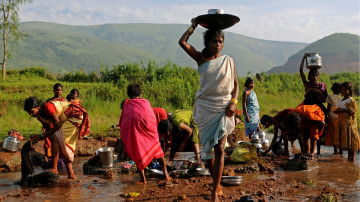
Women collect water outside of the village of Maliguda, (about 60km from Koraput) on Monday, September 21, 2009.  Many of these women are members of India's tribal community and are living in a forest village whose ancient lands were ceded by government to an aluminum mine. Development on nearby land threatens the villagers access to water.
Women collect water outside of the village of Maliguda, (about 60km from Koraput) on Monday, September 21, 2009. Many of these women are members of India's tribal community and are living in a forest village whose ancient lands were ceded by government to an aluminum mine. Development on nearby land threatens the villagers access to water.
Stephanie Nolen
Narayanpatna, India — From Saturday’s Globe and Mail Published on Friday, Oct. 23, 2009 5:31PM EDT Last updated on Saturday, Oct. 24, 2009 1:30AM EDT
Some of the flags are emblazoned with the hammer and sickle, but most are plain. The raggedy scrap of red, knotted on a bamboo pole and stuck in the middle of a rice paddy, is enough to send the message: This land has been occupied. Redistributed. Or reclaimed, depending on who is talking.
The terms matter little. The banners in the paddies that sprawl for miles proclaim the rule of a new authority.
“The government has bowed down before them,” says Lokman Purusiti, looking haggard and distraught, “because their strength is much greater.”
Mr. Purusiti has title to five acres outside the village of Bikrampur, land he says his family has farmed for 200 years. But a few weeks ago, men with red scarves tied around their heads appeared, planted a flag in his paddy and began to plow the land.
The mob smashed up a few houses in Bikrampur and made sure everyone knew that a farmer in the next village who got in their way had wound up dead. Now, Mr. Purusiti and his neighbours mostly keep to their houses. “If anyone goes to the police to complain, he is killed.”
Over the past three months, an insurgency has erupted in Narayanpatna, a region in the eastern Indian state of Orissa that includes Bikrampur and a hundred other small villages. In this particular operation, a few thousand hectares have been occupied, a few thousand people displaced and a half-dozen killed.
But the region is part of a vast tract that cuts a diagonal swath across India, from the state of Bihar in the east through Chhattisgarh to Maharashtra in the west. It covers one-third of the country’s land mass, and the Indian government estimates that, within it, at least 40,000 square kilometres of land rich in forests and minerals are now under the control of Maoists.
Yes, Maoists.
“Outside India, people are still surprised you can have something called left-wing extremism – it’s almost quaint,” says Ajai Sahni, who heads the Institute for Conflict Management in New Delhi and one of the few serious efforts to track the insurgency.
“The Soviet Union collapsed, China has abandoned … communism, and it is very difficult for an outsider to comprehend the power that left-wing ideologies have in a country with such entrenched inequality and absolute deprivation.”
In the wake of last year’s terrorist attack in Mumbai, the government has addressed the Maoist issue with new urgency; last month, Prime Minister Manmohan Singh called left-wing extremism “the gravest internal threat to India’s security.”
But the area under Maoist control lies mostly in the belt of land designated for the adivasis , or tribals, India’s incredibly poor aboriginal population, for whom the country’s first prime minister, Jawaharlal Nehru, created huge forest enclaves much like Canada’s native reserves. Because the conflict has had little impact outside the tribal regions, those in India’s big cities, its political elite and its growing middle class have not taken the insurgency too seriously.
Yet the fight is anything but “quaint.” A few kilometres from here lies the charred carcass of a police truck that was blown up in July, killing nine officers whose limbs were strewn over the jade hillside. That was about the last time the state tried to send personnel through here.
Roads across southern Orissa are lined with huge trees that the Maoists fell and, in their signature move, surround with homemade land mines, cutting off traffic for months. And bodies of local people who are suspected of being dissidents or of acting as police informants are dumped in villages whose terrified residents arrange hasty burials, saying nothing.
Last week, 18 police in Maharashtra were killed by a land mine, while the body of an officer abducted in Jharkhand was dumped a few hundred metres from his severed head.
And there are firefights. As the fields of Bikrampur were being occupied, an elite paramilitary force in nearby Chhattisgarh was locked in battle with the insurgents deep in the jungle. The commandos supposedly had satellite intelligence and a foolproof plan, yet 14 of them were killed.
THE BIG PICTURE
India’s failure to stem the Maoist rise is an ugly flip side to the face of rapid progress that the country prefers to show the world. And it has grave implications: The success of the insurgency shows clearly that, despite a roaring economy and growing international power (Prime Minister Stephen Harper is due here next month to bolster Canada’s ever-cozier relationship with India), the government cannot maintain law and order in large parts of the country, including those eyed most hungrily by its trade partners.
The roots of this conflict are older than modern India. A Communist movement emerged here in the late 1940s, around the time of independence, and there were streams of the party that supported, variously, the ideologies of Marx, Lenin and Mao. The movement split when some groups decided to begin contesting elections, and the Communist Party today forms the government in some of India’s best-run states.
Others, however, insisted that parliamentary politics would never liberate the poor, and took up arms. Since 1967, the hard-liners also have been known as Naxalites, after the village of Naxalbari in West Bengal where tribal people rose up against high-caste landlords. The Naxal movement was once very popular with intellectuals and those with leftist sympathies, but it has alienated many people in recent years by resorting to terrorist tactics; beheaded police officers make front-page news across the nation.
The Naxals finance their movement by extorting from landlords, government, mining companies and anyone else who tries to work in the areas they control; they arm themselves by stealing explosives from the mines and pillaging police stations.
Their strategy is classic Mao: Create what Mr. Sahni, the terrorism expert, calls “disruptive dominance” by gradually driving out the state and encircling urban centres before launching the revolution to establish a people’s commune. Only hard-core sympathizers now think this very likely; meanwhile, havoc is being wrought.
Today, the Home Ministry says the insurgency is active in 22 of India’s 28 states, and admits it has no real idea how big the Naxal movement is. A rough estimate among terrorism experts is 10,000 highly trained fighters and 40,000 other rank-and-file members, many of them women, plus tens of thousands of villagers who may have little choice but to support them. Despite having a fairly small fighting force, the Naxals have staged some high-profile attacks in recent years: Two chief ministers (India’s equivalent of provincial premiers) narrowly escaped assassination, and in July, the Maoists in this district briefly overran Asia’s largest bauxite mine, taking 150 hostages and making off with immense quantities of explosives.
The death toll is escalating steadily, from 482 in 2002 to 721 last year, a figure that excludes the hundreds of Naxal fighters and supporters killed by police. This year’s total, according to the South Asia Terrorism Portal, hit 580 by August, far more casualties than in the higher-profile conflict with Islamist extremists in Jammu and Kashmir.
In the past week, the government has announced plans for a huge, co-ordinated assault on the Maoist regions – but also made one more plea for the insurgents to negotiate. It’s easy to see why the state prefers this route: Even as Prime Minister Singh was warning of the Maoist threat last month, he acknowledged that his government is losing the fight.
100 HALF-NAKED MEN
Narayanpatna is eerily still. The thickly forested hills, the village lanes that twist between whitewashed houses and the streams where women beat laundry on rocks are at once beautiful and somehow sinister. Few vehicles pass along the rutted roads; drivers of those that do keep their windows down and lean out to make their civilian identities clear, because Naxal sentries on every hilltop watch for potential roadside-bomb targets.
In Bikrampur, the poor people who lost land cower in their houses just a few hun-dred metres from the even poorer people who seized it. A hundred half-naked men from the Gond tribe, wearing only tattered sarongs in the 50-degree heat, squat in the paddies, doing the tedious, painful work of thinning the rice plants. Their leader, Promod Taring, watches them, and for any hint of insurrection, from the shade of a battered black umbrella. Sent by the local revolutionary committee to supervise the occupation, he speaks of his mission in the urgent language of a zealot.
“Generations before us have been deceived by non-tribals,” he says. “For liquor and small amounts of money, the land was captured from our forefathers. Now that we have got a small education, we understand that we lost our land unethically, hence this move-
ment to take back our land. You can’t say it’s by force – it is the finding of lost land. It was snatched from us and we took it back.”
A 1995 Supreme Court judgment said tribal people had rights to land, he adds, yet none of the tribals in this region were given any, so they had no choice but to seize it.
Mr. Taring rails about his people’s historic oppression in terms laced with choice words from Chairman Mao – land, he says, must go to the tiller, and that land must be seized because the landlord will never give it up voluntarily.
Yet, in Bikrampur, the fight clearly is about more than the tyranny of the landlord. The haggard Mr. Purusiti, for example, while technically a landlord, was hardly prosperous. His five children and 10 grandchildren lived off his five acres; their house has two rooms and a dirt floor.
At the start of the occupation, the mob attacked the house of his neighbour, Kumari Hiyal, and beat her husband badly. “They say they are with the poor,” she says of the Maoists. “But they are not with us.” The couple earned $30 a month selling brooms.
In fact, the fight in Bikrampur has as much to do with caste as it does with land. Mr. Purusiti and the other villagers, although not high-caste themselves, hired the even lower-caste tribals to work their land, collect dung and sweep the laneways. “We were being tortured by a section of society,” Mr. Taring says defiantly, his gold-flecked eyes trained on the village.
And when his leaders went looking for people to seize the land, they did not have to go far. Men working in the paddy say landowners in Bikrampur were paying them 60 or 70 cents a day – below the legal minimum wage – and would not even let them use the same wells as higher-caste residents, one of a dozen daily humiliations. Now, they finally have land. And revenge.
Inevitably, Mr. Taring observes, some poor people will suffer in the fight for justice, as Marx predicted; casualties are unavoidable.
“Personally, I feel for them,” he says of the villagers, “but as a part of the movement, I am forced not to feel for them.”
This is a typical Naxal tactic, to use local conflicts as an entrĂ©e into a community. The Indian government also boosts their cause: “Even 62 years after independence, there are areas where roads are not there, schools are not there, hospitals are not there,” says Deepak Kumar, the district police chief. “People in some of these areas, from the time they’re born, they don’t know what government is. They only know government as police or the tax collector.
“For them, the Maoists are like Robin Hood.”
In a rapidly changing India, the Maoist message is, for some people, becoming ever more relevant. The state government cannot find these villages to install drinking water systems or to post paramedics, but it has managed to draw up precise surveys of land and population for major international mining companies that want access to the bauxite that coats the hilltops.
Sukanunder Taring (no relation to his leader) helped to seize the fields in Bikrampur and says that he and his four brothers share two acres of land in nearby Bari. That made them far better off than most tribals until six months ago, when a mining company arrived, saying it had permission to stake a claim.
Mr. Taring says people in his village asked the regional administration to protect their fields and forest resources, but no one would even meet with them. This came as no surprise, he adds, since they need to pay a bribe even to collect a pension. “We feared we would soon lose our land to the mine,” he says. “This new land, it isn’t much, but with it we will have a better life.”
In this district, 29 mining companies have been licensed in the past three years. One Gond village has waged a six-year struggle to keep out an aluminum mine. When the people blockaded bulldozers last year, local leader Arjun Khilo says, their member of Parliament angrily told them: “Whether you want it or not, this mine will happen.”
The only offer of help has come from the Maoists, a scenario repeated in locations across the region, according to K. Balagopal, the late head of the Human Rights Forum, which tracks police excesses in the fight against the rebels.
In an interview conducted just before his recent fatal heart attack, Mr. Balagopal explained that India’s business-friendly policies “have alienated the poor so much that the scope for a genuine radical movement is, in fact, greater today than it was …when the Maoist movement started.”
‘WAYWARD CHILDREN’
Even as the government appears to drive people to embrace the Naxals, its own engagement with the rebels has been disastrous. The first problem is a lack of will: Prime Minister Singh began to fret about the insurgence in 2005, only to be continually contradicted by his own home minister (recently replaced by a hawk), who considered the Naxals “wayward children.”
New Delhi is now focused on the threat, but many states have mixed feelings. Those run by Communists have clear leftist sympathies, while others seem to feel the fight would only cost them votes, says Mr. Sahni of the Institute for Conflict Management.
An audit conducted last year found the police unprepared for the fight. Governments had redirected or sat on money meant to upgrade the forces, and failed to procure vehicles, weapons, ammunition and better communications equipment. With insurgents operating freely in two-thirds of its territory, Orissa had 1,000 police stations in sensitive areas with no transport; 1,250 vehicles had been purchased and then diverted to VIP service.
However, one state has fought back effectively. Located directly south of Orissa, Andhra Pradesh was long the intellectual base of the Maoists, who by the late 1980s operated there with impunity. Then it created an elite commando force, the Greyhounds, with a big budget for intelligence, and sent it into the jungle to hunt the Naxals.
Inspector-General Anjani Kumar, who now heads the force, explained in a rare interview that, in addition to the commandos, the state beefed up policing as a whole and implemented a tempting surrender policy, offering employment training and cash to defecting Naxals. All the while, he stresses, the government pushed to roll out development initiatives in the most Naxal-affected areas to lower the rebels’ appeal.
Mr. Sahni calls the hearts-and-minds aspect nonsense and says the skilled policing simply made the cost of operating too high for the Naxals, who promptly decamped over the border, into Orissa, Chhattisgarh and Jharkhand.
Other states have yet to match Andhra Pradesh’s success. The United Nations recommends having 222 police officers for 100,000 residents; at the end of 2007, Orissa had 125 – a deficit that extends into every department that might respond to the insurgency.
The gap is similar in every Naxal-affected state. But the country is in no position to go on a hiring binge: With fewer than nine per cent of Indians educated past high school, Mr. Sanhi calls the skills deficit “monstrous.” Orissa agreed last year to hire more police, only to discover it had no-one qualified to train the officers.
The forces today are just big enough for the occasional major operation, like the disastrous commando raid in Chhattisgarh, which does little more than make headlines. The central government is offering to help, but “pumping in central or paramilitary forces will not work – and it’s what the Maoists want, because there will be killing of civilians and this will influence opinion,” says Insp. Kumar, whose own elite force has a poor human-rights record.
Mr. Balagopal, the human-rights advocate, bemoaned the fact that the Greyhounds’ success in Andhra Pradesh inspired copycat forces in other states: “Okay, in the end, they have succeeded in pushing the Maoists to the wall, but they have been completely brutal and entirely illegal.”
Torture is now a routine part of interrogations, he said, and no one questions why Maoist suspects rarely survive “encounters” with the police.
Like many, he argued that only a political solution will resolve the problem. Varavara Rao, a teacher and poet in Hyderabad, the capital of Andhra Pradesh, has represented the rebels in negotiations with government, and says they are still willing to talk, if the government removes its forces from the forests and allows tribal people free movement.
“It’s not that the Maoist party has asked you [in government] to give away power to them or to accept the Maoist philosophy or even their proposition of land to the tiller,” he says. “They are asking you to implement your own land-reform acts. … They are asking you to implement your principles of state policy and the fundamental rights.”
But Mr. Balagopal predicted that there will be no talks. “How does government explain to the people why land reforms have failed in this country, why minimum wage is not paid and … no actions are taken by the government? They do not have an answer to that so they prefer to make policing the central job.”
Instead, Mr. Sahni says, the insurgency will continue to spread – never to the point of seriously threatening government or seizing power, as Maoists did a few years ago in neighbouring Nepal – but still undermining development efforts in India’s poorest areas.
‘WE LIVE IN FEAR’
In Bikrampur, the families who lost their land are staying put, for now. Mr. Purusiti estimates that his family can survive for about a year on its savings. “When what we have is exhausted, we will leave. We don’t know where we will go.”
Camps have sprung up around police stations and government buildings across the tribal belt to accommodate the thousands of people displaced by the violence.
Mr. Purusiti wonders how long they can co-exist beside the occupiers and whether banners and a few smashed houses will be the end of the violence. “We live in fear every night that we will have to leave in the morning. We have the hope that in the next year the administration will come up with some solution.”
The same administration that has yet to send anyone to investigate the seizure of Narayanpatna?
He sighs heavily. “We don’t have any confidence in the administration. But there isn’t anyone else to listen to us.”
READ MORE - A trip into India’s rebel-held territory

Prisoner swap with leftwing rebels by Indian gov't raises controversy

NEW DELHI, Oct. 23 -- One day after the government of the eastern Indian state of West Bengal swapped prisoners with extreme left-wing Naxalities for an abducted police official, words are doing the rounds in the national capital that this couldbe looked upon as a softening of stand towards the rebels by the government.
    The guerrillas Thursday released police official Attindranath Dutta amid high drama in the forests of the state's Naxal-infested Lalgarh region in exchange for 14 elderly tribal women prisoners, suspected to be rebel supporters, who were released on conditional bail by a court.
    Security experts and political analysts have claimed that this "soft stance" on part of the Indian authorities indicate that the country is somewhat giving in to the demands of the left-wing rebels despite putting up a brave face by refusing to enter into talks with them unless they shun violence.
    "On the one hand, the authorities are saying that no talks till the rebels abjure violence. But, on the other hand, they are agreeing to their demand of prisoner swap for an abducted police official. This seems that the authorities are bowing to the Naxalities," security expert Ravi Dawa said.
    In fact, what started as a peasant movement to acquire justice for landless people and protect them from being exploited by landlords in 1967, Naxalism is now a major internal security threat. They control about 165 of India's 602 districts.
    The states most affected by the Naxal menace include Jharkhand, Bihar, Maharashtra, Chattisgarh, West Bengal, Orissa and Andhra Pradesh.
    Even India has reiterated the serious threat the country faced from left-wing extremism though it asserted that however difficult it might be, it had the capabilities to tackle all kinds of situations.
    "India is going through a difficult phase of internal security, but we will overcome the challenges," Indian Home Minister P. Chidambaram said Friday, refusing to talk or negotiate with the Naxalities until they shun violence and give up arms.
    "It is estimated that the Naxalites have 9,000 to 10,000 armed fighters, 6,500 firearms and about 40,000 full-time cadres. They are spreading their net like anything across the country. At this time, bowing to their demands of prisoner swap only bolsters their morale and cause," said political analyst Professor Ajay Singh.
    Indian Prime Minister Manmohan Singh recently admitted that the country's security forces are failing to curb a growing Naxal insurgency.
    "So much so the threat is that India has allowed its Air Force and the paramilitary forces to flush out the rebels from the Naxal-infested states. But, this act of exchanging prisoners for a police official shows the soft stance on part of the Indian authorities," said political analyst professor S.K. Gupta.
    "The act also showed a new way to the rebels who may now resort to abduction and swap tactics. Today, they abducted a police official, tomorrow they may repeat the same with a cabinet minister. The situation is grim and the swap act only added fuel to the fire," he added.
    According to estimates, over 6,000 people have been killed during the 20-year left-wing insurgency.
    "In some areas they have virtually replaced the local government and are able to mount spectacular attacks on government installations. It's time that India takes up the menace once and all. Either they should be eliminated or they should be invited to talks to sort out the problem. But, this has to end," Gupta said.
READ MORE - Prisoner swap with leftwing rebels by Indian gov't raises controversy

Indian rebels issue demands over police hostage

The body of Indian policeman after he was shot by Maoists

KOLKATA — Maoist rebels holding a policeman hostage in eastern India demanded on Wednesday that jailed ethnic tribal women be freed from prison in return for the officer's release.
Nearly a dozen armed Maoists killed two officers and abducted another in an attack on a police station in West Bengal on Tuesday.
"We will not kill the abducted police officer. He will remain hostage until the release of tribal women who have been falsely charged with sedition," a Maoist leader known only as Kishanji told Bengali TV channel Chabbis Ghanta.
Kishanji said the rebels would continue to attack police officers unless the state government withdrew security forces from Lalgarh, an area previously under Maoist control.
Maoist-linked violence has already claimed over 600 lives this year with rebels staging a slew of raids against police targets despite some successes by security forces in arresting or killing a number of senior members.
The rebels, thought to number as many as 20,000, say they fight for the rights of the rural poor but officials accuse them of using intimidation and extortion to collect money and to control impoverished villagers.
READ MORE - Indian rebels issue demands over police hostage

Chidambaram Says Naxalism & Terrorism Are Different

Union Home Minister P Chidambaram has said that Naxalism is not the same as terrorism in Jammu and Kashmir and mentioned that the Maoists, who are creating problems in the north-east India should be treated as an entirely different entity.
 
He has also urged the Naxals o give up violence and hold peace talks with government. Chidambaram said that the Naxals were not demanding for secession with India whereas this is the aim of the terrorists of Jammu and Kashmir.
 
The Centre has termed as the act of Naxals recruiting kids for carrying out plots against security personnel as a “despicable act". The Centre has also mentioned that it is determined to put an end to the diabolical activities of Naxals.
 
"Intelligence inputs have indicated forced recruitment of children by Naxals in south Chhattisgarh. Naxalities are also exhorting the villagers to provide five boys or girls per village for recruitment in their armed squad," an official spokesman said in a release.
 
"The Government condemns this despicable act on the part of Naxals and reiterates its commitment to control the diabolical activities of Naxals," he said.
 
The Centre is currently firming up plans to counter the Naxal problem which has affected 20 states.
READ MORE - Chidambaram Says Naxalism & Terrorism Are Different

'Afghan mess has spilled over to Pak'

hursday’s coordinated attacks on separate police facilities across Pakistan have intensified calls for Islamabad’s withdrawal from the US-led
Pakistan
Afghan mess has spilled over to India. (Reuters)
war on terror in Afghanistan, which its opponents believe was the real cause of “mayhem in Pakistan”.

Pakistan cricketer-turned-politician Imran Khan, who has over the years become the most vocal critic of America’s involvement in Afghanistan, said as long as imperialistic forces are stationed across the Durand Line, Pakistan would continue to bleed.

“We’ve more Pashtuns in Pakistan and they empathise with their brethren across the border and support their yearning for freedom”, said the politician, who has been aligned to hardline Jamaat-I-Islami. “The Afghan mess had spilled over to Pakistan”.

He said Islamabad shot itself in the foot when it allied with the US and started bombing its own people. “Now we’ve a situation where the entire Pashtun population has turned against us”, he said. He said Pakistan has no homegrown policy on countering the mess. “It’s following the failed US policy of carpet bombing people that has long turned to be counterproductive”.

The Oxford-educated cricketer said the Pakistani rulers starting with military dictator Pervez Musharraf have been taking dictation from the west, because the US is bankrolling them. “We had no violent Taliban before Islamabad allied with the US’s Afghan disaster”.

He said the Taliban are no uniform outfit and that the entire issue had become messy. “There are our own tribal people who have genuine grievances but the Taliban has become hotchpotch with all sorts of criminals joining them.’’

Khan said Musharraf started the war which Pakistanis don’t consider was for them. “No Pakistani was involved with al-Qaida and now when you’ve this impression that our rulers are fighting US war, we have landed in this mess”.

He said Pakistan was getting nothing out of the war. “Compared to $80,000 spent per head on American soldiers per year, around 12,0000 Pakistani soldiers fighting American war get just $900.’’

He said that the only way out for Pakistan was to pull out of “somebody else’s war”.

Imtiaz Gul, author of ‘The Al Qaida Connection: Terror in Tribal Areas’, agrees with Imran in part and says Pakistan is always asked to do more but now it’s the time for the international community to do more for Islamabad.

He called on India to support Pakistan instead of pushing it around. “Pakistan has paid a heavy price for its war on terror. We’ve lost more than 2,000 people in last two years and Indians should understand and support us.”
READ MORE - 'Afghan mess has spilled over to Pak'

India to deploy 75,000 troops to fight Maoist rebels

INDIA IS soon to deploy more than 75,000 federal paramilitary and elite commando troops against Maoist rebels who dominate a third of the country’s 603 administrative districts.
This decision by the cabinet committee on security, headed by prime minister Manmohan Singh, follows a series of well-planned and ruthlessly executed Maoist attacks in western Maharashtra during one of which 17 policemen were killed.
The anti-Maoist operations scheduled for launch within days aim to “wipe out the top rebel leadership” and secure massive tracts of territory controlled by them across 20 of India’s 28 states.
Mr Singh has reiterated that the Maoists, who run parallel administrations in their areas of dominance, levying taxes, dispensing justice through kangaroo courts, dictating the educational syllabi and even launching moral rearmament campaigns, was India’s “biggest internal security challenge ever”.
“It is a matter of concern that despite our efforts, the level of Maoist violence continues to rise,” Mr Singh said in New Delhi last month at a meeting of provincial police chiefs. “We have not achieved as much success as we would have liked in containing this menace.”
Since 2007, Maoist violence has claimed almost 2,000 lives, among them 700 security force personnel and more than 550 rebels.
Security agencies claim there are fewer than 20 top Maoist leaders, some 30 commanders and about 12,000 to 15,000 cadres with varying degrees of influence in more than 220 administrative districts across central, eastern and parts of western India.
AS Gill, who heads the paramilitary central reserve police force, which would be in the vanguard in the fight against the rebels, said: “The [anti-Maoist] action plan, approved by the federal government will be set in motion very soon. The operations will be focused.”
The administration is also working on a new policy that offers financial assistance to Maoist cadres which surrender. The proposed payment is estimated to cost Rs4 billion (€58.4 million) if 10,000 of them accept the government’s proposal.
Maoists dominate in regions populated mostly by illiterate and underprivileged tribal people living in areas that have not benefited from India’s new prosperity.
Sixty-two years after independence land is still unfairly distributed in these regions, resulting in abject poverty, large scale unemployment, ineffective policing and corrupt governance.
Maoist cadres have filled this “power vacuum” with their “Jan Adalats” (people’s courts) and in some states have even been known to kidnap absentee health workers, teachers and lowly district officials, forcing them to perform their legitimate duties.
Their well-knit and ideologically committed members, who have successfully adopted Mao Zedong’s guerilla warfare tactics, claim to be waging an armed struggle to “annihilate class enemies” in order to economically, socially and politically empower tribals, low-caste Dalits, peasants, landless labourers and the dispossessed. The insurgents recruit among these marginalised people.
The Maoists eventual aim is to establish a “people’s government” in their areas of control by progressively dominating the countryside through coercion and indoctrination.
Over the years that the movement has proliferated, the Indian government’s response has been a poorly applied and often harsh use of force, and abuse of anti-terror legislation.
READ MORE - India to deploy 75,000 troops to fight Maoist rebels

Rebels bomb school, railway in India

NEW DELHI, India (CNN) -- Suspected Maoists bombed a school and a railway track, and set several communication towers afire, Tuesday in eastern India in anticipation of a government crackdown, authorities said.
Most of the attacks in Bihar and Jharkhand states occurred before dawn Tuesday, according to officials.
In Bihar, one of India's most lawless states, suspected communist militants held at least three railway employees hostage for at least three hours as they bombed a railway station, said senior police official V. Narayanan.
The hostages were later released, he added.
In neighboring Jharkhand, rail traffic was disrupted for more than 10 hours after suspected Maoists blew up a track, said F. Toppo, an inspector at the state's main police control room.
A band of rebels also bombed a government school before dawn, but there were no casualties, Toppo said.
They set about a half-dozen communication towers afire as well, he added.
The suspected Maoists attacked for a second day Tuesday as the government planned an offensive to seize rebel-controlled areas.
The government offensive will launch in less than two weeks, initially in two of 11 rebel strongholds, Kashmir Singh, the home ministry's joint secretary for Maoist management, said Saturday.
Forces will move to eastern India -- on the border between Jharkhand and West Bengal states -- in an operation expected to last a year.
Meanwhile Tuesday, a shootout erupted between rebels and security forces in the western state of Maharashtra during voting for legislative elections.
The gunfight occurred in the Gadchiroli district, the scene of last week's killing of 17 police officers by suspected rebels, said Jay Kumar, district police chief.
India has deployed thousands of police and paramilitaries for the voting in Maharashtra and in Haryana in the north and Arunachal Pradesh in the northeast.
"An encounter (shootout) has taken place. The situation is under control," Kumar said. There were no immediate reports of casualties.
Prime Minister Manmohan Singh, who describes the Maoist insurgency as the "gravest internal security threat" to India, said the nation's fight with the rebels has fallen short of objectives.
In the name of India's dispossessed, Maoist guerrillas known as Naxalites have battled the government since the late 1960s.
They enjoy support not only in the poorest and tribal communities but also among youth and the intelligentsia, the government suspects.
Indian authorities categorize the Naxalites as hard-core, armed local guerillas and public militias.
The government estimates there are at least 10,000 hard-core armed Maoists.
"We have not achieved as much success as we would have liked in containing this menace," Singh said last month. "It is a matter of concern that, despite our efforts, the level of violence in the affected states continues to rise."
Last year, 1,591 Maoist rebel attacks killed 721 people, government officials said. About 600 people have died so far this year in more than 1,400 rebel attacks.
In addition to targeting police, alleged police informers and people they call "class enemies," the rebels are attacking infrastructure such as roads, bridges, railways, and power and telecommunication networks.
The Naxalites say they are defending the rights of the poor. They now have influence in 20 of the country's 28 states, according to the government.
READ MORE - Rebels bomb school, railway in India