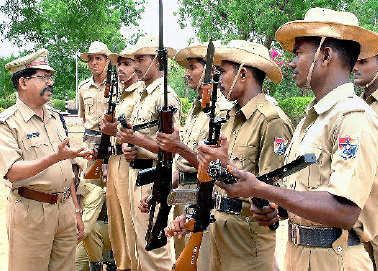
Indian Navy foils piracy bid, leaves pirates high and dry

New Delhi, May 30 : It was an anti-piracy operation with a twist in the tale: Instead of arresting the eight pirates who were attempting to board a merchant vessel in the Gulf of Aden, Indian Navy commandos seized their weapons, emptied their skiff of its fuel and set it adrift, leaving the tidying up to another warship.

FIRE POWER: Indian Navy officers at a review of ships. The countryAbout 225 nautical miles east of Aden on Thursday, as visibility dropped to less than two nautical miles, the guided missile stealth frigate INS Talwar that is currently patrolling the piracy-infested Gulf of Aden received a distress call from the Liberian-registered MV Maud, with 10 Indian crew on board, saying a skiff with eight armed men on board was approaching at high speed, an official here said Friday.
"The Indian warship immediately responded to the distress call and advised the vessel to increase speed and carry out evasive manoeuvres to avoid getting boarded. Simultaneously, a helicopter with marine commandos took off and started closing in on the threatened vessel," a senior Indian Navy official said.
The commandos noticed that the brigands had thrown a rope ladder and were attempting to board the Maud from just off the bow.
"The visibility being low, it was possible that the pirates may not have sighted the warship and the helicopter. The helicopter crew fired warning shots to deter the pirates from boarding the ship," the official added.
Following this, the two pirates who were attempting to clamber up the merchant vessel fell into the water. Commandos from the warship thereafter boarded the skiff and confiscated the weapons and other equipment from the pirates.
"Then, fearing further piracy attacks due to the low visibility, the commandos emptied the skiff of its fuel and set it adrift as INS returned to her patrolling duties while warships from other navies arrived on the scene for follow up action," the official said.
In response to the timely action of the Indian warship, the Indian master of MV Maud, Captain Manpreet Singh Dhaliwal, sent a message expressing his gratitude.
"From available records, this may be the first instance of a piracy attempt being thwarted when the brigands were in the process of boarding a merchant ship," an Indian Navy statement said.
Overall, this is the fifth successful action of the Indian Navy against the pirates in the region.
On December 13 last year, the guided missile destroyer INS Mysore foiled an attack on an Ethiopian merchant vessel and arrested 23 Somali and Yemeni pirates in the Gulf of Aden. Before that, on November 18, the stealth frigate INS Tabar had sunk a Somali pirate vessel after coming under attack.
On November 8, the Tabar had repulsed an attack by pirates to hijack two ships - an Indian and a Saudi Arabian merchant vessel.
Earlier this month, the Indian Navy thwarted a piracy bid off the Seychelles in the Indian Ocean Region.
READ MORE - Indian Navy foils piracy bid, leaves pirates high and dry

Maoist insurgency more bloody than Kashmir, northeast: report

New Delhi, May 30 : The ongoing conflict with Maoist rebels, mostly in Chhattisgarh, Andhra Pradesh and Jharkhand, has led to the deaths of more security personnel and civilians than the insurgencies in Jammu and Kashmir and northeastern states last year, a report by a human right group says.

According to the 2009 Indian Human Rights Report by the Asian Centre for Human Rights (ACHR), released in the capital Friday, the death toll due to the Maoist conflict has doubled over the last four years, whereas a dip has been seen in the insurgency-hit areas of the northeast and Jammu and Kashmir.

“The ministry of Home Affairs says that the a total of 920 people, including 490 civilians, 231 security personnel and 199 Naxalites (Maoists) were killed in Naxal violence in 2008. However the number of security personnel killed in Jammu and Kashmir decreased from 189 in 2005 to 75 in 2008 and in the northeast, it decreased from 71 in 2005 to 46 in 2008,” Suhas Chakma, ACHR’s director said at the report’s release.

The number of civilians killed in Maoist-affected areas during 2005 to 2008 were 1,965 in comparison to 1,666 in North east and 1,195 in Jammu and Kashmir.

Claiming there was a general apathy amongst the main political parties towards addressing Maoist insurgency, Chakma said although the political parties propose much in way of new powers to be given to the security forces, little emphasis is given to accountability.

“The 2009 general elections have been dominated by Naxal violence as never before. Earlier in April 2006, Prime Minister Manmohan Singh stated that the Maoists represent India’s biggest internal threat,” he added.

The report also takes up the case of atrocities inflicted upon the Dalit community in Uttar Pradesh.

“Atrocities against the Dalits and tribals under Dalit chief minister Mayawati have actually increased ever since she has come to power. As compared to the 6,628 cases of atrocities against the Dalits in 2007, there was an increase of 4.74 percent in 2008. According to Uttar Pradesh police, the total number of cases of Dalit atrocities in 2008 was 6,942,” Chakma said.

The NGO has now also asked the newly formed government to review all laws that provide prior permission to the central government to prosecute government and security officials in cases of corruption and human rights violations.
READ MORE - Maoist insurgency more bloody than Kashmir, northeast: report

Police officer tenders evidence contrary to prosecution’s case

Mohd Ajmal Amir KasabIn what appears to be a set back to the prosecution in the Mumbai terror attack trial, a police officer on Thursday said he had seen Pakistani gunman Mohd Ajmal Amir Kasab lying “unconscious” after a police encounter in Girgaum Chowpatty on 26th November last year.


All along, the prosecution has been maintaining through deposition of witnesses that Kasab was “conscious” and was overpowered by policemen at Girgaum Chowpatty.
Police Inspector Vinod Sawant, who is the investigating officer in this case, told defence lawyer Abbas Kazmi that he had seen Kasab and another terrorist Abu Ismail lying in an “unconscious” condition.

Special Public Prosecutor Ujjwal Nikam, asked the court to allow him re-examine the policeman to seek a clarification from him.
Nikam said a police officer is not a medical expert to determine whether a person was conscious or unconscious.
However, Judge M L Tahaliyani rejected Nikam’s prayer saying there was no ambiguity in what the witness has said and hence there was no need to re-examine the witness.
Nikam said, “Kasab is a great actor. He has been given special intelligence training by conspirators in Pakistan and he had pretended to lie unconscious when he was confronted by policemen at Girgaum Chowpatty. Perhaps that is why the police inspector might have considered that he was unconscious”.
Outside the court, Nikam said “the deposition of witness will not affect the prosecution’s case”.
Mohd Ajmal Amir Kasab
READ MORE - Police officer tenders evidence contrary to prosecution’s case

Delhi Police to install security gadgets at business hubs

New Delhi, May 30 : Under a public-private initiative, Delhi Police with the help of local business houses and traders' associations will install high-end cameras and security gadgets at markets and business centres which see footfalls of over 100,000 a day, officials said Friday.

Under the initiative, south Delhi's Nehru Place business centre, the capital's biggest IT market, has become the first centre where 32 CCTV cameras have been installed.


'The police, with the help of local business houses and traders associations, has set up high-end cameras at strategic points of the Nehru Place business centre that consists of several multi-storied buildings that see a footfall of over one lakh a day,' Joint Commissioner of Police (Southern Range) Ajai Kashyap told reporters here

'We are planning to replicate this model at several other markets like Lajpat Nagar, CR Park and Sarojini Nagar,' Kashyap said.
The initiatives have been taken following the Delhi serial blasts last year, which especially targeted crowded markets.

'Crowded business centres like Nehru Place are also vulnerable due to various other reasons, besides the militant threat,' he said.
READ MORE - Delhi Police to install security gadgets at business hubs

Jharkhand police train youth from Maoist infested belts

RANCHI - In a novel initiative, the Jharkhand Police is imparting vocational training to the unemployed youth of Maoist infested belts to enable them earn a livelihood as well as join the mainstream.


About 250 youth from the Maoist infested areas are presently being trained for recruitment in army, paramilitary forces and state police. Besides, they are being given training in driving is also being imparted to them.

It is intended also at bringing back the youth, who are moving towards left extremism because of unemployment, to the mainstream.

According to Superintendent of Police (SP), Ranchi, the initiative is sure to break the local support base of the Maoists, who recruit a large number of local youth every year.

“Our main concentration was rural areas. Because we know that those living in big cities will get this opportunity anytime because of their geographical location. But those living in villages don’t even have access to newspapers and basic information. There are many unemployed youth who are school dropouts and are idle. They do not even try or don’t have the right channel to do anything,” said Praveen Kumar, superintendent of police (SP), Ranchi, said.

“According to my personal observation, all this has created a furore among the Maoists because they are aware that this initiative would lead to eradication of their local support base,” Praveen added.
Praveen further stated that around 157 youth are being given driving lessons and that they would even make arrangements for issuing driving licence to them.

Police have brought these youth from remote areas, mainly Maoist stronghold areas, to state capital Ranchi where apart from providing training, free food and lodging is also provided to them.

Trainees feel the training is a hope for a better future for all of them, as the unemployment has threatened their survival.

“We are scared but unemployed and do not have any means for survival. Even though we live in Maoist infested belt but it’s better to do something rather than dying empty stomach so that’s the reason why we are here today,” said Sagar Baraik, a youth from a Maoist infested area.

Maoists, who have been running an almost four-decade-long insurgency, control vast tracts of rural land in about a dozen states in east, central and parts of southern India. They say they are fighting for the rights of farmers and the poor.

By Girija Shankar Ojha
READ MORE - Jharkhand police train youth from Maoist infested belts

Has Pakistan woken up to the threat of Taliban?

Abhishek Singh Samant

“Once upon a time, not very long ago, there was a country called Pakistan.” Well, the Pak government seems to have apparently understood that this might very well be the text of future History books if the monster of Taliban continues to swell and feed off the ideology of violence and hatred.

From an entity confined to the areas of Pakistan’s tribal frontiers, the Taliban have forced themselves into the country’s heartland riding the chariot of hate. Such has been the audacity and intensity of the group’s march that the Islamic nation appeared, and still appears, on the brink of failure, and there are fears in the global capitals that if the bull is not caught by the horns now, then Pakistan’s fate as a nation will be no more than a chapter in school books.

The country seems to have realised the fact and has launched an ‘all out war’ against the militia. However, the intent and objective still remains to be ascertained.

Pakistan’s tryst with Taliban

A brainchild of the US’ Central Intelligence Agency with Pakistan acting as midwife, the Taliban was created to oust the USSR from Afghanistan. The ouster of the Soviets was vital for Uncle Sam to protect its strategic interests in Central Asia. The US, which had once bloodied its nose in Vietnam, wanted someone to fight as its proxy. Pakistan, on the other hand, was eager to make inroads into its western neighbour with an aim to get the ‘strategic depth’ against its arch-rival India. This created an environment of mutual benefit for both the nations to take advantage of each others’ predicament. The Americans provided the dollars and Pakistan’s notorious Inter Services Intelligence agency assisted the process of gathering radical Muslims from around the world to fight against the Soviets.

Once the US purpose of driving out the Soviets was achieved, it left the field to save itself from doing the cumbersome job of reconstructing and restructuring the ravaged nation. Eager to have its share of the pound of flesh for its ‘help’ in the war, Pakistan willingly stepped in to fill the vacuum and slowly nurtured the Taliban to gain a permanent influence in its neighbour’s affairs. Pakistan’s policy on Afghanistan bore fruit during the rule of slain former prime minister Benazir Bhutto, as it was during her tenure that the Taliban gained prominence in Afghanistan and finally captured power in Kabul in September 1996. Thus, a Pak friendly government was in power in the Islamic nation’s west.

9/11 Attacks

The 9/11 World Trade Centre terrorist attacks in the US was a watershed moment in the way the West in general, and the US in particular, viewed terrorism. The attacks were attributed to the big daddy of terrorism, Osama bin Laden, who was in Afghanistan. The Taliban refused to hand over Osama without proof. The US coerced Pakistan into snapping ties with Taliban and supporting the former in its ‘war against terror’ or else risk being ‘bombed to stone-age’. The Northern Alliance, backed by the US forces, toppled the Taliban regime and the Hamid Karzai-led government assumed power, much to Pakistan’s discomfort.

Reasons for Pak’s inaction

It is hard to fathom how an Army of half a million well-trained personnel could not halt the advent of the Taliban for so long? The reason lies in Pakistan’s age-old India phobia. Since 2002, when the Taliban regime was toppled in Afghanistan, our Western neighbour has been providing sanctuary to their militants in the country’s north-west. Now the question arises: what purpose would it have served by providing refuge to the battered ‘soldiers’ of a demoralised ‘army’? Pakistan expected, and probably still expects, that al Qaeda leader Mullah Omar will manage a comeback in Afghanistan, topple the Karzai government (or for that matter, any West-backed government), force NATO’s ouster and reverse India’s influence in Afghanistan. Further, the Pakistani Army and the ISI continued to look over the advancing Taliban in the hope of achieving their aims in Afghanistan through the militia while keeping control of militancy and terrorism on their side of the borders.

Why has Pakistan acted now?

Well, as is pretty evident, the above mentioned calculations of Pakistan’s ISI and Army went horribly wrong. The Frankenstein’s monster, which they created, seems to have gone out of control and it was only when the Taliban started knocking at the doors of Islamabad sending shivers down the spine of country’s elite that the Pak Army swung into action. The Army action was followed by the country’s leaders claiming that: “This is the war for our survival”, “We won’t stop till the Taliban is vanquished”, “We will end terrorism in Pak”, and so on and so forth. But considering the Islamic nation’s ‘one step forward, two step backward’ approach toward the radicals, its continuous hide and seek with the Islamists, and the common umbilical chord shared by the Army-ISI and Taliban, it is natural to have doubts over Pak’s current action. So what are the reasons behind the ultimate Pak action and is it real or just eyewash?

The timing of the counter-attack makes one feel that the attack is just another attempt to fool the world (I wish it is not). The Army response started just a couple of days before Pakistan President Asif Ali Zardari was scheduled to visit the US at a time when the Congress was getting ready to approve an aid package for the country, which President Barack Obama had clearly stated would be subject to Pakistan’s verifiable action against the terrorists. In such a backdrop, it wouldn’t be naive to think that the aim of the Army action was more to give a face saver to Zardari in the US and help in the smooth passage of the aid bounty.

Secondly, rather than a genuine desire to root out terrorism and extremism, the ongoing Pakistani action is seen more as an effort of the Army to maintain the country’s integrity and to keep Pakhtun ambitions under check. The country’s north-western areas are inhabited by Pakhtuns, who are a rule unto themselves ever since the days of the British rule. A majority of the Taliban fighters are also Pakhtuns. A victory of the former would have infused a life into the now dormant, but very much present, Pashtunistan movement and the threat of the region’s secession would have become very real.

Another development which seriously questions Pakistan’s commitment in fighting terror is the fact that the current military operation is mainly concentrated in the upper areas of the NWFP and the Federally Administered Tribal Areas (FATA) are left untouched. It may be worth noting here that the latter is inhibited by Tehrik-e-Taliban leader Baitullah Mehsud – considered to be a close associate of Mullah Omar and accused of killing former PM Benazir Bhutto and carrying out several other terrorist attacks across the country. A month back, US magazine Newsweek reported that Mehsud has links with the country's Inter-Service Intelligence (ISI).

Following the Mumbai terror attacks, a top Pakistani security official said, “We have no big issues with the militants in FATA. We have only some misunderstandings with Baitullah Mehsud and Fazlullah. These could be removed through dialogue.” The statement is a reflection of how the nation’s security establishment views the militants, especially those which are indigenous and can be used against India. It is pretty evident that Pak still considers these militants as a strategic hedge against India. Their actions, which are concentrated in the northern areas of the NWFP, are more to curb the nationalist aspirations of Pakhtuns rather than any serious efforts to root out terrorism.

What lies ahead?

After 60 years of independence, Pakistan still finds itself where it started – in search of its identity. The notion of religion as a unifying factor, which was the basis of its origin, was exposed in 1971 when Bangladesh was liberated. The terrorists, whom it nurtured over the years, are biting the very hand that fed them. If the country’s establishment still fails to recognise the real threat to its existence then the fragmentation of Pakistan may no more be a topic of intellectual discussions, but a sad reality. It is up to the country to decide its destiny. It can very well sit back and watch the country slipping into the medieval-style rule or sustain its efforts in making the country what it was supposed to be – a successful Islamic Republic.

A popular saying is that the country is ruled buy three As –Army, America and Allah. While the former two are expected to bring back normalcy to the nation, it is probably the time for Allah to come down and rout the elements, who are using his name as a shield to justify their brutal methods and radical ideology.
READ MORE - Has Pakistan woken up to the threat of Taliban?

Security scenario around India matter of concern: Antony

New Delhi, May 26 : Advocating "eternal vigilance", A.K. Antony on Monday expressed concern over the security scenario around India and spelt out priority areas in his second term as defence minister -- infrastructure development in northeast and border areas, modernisation of the armed forces and welfare of the troops.

"The security scenario around India is getting more and more challenging. Developments around us are a cause of concern to us. So eternal vigilance is must for us," Mr. Antony said, referring to the instability and violence in neighbouring Pakistan, Nepal and Sri Lanka.

"Further strengthening of the security apparatus around us is the priority of my ministry," Mr. Antony said after taking over assuming office.

"To meet these challenges India needs to push modernisation of armed forces. Modernisation does not mean only procuring of equipments. Along with that, training of the armed forces is also important," he added, underscoring the need for strengthening land-border security, air defence and coastal security.

Referring to the Mumbai terror attack, when terrorists used the sea route to access the city, the minister stressed the need for paying more attention to coastal security.

He said his ministry had taken note of the rapid development of infrastructure by China on its side of the border.

"Infrastructure development in northeast and other border areas, modern equipments in coastal area is more important and will require fast track procurement."

"India wants to have friendly relations with all its neighbours. We have to not only maintain but improve relations with China. At the same time, we have to be eternally prepared for any challenges to our security," Mr. Antony added.

With Left parties out of the picture, Mr. Antony is expected to give impetus to defence ties with the US and Israel.

"We are developing defence ties with all the important countries. It is not one or two countries centric. We have good defence ties with the US, UK, Russia, France, Germany, Israel, Italy and Ukraine. We have defence cooperation with 45 countries, including China," the minister added.
Mr. Antony, 68, also discussed the welfare of troops.

"Equipment and training alone will not keep the morale of the armed forces high. The welfare of the armed forces who are deployed in the far-flung difficult areas like Siachen, Nathu-La and in deep sea in submarines and dense forest have to be protected.

"I will take personal interest to improve their service conditions, including their accommodation, ration, food and clothing," he added.

Mr. Antony was received by Defence Secretary Vijay Singh and senior officials when he arrived at the ministry's headquarters in South Block. Later, the three service chiefs also called on him.
READ MORE - Security scenario around India matter of concern: Antony

Four lakh tribals displaced due to Maoists: Report

Naxal Cadres. Photo Courtesy: AP
Naxal Cadres.

New Delh, May 25 : More than four lakh tribals have been displaced due to extremists activists by Maoists in various parts of India, Asian Indegenous and Tribal People's Network (AITPN) has claimed in its latest report.

"A total of 4,01,425 tribals have been displaced due to armed conflicts and ethnic conflicts across India," Asian Indegenous and Tribal People's Network (AITPN), which has special consultative status with the UN's Economic and Social Council (ECOSOC), claimed in its report.

"These displaced persons (tribals) have been living miserable lives without basic amenities including food, water, shelter, medical services, sanitation and livelihood opportunities," it added.

About 1.2 lakh members of Gutti Koya tribes of Bastar and Bijapur districts of Chhattisgarh fled to Andhra Pradesh's Khammam between January to June in 2008 to escape violence by the maoists and the salwa judum activists, the report said.

Initially, they were provided humanitarian assistance by the Andhra Pradesh Government and tribals benefitted from NREGA and were also provided with ration cards.

But, these benefits were later withdrawn by the Andhra Pradesh Government soon after maoists killed more than 30 Greyhound personnel in an ambush at Chitrakonda reservoir in Orissa on June 29 last year and police accused Gutti Koya tribals of being supporters of the maoists, the report said.

The AITPN said that about 36,991 tribals from 201 villages in Dantewara district and 10,949 tribals from 275 villages in Bijapur district are living in 23 government-run makeshift camps in the state following the armed conflicts in the region.

Over 96,000 tribals, mainly Bodos, are staying in relief camps since the communal clashes broke out between Bodos and "non-tribal" Muslims in Assam in August 2008.

In Tripura, 30,000 Bru tribals of Mizoram, displaced after an ethnic clash a few years ago, continue to languish in six relief camps and struggle for their basic rights, AITPN said.
READ MORE - Four lakh tribals displaced due to Maoists: Report

Genesis of a National Counter Terrorist Centre?

2007092261210601I found this story through Shlok Vaidya’s great blog, Naxalite Rage (Shlok in turn got it from one of his readers). I’m not sure what to think.
Now that the Indian government’s 24 hour, Multi-Agency Centre is providing continuous, integrated tracking of terror-related data, Delhi is seeking to develop a co-ordinated response capacity through the establishment of the National Counter Terrorism Centre (NCTC).
I have slightly mixed feeling about this. There is no doubt that something along the lines of the NCTC is needed. India is one of the most terrorist affected countries in the world. They face a diverse set of threats ranging from ethnic separatism in the North-East, revolutionary Maoist in the centre and so-called ‘Islamic’ terrorism in the cities. In particular, one of the great failings of the effort to combat Naxalism has been a consequence of India’s strongly federal (qualified by the constitutional sledgehammer of president’s rule) structure. Such a system is ill-suited to combat a diffuse, ephemeral and multi-dimensional insurgency.
The Naxalites have exploited the lack of information-sharing and co-ordination amongst India’s states. At the most obvious level, the Naxalites have used state boundaries to launch hit and run attacks between states. Additionally, the lack of co-operation and co-ordination between the states has lead to a set of isolated, largely incoherent and ineffective responses. In this sense, the NCTC is long overdue.
On the other hand, I am uncomfortable with the way in which the NCTC will define the Naxalites and, consequently, respond in an internally consistent way. Dealing with  Naxalism as a ‘terrorist’ problem no different than, say, ISI-supported, ‘Islamic’ attacks, would be ineffective.  The two are very different beasts.
The Naxalites are, in the first instance, insurgents. They may use terrorist tactics, but, fundamentally, they have neither the structure nor the modus operandi of a terrorist group. Yes, they are networked. Yes they attack civilians. However, they do have a very rooted territorial presence which is used not only to organise attacks, but also used as a base for the construction of alternative institutions of power.
It remains to be seen how effective the NCTC becomes. Hopefully, the institution will be flexible enough to deal with the phenomenon of Naxalism as a consequence of weak state institutions, economic underdevelopmentm and social exclusion. The Naxalites can only be defeated through a combination of police/military force and government-imposed reforms.
READ MORE - Genesis of a National Counter Terrorist Centre?

China now bigger threat than Pak: IAF chief

Taking China’s dramatic military expansion seriously, the Indian Air Force chief has said China poses a more real and potent threat to India than Pakistan, which remains caught in a vortex of conflict and instability.

Talking to HT, Air Chief Marshal Fali Homi Major said India was rapidly upgrading its fighter bases in the country’s northeast to boost its military deterrence against China.

“China is a totally different ballgame compared to Pakistan,” the air chief said. “We know very little about the actual capabilities of China, their combat edge or how professional their military is…they are certainly a greater threat.”

The comments are bound to lend urgency to the new government’s China agenda and the need to understand the security implications of the rapidly modernising Chinese military.

The Chinese air force is ridding itself of obsolete platforms from the 1960s such as the J-6 and J-7 (equivalent to MiG-19s and MiG-21s). The People’s Liberation Army Air Force is pushing full steam ahead with the induction of first-rate fighter jets such as Sukhoi-30s, JF-17 Thunder light combat aircraft, J-10 strike fighters, airborne early warning aircraft and midair refuellers to expand the operating radius of its fighter jets.

“The way he (China) is growing, he definitely has the capability. But we should neither put China on a pedestal and say it will chew us up nor lose sight of the fact that they have (acquired) huge capabilities,” Major said.
READ MORE - China now bigger threat than Pak: IAF chief

9 Hindi speakers shot dead, 16 policemen killed: The Truth of Terrorism

1. Nine persons were brutally killed because of being outsiders and Hindi speakers. They were abducted, taken away blindfold and then murdered. This incident didn't take place in Swat but in our own country barely over a week ago.

Wasn't it shocking? Hindi speakers killed in Hindustan. But do you remember any such headline?

All of them were migrants to Uttar Pradesh who had gone in search of work in Manipur. However, the news failed to find mention in the mainstream media that was busy in elections and IPL. Read the report.

2. Another massacre occurred soon after election, leaving no less than 16 persons including nearly half-a-dozen women police personnel dead. Once again these dead personnel were not termed martyrs and we don't even know the names of these young men and women who lost lives fighting the Naxalites in Gadchiroli in Maharashtra.

Again it didn't get widely reported. Everybody was so entranced by the Congress victory. The newspapers and channels were wondering which faces would be inducted in cabinet and how much the allies will bargain for.

THE BJP was too stunned to react. Even otherwise it doesn't react unless the killing organisation has a Muslim-sounding name. In the past incidents in which one person (or policeman) has been killed or even none, have been termed as terrorist acts and for days there are reports and followups on these organisations.

3. After Mumbai terrorist strike in November 2008 [26/11], Congress leaders had lost hopes of winning elections. But the Assembly polls in four states a few months later brought surprise victories to party in Rajasthan and Delhi.

Still, they were privately praying that no more terrorist attacks should happen till elections, lest the public anger mounts against the Centre. However, it seems they were mistaken as nobody, neither Congress-BJP nor the public seem to care about terrorism.

In the last couple of months there have been the most deadly militant strikes but none of them took place in urban India or the mainland India (North East, Chhattisgarh, Jharkhand, Gadhchiroli are all out of it).

That's why BJP that loved to rake up terrorism also cares little when ten times more persons die in Naxalism. They do care that just one person died in Batla House encounter but 124 policemen have died this year alone in rest of India.

Their selective definition of terrorism hasn't helped them. Naturally Indian public knew that mocking Gandhi family or Congress for weakness on terrorism was foolish. After all, nobody has paid a bigger price than Gandhis.

Two generations--Indira and Rajiv have lost their lives to terrorism. How can they be soft on terrorism? They (the party and government) may be ineffective or inefficient but can't be soft. But it's time media also did a serious introspection of raising the bogey of Muslim terrorism.

All terrorism is equally condemnable. BJP and Congress must understand that all forms of terror have to be dealt with sternly, in national interest. Neither Congress, nor BJP should play politics and must ensure that there are steps to quell militancy and terrorism.

Now is time for a clear consensus on terrorism and efforts to deal with it.

[This is a part of the ongoing series on Terrorism. Read the dozen-odd posts on the blog on this subject that were posted earlier here]
READ MORE - 9 Hindi speakers shot dead, 16 policemen killed: The Truth of Terrorism

'India focus instead of extremists may undermine Pak stability'

By Lalit K Jha

Washington, May 20 : The CIA Director has cautioned the Pakistani leadership that the countries stability would be at stake if they continued to focus on India as their primary threat instead of concentrating on the serious security problem posed by the Taliban and al-Qaeda.

Leon Panetta also told the Pakistani establishment that they have to clear the tribal areas - the safe havens - of the terrorists.

"I guess what I'm hoping for is that Pakistan recognises the danger that is involved in dealing with these areas and the threat it constitutes to their stability," Panetta said, in response to a question at the Pacific Council on International Policy in Los Angeles yesterday.

Observing that he understand the Pakistani concern about India, Panetta said: "I understand the historical concern that's always been there".

"But I have to tell you that if they don't pay attention to these areas while they're worried about India, this threat could undermine the stability of the country, and that's why they have to face it," the CIA boss underlined.

Panetta said he cautioned the Pakistani leadership before they entered into a peace agreement with the militants in the Swat Valley.
READ MORE - 'India focus instead of extremists may undermine Pak stability'

Dhaka to prosecute 2 former spy chiefs smuggling arms for Indian rebels

Dhaka, May 18 Two former Bangladesh Army generals, who headed the National Security Intelligence (NSI), will be prosecuted for facilitating the landing of Chinese arms meant for insurgents in India’s northeast and for trying to smuggle these arms into India.

Major General Rezakul Haider Chowdhury and Brigadier General Abdur Rahim, both retired, were picked up from their Dhaka homes Saturday night. They were produced before a judge in Chittagong port town, where the country’s biggest arms haul took place in April 2004.
Another NSI official, Shahabuddin Ahmed, a former Bangladesh Air Force wing commander, has confessed that he had acted under directions of the two generals who had received orders from “political bigwigs” in Dhaka, media reports said Monday.
Ten truckloads of arms and ammunition were brought from China in a ship owned by Salahuddin Qader Chowdhury, a lawmaker of the Bangladesh Nationalist Party (BNP) that is led by Begum Khaleda Zia, the country’s prime minister at that time.
The arms cache was off-loaded not at the main port but at the jetty of a state-owned fertiliser firm. It was detected by guards before it could be transported to Assam in India for the internationally outlawed United Liberation Front of Asom (ULFA).
India has alleged that ULFA’s top leadership is hiding in Bangladesh and carries out its operations with the help of the local authorities.
Dhaka denied this as long as Zia was in office and suppressed the arms haul case, Bangladesh Today said Monday.
The police recovered different types of sophisticated firearms, including 27,020 grenades, 840 rocket launchers, 300 accessories of rocket launchers, 2,000 grenade launching tubes, 6,392 magazines and 1,140,520 bullets from the jetty of the Chittagong Urea Fertilizer Limited April 2, 2004, New Age newspaper said.
The case was revived by the caretaker government that ruled during 2007-08 and Gen Chowdhury was made to resign from the army.
Since the change of government in January, the case is being pursued on a daily basis in a Chittagong court.
ULFA chief Paresh Barua, said to be hiding in Bangladesh under the name of Zaman, figures in the statements made to the court.
Shahabuddin Ahmed told the court that he and Rahim had visited the Aga Rahman Yousuf Group, a Dubai-based business conglomerate, which sent the arms and ammunitions from China to Bangladesh for ULFA use.
READ MORE - Dhaka to prosecute 2 former spy chiefs smuggling arms for Indian rebels

Prabhakaran killed, confirms Lanka army

Test This picture released by the Liberation Tigers of Tamil Eelam (LTTE) in August 1994 shows the group's supremo Velupillai Prabhakaran

 
COLOMBO: Tamil Tiger supremo Velupillai Prabhakaran was today shot dead by Sri Lankan special forces as he tried to stage a dramatic breakout from the army encirclement, a military spokesman said. Prabhakaran and his top aides came out of their last hiding place in a small convoy of van and an ambulance and tried to drive out of the war zone, but were gunned down, he said.
However, the army is withholding an official announcement till a DNA test of the bodies are conducted. The Tiger chief was killed with two others, who are yet to be identified but believed to be his closest associates LTTE intelligence chief Pottu Amman and Sea Tigers' chief Soosoi.
The deaths of the top LTTE leaders came a day after Tamil Tigers conceded defeat saying the decades-old battle has reached its "bitter end" and they have decided to "silence" their guns.
Earlier in the morning, military spokesman Brigadier Udaya Nanayakkara had said that Prabhakarn was still alive but completely encircled by advancing Sri Lankan forces in a tiny jungle area north of Vellamullivaikkal after most of the LTTE's top leaders were found killed.
The army said that its special forces had encircled Prabhakaran, Pottu Aman and Soosoi who were boxed into a 100m x 100m area. The killing of Prabhakaran came as officials confirmed that more than 220 frontline rebel cadres, including his elder son Charles Anthony, LTTE political head Balasingham Nadesan and LTTE peace Secretariat chief S Pulidevan had been killed in fierce battles in the last 12 hours.
The other top LTTE leaders slain include Black Tigers' chief Ramesh, Tigers' police wing chief Ilango and senior leaders Sundaram and Kapil Amman. The body of 24-year-old Anthony, chief of LTTE's air wing, was found during mopping up operations in the last rebel-held territory in the no-fire zone this morning, the defence ministry said.
Nadesan, a former constable of Sri Lankan police, was heading the political wing of the Tamil Tigers. S Pulidevan was the head of "LTTE peace secretariat" while S Ramesh was the chief of Black Tigers. According to the defence sources, the body of Anthony was found after an unsuccessful attempt by the Tamil Tigers to evacuate their leader's son early this morning. Anthony was known to be the head of Information and Technology department of the LTTE.
After being cornered, LTTE yesterday said it had no other option but to silence its guns. "We remain with one last choice -- to remove the last weak excuse of the enemy for killing our people. We have decided to silence our guns," LTTE's chief of international relations Selvarasa Pathmanathan said. "This battle has reached its bitter end," Pathmanathan said, adding that "our only regrets are for the lives lost and that we could not hold out for longer." The rebels' statement followed President Mahinda Rajapaksa's declaration on Friday in Jordan that the LTTE has been defeated militarily. "My government with the total commitment of our Armed Forces, has in an unprecedented humanitarian operation, finally defeated the LTTE militarily," Rajapaksa had said. The over three-decades old conflict for a separate Tamil state waged by LTTE has left more than 70,000 dead in pitched battles, suicide attacks, bomb strikes and assassinations.
READ MORE - Prabhakaran killed, confirms Lanka army

Maoists attack police chopper in Chhattisgarh, one killed

Raipur, May 16 :  Maoist guerrillas opened fire on a police helicopter as it was about to take off in Chhattisgarh’s restive Bastar region Friday, killing a policeman and injuring another, officials said.

The incident took place in a heavily forested location under Kistaram police station in Dantewada district, some 500 km south of capital Raipur.


“The four-seater police chopper was about to take off, when the rebels fired on two policemen of the District Force (DF) who were on the ground,” Pawan Deo, deputy inspector general at the police headquarters, told IANS. The killed policeman was identified as Laxmi Narayan Dhruv. The injured cop was taken to hospital in a critical condition, Deo added.

Police sources said the chopper was damaged partially as it had received at least two gun shots, but it managed to take off and landed in the evening at Jagdalpur town in Bastar region, some 200 km from the attack site.

The helicopter belongs to a private company but had been hired by the police department for anti-Maoist operations. The police had sent it to a Maoist stronghold for stocking of rations for the local policemen and bringing back a few ailing cops to urban areas for treatment.
READ MORE - Maoists attack police chopper in Chhattisgarh, one killed

LTTE looking to infiltrate from western coast: Indian Navy

PANAJI:The Tamil Tigers, fighting for survival against the Sri Lankan army, may try to infiltrate into India through the western coast, a top naval officer said here Saturday.    

Southern naval command's Flag Officer Commanding-in-Chief Vice Admiral S.K. Damle said: "We have to make sure that our coastal borders are secure and allow no unauthorised elements to come into our country."        

The officer said that tight vigil along the Tamil Nadu coast has forced the Liberation Tigers of Tamil Ealem (LTTE) to look for other areas to infiltrate. He said that there have been reports of movement of LTTE boats off the western coast.       

"LTTE is not a question of today. Earlier too we found that the moment the Indian Navy increased vigil along the Tamil Nadu coast, many unauthorised persons, including the LTTE, were coming in from the west coast," Damle said.   Damle, who was in Goa to to attend a passing out parade of cadets at INS Mandovi, also said that there is no cooperation between the Indian and Sri Lankan navies.      

  "The Sri Lankan navy is acting on their own for their own security and there is no direct coordination between the southern naval command and the Sri Lankan navy," Damle told reporters.        

Commenting on the slow pace of development vis-a-vis reinforcing the coastal defence mechanism, Damle said that while state officials were "doing their best", it was still not good enough.         

 He also advocated better interaction with fishermen and other marine agencies for increased vigilance on India's coast.
READ MORE - LTTE looking to infiltrate from western coast: Indian Navy

3 militants killed in separate gun fighting in India-controlled Kashmir

SRINAGAR, India-controlled Kashmir, May 8 (Xinhua) -- Three militants were killed in two separate gun fighting by Indian army troops and police in India-controlled Kashmir, defense spokesman said Saturday.

Two militants, including a Divisional Commander of Lashkar-e-Toiba (LeT) militant outfit, were killed by a Indian army and police early Saturday in Jammu's Doda district, said an army spokesman.

Army spokesman in Jammu Lt. Col. Biplav Nath, army and police Friday night got specific information and cordoned off Dhar Bighnan area in Doda district, 178-kilometers northeast of Jammu.

The spokesman said army troopers managed a contact with militants around 1:00 a.m. and the militants present in the area fired upon the troopers, triggering an encounter that lasted several hours.

"In the gunfight two militants one owing allegiance to Lashkar-e-Toiba and the other one belonging to Hizbul Mujahideen were killed," said Nath.

The spokesman identified the Divisional commander as a Pakistani national, and the other militant as a local.

Army also claims to have recovered some arms and ammunition from the site of encounter.

In another gunfight in Kangan, 47-kilometers north of Srinagar, one militant was killed in a joint operation launched by Indian army and police.

"One militant has been killed and the search operation is going on. We are ascertaining his identity," said Lt. Col. J.S. Brar, Indian army spokesman in Srinagar.
READ MORE - 3 militants killed in separate gun fighting in India-controlled Kashmir

Seized video 'reveals dark secrets of LTTE'

The Sri Lankan Ministry of Defence, Public Security, Law & Order has released a video "recovered from the possession of a dead LTTE terrorist by the 58 Division during ground advances made into general area South of Vellamullivaikkal."

Since the original file posted on the www.defence.lk website was an unwieldy 14 MB WMV file, I've reprocessed it in a more web-friendly format.


Sri Lankan authorities assert that the video proves "LTTE's use of civilians as forced labour."

"The video shows footage of terrorists in civilian attire firing at both security forces and fleeing hostages by a pedal gun fixed to an armour-plated 'Unicorn' type vehicle. In the background, civilians brought to build earth bunds are forced to camouflage the vehicle with leaves and branches. The video clearly shows another LTTE cameraman who is positioned to video any form of military retaliation towards the terrorists, taking cover among the civilians brought to forced labour. This is what they do and this is the very sort of footage extracted by international media to carry spread the LTTE's spin on the ground reality."

The Lankan government has also published images from 'Prabhakaran's family album': Album 1 | Album 2
READ MORE - Seized video 'reveals dark secrets of LTTE'

India vigilant in Siliguri in West Bengal

SILIGURI/ COIMBATORE - In the wake of ongoing crisis in Nepal, Indian authorities have intensified security along the Indo-Nepal transit border in West Bengal.

Security personnel of the Sashastra Seema Bal (SSB) are monitoring the movements round the clock along the border across Mechi river at Panitanki in the state.

Police have also been put on alert to prevent any attempt of infiltration in India from across the border.

Meanwhile, expressing hope that the crisis in the Himalayan state would come to an end soon, D Raja, National Secretary of the Communist Party of India (CPI), said that the no external force should intervene in Nepal’s matter as the country’s political parties are capable of overcoming the crisis.

“There should not be any external interference in the affairs of Nepal. Nepal parties are capable of accessing the situation and meeting the challenges that are emerging in Nepal,” D Raja said in Coimbatore.

Nepal’s Maoist Prime Minister Prachanda resigned on Monday after a crisis sparked by his sacking of the country’s army chief General Rookmangud Katawal.

The one-year-old Maoist-led government had fired General Katawal on Sunday, accusing him of disobeying instructions not to hire new recruits and refusing to accept the supremacy of the civilian government.
The ongoing crisis in Nepal is a huge blow to a 2006 peace pact that ended a decade-long civil war that pitted the army against the Maoists.

The peace agreement ushered the Maoists into the political mainstream and they won an election last year.
READ MORE - India vigilant in Siliguri in West Bengal

LTTE is a terrorist organization, India seeks Prabhakaran’s extradition every year: Pranab

NEW DELHI - External Affairs Minister Pranab Mukherjee has said that there is no confusion regarding status of the LTTE, and added that every year India seeks the extradition of Tamil Tigers chief V. Prabhakaran.

“Every year we ask for extradition of Prabhakaran. LTTE is a terrorist organization. It is banned in India, it is banned in Sri Lanka,” Mukherjee said.
The senior Congress leader was clarifying his party’s stand on LTTE being a terrorist organization while speaking exclusively to NDTV.
Commenting on the tie up with Left, Mukherjee said: “It is Left who deserted us by withdrawing support and that on an issue where we tried to resolve the differences by series of discussions.”
He also added: “What would happen after the Elections will depend on numbers. After all ours is a multi-party system. Which political party holds how many seats in a vast electorate of more than 710 million voters, it is very difficult to make any assessment, precise assessment before the poll results are out and even two phases elections have not yet taken place.”
READ MORE - LTTE is a terrorist organization, India seeks Prabhakaran’s extradition every year: Pranab

India send wanted terrorists list to Bangladesh

Border Security Force personnel patrol along the border with Bangladesh. Photo courtesy: AFP

New Delhi, May 04 : India on Sunday handed over a list of top Indian criminals and terrorists hiding in Bangladesh and asked Dhaka to step up security along the international border in the wake of the ongoing general elections in the north-east.

A home ministry official told PTI that Indian High Commissioner in Dhaka Pinak Ranjan Chakravarty made the request as he called on State Minister for Home Affairs Tanjim Ahmad Sohel Taj at his office.

"The Indian envoy handed over a list of the (Indian) criminals and terrorists to the state minister," Taj said adding Bangladesh would not allow any foreign elements to use its soil against any of its neighbours.

"We have also requested the authorities to intensify security vigil over them specially until the end of the polls in our eastern states," Chakarvarti said.

Later talking to newsmen Chakravarty said he handed over the list of top Indian terrorists hiding in Bangladesh to the government here but added that he did not have any discussion on any particular person like separatist ULFA leader Anup Chetia, now serving jail term.

Chakravarti said they did not discuss the issue of separatist ULFA leader Anup Chetia, now serving jail term.

An Indian high commission spokesman later said during the half an hour meeting, the envoy also discussed with the junior minister about the bilateral security issues and extradition of their nationals who were jailed on charges of intrusion and other charges.
READ MORE - India send wanted terrorists list to Bangladesh

Impact of Armed Conflict on Environment in the State of Jammu and Kashmir: An overview

By Ejaz Ur-Rehman
Barali Kass Kotli Azad Kashmir Pakistan

“There are no ultimate winners in war - neither people, nations nor the planetary ecosystem. War is indiscriminate and can bring harm or destruction to life anywhere”(Australian Conservation Foundation,1996).Destruction of the natural environment has itself become a tactic of war. To protect the natural environment as one of our fundamental security needs, recognising that all species have a right to exist, that humans should only take what the natural environment can sustainably contribute to our life support system, and that nations should not assume that warfare and training for warfare justify environmental destruction (Australian Conservation Foundation,1996)

Armed conflict has multiple, long- and short-term impacts on development, and on environmental and human well-being(Saundry,2008).Conflict undercuts or destroys environmental, physical, human and social capital. It results in the loss of lives, livelihoods and opportunity, as well as of human dignity and fundamental human rights. Livelihoods are directly affected through decreased access to land, and inadequate access to natural resources, as a result of exclusion, displacement and the loss of biodiversity and trigger new tensions and conflict over critical resources, such as water or food(Saundry,2008).Each injury to the environment accumulates and interacts with all the other injuries, the welfare of future generations is endangered(Edie,2002).Generally, one of the most robust findings in the quantitative conflict literature is that impoverished and institutionally weak countries, usually measure by low GDP per capita, have an exceptionally high risk of armed conflict and civil war (Urdal,2008).

Environment represents the hope and future of every society. Destroying the environment means destroying the society itself. There are a number of wars in which attempts have been made to annihilate the enemy by assaulting the environment (Maliviya,2001).

Military activities place a number of stresses on the physical environment, but their contribution to over-all environmental deterioration has not received its share of attention (Edie,2002).The upcoming World Summit on Sustainable Development ("Rio+10", Johannesburg, August 2002) opens up an important opportunity to bring the military dimension into the ongoing dialogues on development, the environment and human security(Edie,2002).Aware that the consequences of military action on the environment are sometimes more disastrous than the war operations themselves and that the means employed should never be disproportionate to the desired military objective. Noting public outrage at images broadcast by the media at the end of conflicts highlighting damage to the ecosystem that hinders the resumption of human and economic activities and makes political stability harder to achieve.Regretting that assessment of the impact of armed conflict on the environment is not yet considered a fundamental notion to be taken into account in the implementation of defence policies in both countries(India and Pakistan) (Silvestri,2008).In this article it tried to highlight the issue of Armed conflict on Environment in the Jammu and Kashmir and also the plight of wildlife in the region.

Jammu and Kashmir:

“A study by the scientific journal ’Conservation Biology’ has raised alarm bells with its findings that 80 percent of the world’s major armed conflicts from 1950-2000 have occurred or are occurring in the most biologically diverse and threatened places on the earth. The study points out 34 bio-diverse hotspots in the world and one among them is the Himalayan region with its multiple conflicts - Afghanistan, Kashmir, Tibet and North-East India”(Kashmir Times,2009). Armed conflict remains a critical concern in many parts of the world and it is an also very serious problem in parts of Jammu and Kashmir today. The conflict has wrecked havoc on the forests and water resources of Jammu and Kashmir. Though there may be other reasons for the threat to the environmental degradation of the Himalayan region including Kashmir, the two decade long conflict has only doubled up the speed of destruction. The highly militarised space has not only usurped agricultural lands and residential areas, it has also taken a heavy toll of the forests (Kashmir Times,2009).

Kashmir is located in the heart of south-central Asia amongst the most populace countries of the world. It shares a border with China, Afghanistan, India and Pakistan.Kashmir once known as "paradise on earth," and home for many species of rare and endangered wildlife and wildlife reserves.Some species so rare they existed only in Kashmir (Crook,1998, Pervaiz,2009) but it has been affected by many years of war ((Shambaugh,et al,2001,Pervaiz,2009). The conflict between the military and the militants in Kashmir is indirectly contributing to the increase in the number of man-animal conflicts (Pervaiz, 2009).

Map of Jammu and Kashmir - Source: (Crook, 1998).

Kashmir has many problems with its environments stability (Crook,1998) and has had grave social, economic and environmental impacts (Saundry,2008). The India-Pakistan armed conflict has greatly disturbed the flora and fauna of the region since the mid-eighties when the icy heights were first militarized. Besides, the huge pressure of the soldiers on both sides is fast reducing this glacier, which is a major source of water of the Indus river to just a trickle at many place (Kashmir Times,2009).While the human toll as a consequence of the militancy in Jammu and Kashmir is well known, little is known about the wildlife plight and environmental situation in the valley. Army and paramilitary forces have set up camps in forests to target militants hiding in the area. Often, wildlife is target of the combat(Shambaugh,et al,2001).Wild life species are now quickly falling victim to the desolation which has encompassed much of this piece of land.

The effects of military action in Jammu and Kashmir in terms of toxicity or other hazards pose a problem during the conflict.It is very true that environmental protection is not foremost in peoples' minds when human lives are at stake, it is essential to give thought to the environmental repercussions of military intervention both Indian and Pakistani military forces, which in certain cases can be even more catastrophic than those of the war operations themselves in terms of the devastation of ecosystems and infrastructure, contamination of soil and disruption of agricultural cycles, and the resulting famine, drought, displacement of populations and political destabilization (Silvestri,2008).

It is of particular concern in Jammu and Kashmir, which has experienced three wars since 1947 and still continues conflicts between India and Pakistan on the line of control. This conflict is driven by a variety of motives with a wide range of contributing factors, among them ideology, access to resources, ethnicity, religion, greed, distribution of power between India and Pakistan., This conflict is driven by some combination of these factors in these weak states, and also lack of leadership. Moreover, these conflicts are usually fueled by patronage systems and the hegemonic desire of political elites or military strongmen to control and exploit valuable natural resources(Shambaugh,et al,2001).

During this continue armed conflict, an armed and lawless society can have both direct and indirect impacts on the environment. These impacts occur for subsistence, strategic, or commercial reasons, and often have political, social, and economic root causes. The main impacts of armed conflict on the environment occur through habitat destruction and loss of wildlife, over-exploitation and degradation of natural resources, and pollution(Shambaugh,et al,2001).

Due to human movement in the forests and the fencing of the LoC, the natural habitat of the wild animals has got disturbed; this is one of the reasons that they stray into human settlements (Pervaiz,2009).The relationship between environmental devastation and armed conflict has only come to the awareness of public opinion over the last few decades but region of Jammu and Kashmir lacks this(Silvestri,2008).At this time there is no effective legislation in force to prevent environmental and ecological damage which is being inflicted upon the natural resources of these beautiful Himalayan region by the presence of military forces and constant fighting(Crook,1998).

Wildlife Plight:
The wildlife population throughout the valley is rapidly declining because of extensive areas of deforestation resulting in the loss of natural habitat for wildlife. For the past seven years widespread use of high velocity rifles by security forces in villages and forests surrounding the Himalayan Valley in their pursuit to apprehend the Kashmiri Freedom Fighters, have further added to the total loss of specie lives lost in an already precarious situation(Crook,1998).

Rare species like the Snow Leopard frequently hunted by military officials and poachers for its precious skin and teeth has now almost become extinct. Similarly, the world famous Kashmiri Otter are now rarely seen in the valley (Crook,1998).The massive deployment of Indian and Pakistani armies on the borders of Kashmir in 1947, resulted in large scale poaching as the troops living in the border areas indulged in killing rare species like the Ibex, Blue Sheep, Urian, the big horned sheep, Antelope and Snow Leopard. At first, the soldiers were killing the animals for food needs but when the poorly paid soldiers realized how valuable the animal furs and skins were, in the international markets, they started to slaughter the Kashmiri animals with much greater zeal. The consequence has been that some of the rare species like the Snow Leopard, Flying Squirrel and Long Tailed Himalayan Marmot have been pushed to being on the verge of extinction. Barking Deer, Cheetal, Nilgai, Musk Deer, Himalayan Black Bear, Shapu, Ibex, Blue Sheep, Marmot and Lynz may soon become extinct if their unrestricted slaughter is not checked(Crook,1998).

Over 300 species of birds which included Pheasants, Quills, Partridges, Vultures, Kites, Eagles and a large number of colorful birds, all of which use to reside in the lush forests of Kashmir have virtually disappeared. Today those forests stand naked and void of any visible sign of bird life. Along with loss of forest, Kashmir has also lost a number of wildlife sanctuaries. A rich variety of birds, Ducks, Geese Cranes, Croots, Terns and water-fowls however still nest in the wetlands, lakes and streams in Kashmir(Crook,1998).According to Pervaiz,2009 “in the winter of 2006 a frenzied mob burnt a bear to death in a hamlet of Kashmir's Tral township. Over the last few years there have been many such incidents where people have tried to capture the animals or kill them”.Endangered or vulnerable species can also be directly affected by landmines.In some cases, landmines have even been used by poachers, as a field of mines can kill or wound an entire herd of animals. Conflict may also have negative impacts on biodiversity in neighbouring countries (Saundry,2008).

Habitat Destruction:

Habitat destruction and the accompanying loss of wildlife are among the most common and far-reaching impacts of conflict on the environment in Jammu and Kashmir. Habitats are sometimes directly affected during armed conflict. Vegetation may be cut, burned, or defoliated to improve mobility or visibility for troops. With habitat destruction, certain plant and animal species may become locally threatened, or even extinct. Naturally when large numbers of displaced people (refugees) are migrated from Line of Control and temporarily resettled in Azad Kashmir , they often clear away vegetation, to farm and to obtain firewood—practices that swiftly lead to deforestation and erosion (Shambaugh,et al,2001).The displacement of people is a major social and economic cost of serious conflict, in the short term as well as in post-conflict periods(Saundry,2008).

Displacements of people also have direct impacts on receiving communities and countries. The burden placed on local infrastructure such as schools, hospitals and sanitation facilities may be considerable and difficult to bear(Saundry,2008).Some of the environmental problems associated with landmines in Kashmir include: habitat degradation, reduced access to water points and other vital resources, species loss, alteration of the natural food chain, and additional pressure on biodiversity. When landmines are found they undermine the tourist trade and affect the ability of managers and others to do their work(Saundry,2008)..

Over-exploitation of natural resources:

Steadily decreasing forest cover in Kashmir, a result of legal and illegal logging operations and human encroachments into the forest, is a direct cause for increasing encounters between humans and animals (Pervaiz,2009).The combined effect of deforestation and mismanagement of water resources has resulted in soil erosion which is responsible for frequent flash floods now seen in the state of Jammu and Kashmir (Crook,1998).Environmental stress is a cause and effect of political tension and military conflict between India and Pakistan in the region and they fought to assert or resist control over natural resources of Jammu and Kashmir. If this conflict continue these resources become scarcer (Edie,2002).

People around the world are displaced where the military take over land (and bodies of water) that the local residents need to live on or feed from, for use as bases, target ranges, weapons stores, training grounds etc.Because of this of political instability local people often cannot grow basic crops especially on the line of control. For their survival, they are increasingly forced to depend on wild foods such as bushmeat and wild food plants. At the same time, displaced people usually collect firewood, food plants, and other natural resources in the areas they have moved. Such exploitation on a large scale may be unsustainable even in the short term. The situation may be made worse if these people lack local knowledge of optimal resource management practices. When displaced people return to their homelands, moreover, they are often forced to rely heavily on natural resources until they can re-establish their normal livelihoods, including agriculture. In addition both in Indian Kashmir and Azad Kashmir, humanitarian organizations themselves often use excessive amounts of local wood for construction (Shambaugh,et al,2001).

Armed conflict can have very different effects on timber production.The opening of new roads in remote forest areas permits the expansion of illegal trade in bushmeat; while logging methods often reduce biodiversity and have a major impact on the livelihoods of poor, resource-dependent communities(Saundry,2008).

Pollution:
According to Edie,2002 “The world's military forces are responsible for the release of more than two thirds of CFC- 113 into the ozone layer”.Another serious environmental impact of armed conflict is pollution. Pollution can take many forms, and can result directly from actions by military or other armed groups, as well as indirectly from the human and economic crises created by conflict.

During continue conflict in Jammu and Kashmir, burning oil, leaked oil products and chemicals into the rivers, spreading extremely dangerous substances into the environment. Biodiversity sites were hit. This pollution can be serious and posed a threat to human health (Edie, 2002).Hundreds of thousands of anti-personnel landmines litter the fields and mountain passes.Military activities often involve the use of fuels, explosives, solvents and other toxic substances. When improperly handled or stored, they can seep into the environment and affect nearby communities. Military exercises often damage farmland and other property, as heavy military vehicles travel over small roads and bridges (Edie, 2002).

In refugees camps in Azad Kashmir displaced people often find themselves living in conditions so overcrowded that they become a significant source of potential pollution. In their need to subsist, the displaced may pollute surface water; in their flight, they may bring infectious diseases. The latter concern threatens not just the health of human populations but also that of the indigenous wildlife(Shambaugh,et al,2001).

Pollution of rivers and lakes also occurs when human bodies are deposited in them and decompose, as occurred during .Pollution may sometimes be exacerbated by humanitarian agencies operating in the field during a refugee crisis. Because the primary objective of humanitarian operations is to improve the welfare of refugee or displaced populations, environmental considerations may fall by the wayside. One common consequence is that the facilities and infrastructure in some refugee camps may not meet long-term requirements for protecting the environment. Poorly placed or badly designed latrines or medical facilities may contaminate water or soil. In some cases, the environmental impacts of these practices do not become apparent until well after the camps are dismantled (Shambaugh,et al,2001).

Impacts of conflict on urban areas:
Conflict can have a distorting affect on settlement and production systems, making a bad situation even worse. Increased urbanization can be a factor. A combination of these war-related factors in Kashmir resulted in rapid and unplanned urbanization. Infrastructure deterioration is particularly significant, due to a loss of investment as well as a reduced ability to maintain these structures. This has implications for health, communications, education and overall well-being(Saundry,2008).

Vicious circle of conflict, environmental degradation, and poverty:
Depletion of biodiversity and the natural resource base because of armed conflict can weaken the chances of lasting peace and sustainable livelihoods for a region’s longterm residents. Although conflicts may start for other reasons, there is a risk that resource depletion and environmental degradation can drag a region into a vicious circle: poverty, further political instability, more armed conflict, greater environmental degradation, and even greater poverty.In many cases, natural resource scarcity and environmental degradation may be more accurately understood as symptoms of larger societal problems, rather than as direct causes of conflict itself (Shambaugh,et al,2001).

Further political, social, and economic aspects:
Current armed conflicts between two nations has fragmented societies, disrupt traditional natural resource management systems, divert resources away from development and conservation, and lower the priority of conservation in general.The conservation sector has relatively little experience in dealing with social, economic, and political issues in armed conflict situations and earthquake disaster has also paralyzed society. If conservation is to remain effective during and following times of conflict, however, conservation organizations must understand the broader context in which they are working, assess how this context hampers their effectiveness, and apply this knowledge to the design, implementation, and management of their activities(Shambaugh,et al,2001).
Armed conflict impacts are so swerve and on a larger scale, national economies can collapse for a wide range of reasons, including disruption of trade, loss of outside investment, and loss of tourism revenue. This economic vacuum may swiftly be filled by new illicit trade networks, as various actors exploit natural resources to boost the economy and, often, to finance conflict. In sum, armed conflict often reduces access to resources for many, increases access (often illegal) for a few, and creates a new array of winners and losers(Shambaugh,et al,2001).

Spread of HIV/AIDS:

In this regions people are more at risk of HIV infection, through the presence of armed forces and from social dislocation and insecurity. The breakdown of social structure and legal protection results in more transitory sexual relationships, involving more partners. Rape is often used as a weapon of war. Women and children may be forced to turn to prostitution when normal livelihood activities become impossible during conflict. HIV education and preventive means during sex are often lacking for both the general population and the armed forces. HIV infection rates in military and peacekeeping forces tend to be up to five times higher than in the general population and much higher during conflict. The increased spread of HIV due to conflict can have serious consequences for the environment (Shambaugh,et al,2001).

Recommendations:
During wars and human crises, the high degree of dependency on natural resources of most communities in Jammu and Kashmir makes it essential that the environment remain a high priority(Shambaugh,et al,2001).
Glaring evidences of destruction and vandalism of the environment in Kashmir need to be taken up more seriously. The cost of each conflict, especially in regions of immense bio-diversity, is too immense to be ignored. The depleting water resources and the forest cover, which are crucial to life are a collective inheritance of humankind and so there is dire immediacy to resolve disputes that are taking a heavy toll of this wealth (Kashmir Times,2009).

• While international fora on the environment and development have touched upon the military dimension, it has not been fully addressed(Edie,2002) .Reconstruction efforts of the United Nations agencies and non-governmental aid organisations are not yet adequate to cope with the effects of armed conflict on the environment and there is great need to highlight and address this issue.

• Both India and Pakistan s` governments should make a serious commitment for their armies to comply - in peacetime and in wartime - with international standards designed to safeguard natural resources.

• Parliaments of both countries should provide the impetus in this context of legal uncertainty and encourage the adoption of more highly developed standards regarding responsibility, including criminal responsibility, for the environmental consequences of conflicts.

• Promote constant awareness of the need to oblige military planners to assess the impact of armed conflict on the environment(Silvestri,2008).

• Take every opportunity to this end offered by parliamentary procedures during debates on defence budgets and the deployment of troops in international operations.

• Take legislative initiatives in order to clarify the conditions for applying legislation, in peacetime and in wartime, to military actions(Silvestri,2008)..

• Submit proposals to the international organisations of which they are members to the effect that advance assessment of the environmental consequences of military action should become the norm for military staff and academies(Silvestri,2008)..

• It is of course more difficult to assess the environmental impact during a conflict in Jammu and Kashmir, because all operations have an element of uncertainty and the needs of the moment may call for the use of different weapons or tactics that may cause unforeseeable damage. The rules of warfare cannot rule out all damage to the environment but should aim, realistically, to limit it to a level deemed tolerable under the circumstances. Clearly it is more difficult to follow a precise methodology during the acute phases of a conflict, but it is necessary to stand firm during military action as regards the ultimate objective of the proportionality of the means to the ends(Silvestri,2008).

• Environmental awareness and training of armed forces is very important, an exercise involving an environmental impact assessment.

• Legal instruments would provide a good basis if they were properly applied. (Silvestri,2008).

• In addition to understanding the impacts of armed conflict on the environment, it is critical to appreciate the broader political, social, and economic context within which conservation is taking place, and how this influences the distribution and use of natural resources and affects the ability of conservation organizations to work effectively in an area(Shambaugh,et al,2001).

• Recognizing the nature of these armed conflicts is an important first step in understanding their impacts, both on local populations and on the environment that supports them, and in developing mitigation strategies. In order to develop such strategies, it is important to first understand the impacts of these conflicts and the consequences they hold both for conservation and for the broader political, social ,and economic context (Shambaugh,et al,2001).

• "Green Beret" corps of military forces assigned to the UN for rapid response to ecological disasters, including war(Edie,2002).

• The environment itself should not be used as a weapon. Destruction of large areas of natural habitat or the poisoning of waterways, for instance, should be prohibited. The use of environmental modification techniques, that is, any techniques for changing, through the deliberate manipulation of natural processes, the dynamics, composition or structure of the Earth, including the biota, lithosphere, hydrosphere and atmosphere, or of outer space, should be banned(Australian Conservation Foundation,1996).

• Weapons that destroy the environment or make it uninhabitable should be banned. Whilst it is recognised that most weapons have some damaging effect on the environment, a clear threshold should be defined at international law, so that weapons whose impact is likely to cause destruction beyond this threshold could be outlawed. Such a ban should include research, testing, possession and use of nuclear, chemical and biological weapons(Australian Conservation Foundation,1996).

• Attacks on infrastructure or installations that result in pollution, the release of poisonous substances or radioactivity be prohibited. Such infrastructure should be clearly marked and identified in accordance with international law.

• National parks and areas of special ecological significance should be declared demilitarised zones and protected by international law.

• An international agency should be established to ensure protection of the environment in times of armed conflict. This should preferably be a part of the United Nations Organisation. It should have the powers to prosecute nations, organisations and individuals for crimes against the environment committed during armed conflict. It should also have the ability to monitor activities of combatants, to ensure compliance with international law, and to secure compensation where there has been a breach(Australian Conservation Foundation,1996).

• All military personnel should be educated in international and national 'best environmental practice' and environmental legal requirements. Military manuals should contain clear instructions in this regard. Offences should be punishable by both military and civilian courts.

• Military activities should not take place on land held or claimed by indigenous people without prior consultation and fully informed agreement; and where their land is presently under military control and until it is restored and returned, respect for their culture and rights should be shown.

• A national taskforce should be set up to establish clean production standards and life cycle analyses for all military equipment, whether manufactured in the region or imported. It should seek ways to avoid the production of toxic wastes, the dumping of wastes and the unacceptable disturbance of the environment wherever required raw materials are extracted, equipment is used, or worn-out or obsolete equipment is discarded. The taskforce should include representatives of environmental agencies and organizations (Australian Conservation Foundation,1996).

• Wildlife authorities should issue advisories to the citizens to try and minimise chances of conflict with the wild animals and have supplemented it with a number of guidelines for them to follow (Pervaiz,2009).

References:
Australian Conservation Foundation.(1996).Armed conflict, the military and the Environment,
Australian Conservation Foundation.
Crook.,J. (1998).War in Kashmir and its Effect on the Environment, Conflict and the Environment in Kashmir, ICE Case Studies, Trade and Environment Date base. Case Number:76.
Edie.,D.H(2002).The Military s`impact on the Environment,A neglected aspect of the sustainable development debate,A Briefing Paper for States and Non-Governmental Organisations, International Peace Bureau, Geneva.

Kashmir Times.(2009).Environmental cost of conflict in Kashmir, Shrinking agricultural space, vandalism of forests.In: Kashmir Times ,South Asian Citizen Web.
Mlbiya ,R.A.(2001).Laws Of Armed Conflict And Environmental Protection: An Analysis Of Their Inter-Relationship. ISIL Year Book of International Humanitarian and Refugee Law. www.worldlii.org/int/journals/ISILYBIHRL/2001/5.html - 61k.
Pervaiz.,A.(2009).ENVIRONMENT-INDIA: Wildlife - Kashmir's Other Conflict, IPS.
Saundry,P.(2008)."Environmental and socioeconomic impacts of armed conflict in Africa." In: Encyclopedia of Earth. Eds. Cutler J. Cleveland (Washington, D.C.: Environmental Information Coalition, National Council for Science and the Environment). http://www.eoearth.org/article/Environmental_and_socioeconomic_impacts_of_armed_conflict_in_Africa.

Shambaugh,J.,Oglethorpe,J.,& Ham,R.(2001)..Introduction: armed conflict and the environment.WWF ,Washington, DC.
www.worldwildlife.org/bsp/publications/africa/139/chap1.pdf

Silvestri,G.(2008).Assessing the impact of armed conflict on the environment, Report submitted on behalf of the Committee for Parliamentary and Public Relations,European Security and Defence Assembly, Assembly of WEU.

Urdal.,H.(2008).Demographic aspects of Climate Change, Environmental Degradtion and Armed Conflicts,United Nations Expert Group Meeting on Population,Distribution,Urbanization,International Migration and Development Department of Economic and Social Affairs United Nations Secretariat New Yark. UN/POP/EGM-URB/2008/18,Population Division Department of Economic and Social Affairs United Nations Secretariat New Yark.
READ MORE - Impact of Armed Conflict on Environment in the State of Jammu and Kashmir: An overview

Terror attacks aimed against India's economic progress: US

Washington, May 1 A series of terrorist attacks on India by Islamic extremist groups like the one on Mumbai were aimed at creating a breakdown in India-Pakistan relations and impeding India's economic resurgence, according to a US State Department report.

India, one of world's most terrorism-afflicted countries in 2008, was the focus of numerous attacks from both externally-based terrorist organizations and internally-based separatist or terrorist entities, said the State Department's annual report on global terrorism released Thursday.

India assessed that South Asian Islamic extremist groups including Pakistan based Lashkar-e-Taiba and Jaish-e-Mohammad, and Bangladesh based Harakat-ul-Jihad-i-Islami, were behind several of these attacks, the report said.

'The Government of India believed these attacks were aimed at creating a break-down in India-Pakistan relations, fostering Hindu-Muslim violence within India, and harming India's commercial centres to impede India's economic resurgence,' it said.

However, the report suggested that despite a clear commitment to combating violent extremism, India's efforts to counter terrorism remained hampered because of poor coordination between regional authorities and an inefficient legal system.

'Although clearly committed to combating violent extremism, the Indian government's counterterrorism efforts remained hampered by its outdated and overburdened law enforcement and legal systems,' the report said.

In the November 26 Mumbai terrorist attacks, described as 'a pivotal moment that is now called '26/11'', the terrorists appeared to have been well-trained and took advantage of technology, such as Global Positioning System trackers.

But 'local and state police proved to be poorly trained and equipped and lacked central control to coordinate an effective response,' the report said noting India has not successfully prosecuted suspects in last year's attacks.

It however praised a proposal by the government to reform its counter-terrorism apparatus.

India's parliament has introduced legislation to restructure counter-terrorism laws and proposed creating a National Investigative Agency to build a national-level ability to investigate and prosecute alleged terrorist activity.

Since the Mumbai attacks, India has looked to improve counter-terrorism cooperation with the US and European Union, the report said.

The report noted that the Mumbai 'attack was the most recent in a long list of lethal terrorist incidents this year' including the May 13 Jaipur serial bomb blasts, the July 7 attack on the Indian embassy in Kabul, Sep 13 serial bomb attacks in New Delhi and the Oct 30 bomb in Assam.

Illicit funding sources that may have been exploited to finance terrorist operations were being closely investigated by India, the report said.

Indian authorities believe that the Mumbai terrorists used various funding sources including credit cards, hawala, charities, and wealthy donors, it said.

In addition to the Mumbai attacks, the rise in terrorist attacks and their coordinated nature throughout India suggested the terrorists were well-funded and financially organized.
READ MORE - Terror attacks aimed against India's economic progress: US

Taliban battle Pakistan forces in valley, 60 killed

BUNER VALLEY, Pakistan  - Pakistani forces battled the Taliban for control of a strategic northern valley for a fourth day on Friday, killing up to 60 of them, as the government opened talks with an influential cleric to end the violence.

The militants were still in control of parts of Buner valley, just 100 km (60 miles) northwest of Islamabad, though troops had secured the main town of Daggar on Wednesday after helicopters dropped troops behind enemy lines.

The ground troops have established links with the soldiers airlifted to Daggar, but heavy fighting was going on elsewhere in the valley, military spokesman Major-General Athar Abbas said.

"The kind of resistance militants are offering shows what are their objectives. Resistance is still continuing," Abbas told a news conference in Rawalpindi, a garrison town adjoining Islamabad.

He said 55-60 militants including some foreigners were killed in fighting in Buner over the last 24 hours, raising the death toll of militants to more than 170 in the region since Sunday.

Security forces switched to Buner on Tuesday after clearing Lower Dir.

In another district of the region, Upper Dir, over 50 militants stormed the headquarters of a paramilitary force early on Friday and kidnapped 10 of them.

Buner, Upper and Lower Dir are part of the North West Frontier Province's Malakand Division, where the government agreed to allow Islamic sharia law in February if militants shunned violence in their stronghold of Swat valley. Swat is also part of Malakand.

But the militants foray into Buner this month sent jitters across Pakistan and caused the United States to worry about the stability of the nuclear-armed nation, which is vital to U.S. efforts to defeat al Qaeda and stabilize Afghanistan.


CIVILIAN EXODUS
Pakistani military officials say troops were securing the Buner valley at a slower pace to avoid civilian losses. Hundreds of families were seen streaming out of the valley, their vehicles laden with belongings, including cattle.

Abbas said security forces have destroyed several explosive-laden "suicide" motorbikes and vehicles parked by the militants in the battlezone to block advances of the forces.

Abbas said militants had also set up checkposts in parts of Swat in violation of the peace pact, prompting speculation that the offensive could be extended to the valley.

NWFP authorities on Friday opened talks with Sufi Mohammad, an influential cleric of the region who has acted as a go-between with the Taliban, in a renewed effort to stop violence.

"Everything is being done to end militancy. Everything is being done for peace," Mian Iftikhar Hussain, the provincial information minister told reporters after talks with Mohammad in Timergara, in Lower Dir.
U.S. officials have urged Pakistan to follow through on this week's offensives in Dir and Buner rather than let the enemy regroup.


Government officials say they were committed to enforcing sharia law in Malakand but militants had to lay down arms.

The State Department said on Thursday the number of people killed in terrorist attacks in Pakistan last year rose by more than 70 percent, despite an overall drop in such violence worldwide.

President Barack Obama on Wednesday praised the Pakistani army's new resolve to fight militants and said it had begun to realize that homegrown militants posed a bigger current threat to the Muslim nation's stability than old rival India.

A U.S. official said on Thursday the United States and Pakistan will likely discuss stepping up U.S. training for Pakistani security forces when President Asif Ali Zardari visits Washington next week.

Zardari and Afghan President Hamid Karzai will meet separately with Obama and then have three-way talks during visits to the White House on May 6 and May 7.

U.S. lawmakers are likely to consider this month giving more than $400 million to train and equip the Pakistani military in counter-insurgency tactics, which U.S. officials say are vital to Islamabad's ability to defeat militants.

A top al Qaeda commander in a message that appeared on Islamist websites on Thursday urged Pakistanis to rise up against their government.

"Muslims in Pakistan, and especially their clerics, should prepare themselves and rise up to perform the duty ... of fighting the Pakistani army and the rest of the apparatus that are the pillars of their tyrannical state," Aby Yahya al-Libi, who is thought to be in Afghanistan and Pakistan, said in an article dated mid-March.

(Additional reporting by Sahar Ahmed; Writing by Zeeshan Haider; Editing by Bill Tarrant)
READ MORE - Taliban battle Pakistan forces in valley, 60 killed

India accuses foreign agencies of helping infiltration bids in Kashmir

 NEW DELHI, May 1  -- India Friday accused foreign agencies of helping infiltration bids of militants into the country from the Line of Control (LoC) in Kashmir and said the country is ready to deal with any exigencies.
    "We are aware of the training being given in the camps across the border to facilitate infiltration. We are alert at the LoC. Army and Border Security Force is alert. All efforts are being taken to foil the infiltration bids," Indian Home Secretary Madhukar Gupta told local media.
    The Indian army said recently that some 120 militants have infiltrated into India-controlled Kashmir across the LoC and more than 40 of them have been killed, while the rest of them have either gone back or are still in hiding.
    "We have been saying very clearly that agencies across the border are involved in infiltration bids in Indian-controlled Srinagar. We are taking the entire issue of infiltration seriously. We are vigilant and the vigil needs to be continuous," the home secretary said.
    Meanwhile two militants owing allegiance to Lashkar-e-Toiba (LeT) militant group were killed by a joint army and police operation Thursday evening in India-controlled Kashmir, said the Indian military.
    Indian army and police cordoned off Chinot, Bhaderwah, 200-km northeast of Jammu, triggering an encounter that lasted several hours.
    Some arms and ammunition was also recovered from the possession of slain militants from the site of encounter. Both the militants have been identified as locals, said the military.
READ MORE - India accuses foreign agencies of helping infiltration bids in Kashmir