Rampage of copycats near gates of India

(Extreme top) An injured police officer lies on the premises of the police academy near Lahore. (Above) A soldier catches hold of a suspected militant near the compound. One of the captured terrorists — described as bearded and in his twenties — was identified as Hazrat Gul from South Waziristan near the Afghan border. (AP, AFPpictures)
Lahore, March 31 : Young attackers carrying rucksacks launched a gun-and-grenade attack on a police academy within sniffing distance of the Indian border and rampaged through it for eight hours, seizing hostages and killing at least seven personnel and one civilian before being overpowered.
Unofficial reports put the death toll at 11, including three terrorists. Around 95 people were wounded in the Mumbai-style assault at Manawan, on the outskirts of Lahore and about 10km from Wagah.
The audacious strike, which began around 7.15am, is the second on the city in a month — the Sri Lankan cricket team was ambushed here on March 3.
Senior superintendent of police (operations) Syed Ahmed Mubeen confirmed one gunman was captured alive while three blew themselves up. Eyewitnesses said they had seen at least two other suspects being carried away in armoured police cars.
Interior ministry chief Rehman Malik said the militants were believed to be loyal to Pakistani Taliban leader Baitullah Mehsud and had come from the South Waziristan tribal region.
“The entire planning was done there,” Malik said. The tribal belt is at the heart of al Qaida and Taliban activities and has been the target of US missile strikes.
A report in The Times, London, identified the captured gunman as Hazrat Gul. Bearded and in his early 20s, Gul reportedly comes from Miran Shah in South Waziristan.
The attack on the academy near Lahore, considered by many to be Pakistan’s cultural capital, appeared to signal a significant escalation in efforts by al Qaida and the Taliban to destabilise Pakistan at its very heart, rather than at the fringes in tribal areas.
“This took many weeks to plan, someone should have smelled this was going to happen,” said Masoof Sharif, a former intelligence chief.
The highly co-ordinated attack began as dozens of officers carried out morning drills. About 700 trainees were inside at the time.
Cadet Mohammed Tahir said he was at a PT drill when the men entered the sprawling campus after climbing the walls. Some started firing from their rifles and Mausers while others hurled grenades. “There was utter panic. I somehow crawled to the nearest wall and managed to jump over it,” said Tahir.
A few of the attackers wore police uniforms, the rest were clad in salwar-kameez. All of them were protected by bullet-proof jackets and had backpacks, a chilling throwback to the 26/11 Mumbai terrorists.
The army and commando outfits soon moved in, exchanging fire. A helicopter ferrying troops was hit but managed to land safely. TV footage showed several frightened police officers jumping over the wall of the academy to flee, while bodies lay on the compound in scenes reminiscent of the Mumbai seige.
Just before 4pm, black-clad commandos launched a flush-out operation. In a hall, three gunmen blew themselves up with grenades as they found themselves cornered. Body parts, blood and spent ammunition lay strewn.
“The eight hours were like eight centuries,” said Mohammad Salman, 23, one of the hostages. “It was like I died several times.”
The attack came days after President Barack Obama unveiled a new strategy for Afghanistan and some hours before federal rule was lifted in Punjab.
READ MORE - Rampage of copycats near gates of India

Terror activities continuing unchecked in Pakistan: Pranab

Behrampore(WB):India today said the terror attack on a police training centre near Lahore once again proved that terrorist activities had been continuing unchecked in Pakistan.

Expressing shock over the incident, External Affairs Minister Pranab Mukherjee said it once again proved that terrorism had not been eliminated in Pakistan and was rather continuing unabated.

Mukherjee conveyed his sympathies to the members of the bereaved families. Heavily-armed gunmen today stormed a police academy near Lahore, killing at least 22 policemen and injuring 90 others before taking an unspecified number of security personnel as hostages.

Mukherjee, who is contesting from the Jangipur Lok Sabha constituency for re-election, was talking to reporters at the end of a poll rally at Lalgola in Murshidabad district.
READ MORE - Terror activities continuing unchecked in Pakistan: Pranab

Jihadis enter Upper Assam to disrupt poll

Dibrugarh (Assam), Mar 31 : The police today claimed that a group of Jihadis had entered Upper Assam with the help of local extremist organisations to disrupt poll campaign.

The Jihadi ultras had entered Upper Assam through Myanmar and neighbouring Nagaland&aposs Mon district, Superintendent of Police, Dibrugarh, Abhijeet Bora told PTI.

He claimed that there were&aposspecific intelligence inputs&aposabout the entry of the extremists.

Bora said ULFA's Bravo's company had possibly helped the Jihadis to enter the area as the Alpha's Charlie's unit of the outfit were on ceasefire.

The police, he said, have started search operations in suspected militant hideouts to find out the jihadis.
READ MORE - Jihadis enter Upper Assam to disrupt poll

Explosion claims four in Orissa

Mar 29
In Orissa, at least four persons have been killed and 13 others injured early on Sunday in a powerful explosion at a house in Purushottampur, 50 km from Berhampur.

The Superintendent of Police of Ganjam district, Nitinjit Singh, said that the explosion took place at Nuapalli village around 2 am when some people were allegedly making bombs in a rented house near the site of local 'danda dance' festival. He said the explosion was so powerful that the building collapsed under its impact, while some nearby houses were also affected.

Four persons were arrested in connection with the incident. The bomb disposal squad was pressed to neutralise the remaining unexploded bombs at the site. Senior police officials have rushed to the spot.
READ MORE - Explosion claims four in Orissa

India urged to prepare for next war!

Bharat Verma, the Editor, Indian Defence Review, writes in Organiser:


By nature, the average Indian is highly individualistic and an entrepreneur. In every endeavour, his calculation is simply based on, “What’s in it for me?” He does not have the time or the inclination to actively get involved with the intricacies of the nation’s security. India’s ‘near abroad’ is under unprecedented turmoil. Pakistan is almost split into two states. The Pakistan Army controls one part and the other it ceded to radical Islam. The Pakistan Army appears to be under retreat. In Bangladesh the war between Pakistan-backed radical Islam threatens to undermine the present regime. Maoists in Nepal look up to China. Beijing successfully out-manoeuvred New Delhi’s influence in the latter’s backyard.

A nation’s foreign policy is dependent primarily on the strength of its economic and military power. The ability and the will to wield military power ruthlessly, to defend and advance national interests, when combined with the capacity and resolve to create wealth, constitute the proven route for every aspirant seeking recognition as an eminent power. To attain eminence in Asia, India needs to move simultaneously on three axes. These are India-West Asia, India-Southeast Asia and India-Central Asia.

Of these, the critical one is the India-Afghanistan-Iran-Russia axis. Today, Russia is reacting firmly to intruders into its neighbourhood. Her economic and military resurgence presents an opportunity for a relationship which would lend stability to the region.

Today, India is ringed by turbulent states—Pakistan (land boundary with India 3,310 kms in the northwest), Nepal (land boundary with India 1,751 kms in the north), Bangladesh (land boundary with India 4,095 kms in the southeast) and Myanmar (land boundary with India 1,463 kms in the northeast). Turbulence has percolated through India’s porous borders in the form of arms and narcotics to finance insurgents, militants, terrorists and religious fundamentalists. India remains Pakistan’s primary target and operating ground for Islamic fundamentalists and terrorist groups who infiltrate through Jammu & Kashmir (J&K), Nepal and Bangladesh and carry out anti-Indian activities with impunity.

Nepal is vulnerable to China’s influence. Its extremists have linkages with the People’s War Group (PWG) in India. In its bid to expand its influence, the PWG has carved a corridor ringing the states of Andhra Pradesh-Madhya Pradesh-Chhattisgarh-Orissa-West Bengal-Jharkhand-Bihar. This endless internal turbulence in India is also inter-linked with external factors.

To the North, India shares a 3,440 km long border with China, which can pose the entire spectrum of conventional, nuclear and missile threats. It can also influence and use as proxy India’s neighbours to weigh India down in every possible way. In short, India’s 14,058-km long land frontier is impacted by a perpetually hostile or semi-hostile environment. Indian security stands threatened by demographic assault, arms and drug smuggling, and the safe havens that the insurgents have in India. Fundamentalist-religious groups in Bangladesh under Pakistani tutelage, West Asian finance and China’s patronage have synergised sufficiently to add to India’s security headache.

The grim reality is that the unending turbulence will continue to afflict our land and sea frontiers and airspace. The Indian Temperament By nature, the average Indian is highly individualistic and an entrepreneur. In every endeavour, his calculation is simply based on, “What’s in it for me?” He does not have the time or the inclination to actively get involved with the intricacies of the nation’s security. This kind of entrepreneurial society requires a steel frame of military, naval and air power to ensure that India’s accommodative temperament and societal characteristic of gentleness remains protected from the turbulent violence that assaults the values of our democratic polity.

India’s Armed Forces On attaining Independence in 1947, India inherited possibly the best instrument of war in Asia—a fine battle-ready military machine with a formidable reputation of winning wars in distant lands. Britain had employed it skillfully for over a century to sustain her empire and treasured it as the jewel in its crown. In the years after Independence, India’s Army has been unendingly deployed for internal policing tasks to cope with the complex security situation. This deployment has kept the Union of India physically intact. But it is sad that 60 years after Independence, the stability of India still depends directly on the stability of the Indian Army. Field Marshal Wavell who was India’s British Viceroy in 1946, was prophetic when he said “… the stability of the Indian Army may perhaps be a deciding factor in the future of India.”

Making India’s Armed Forces Younger
For a number of reasons, and despite considerable efforts, the Armed Forces remain short of the manpower they need. It is imperative that this manpower shortage be removed speedily before the system buckles under the ageing profile of its leadership. There is only one viable strategy to attract the kind of talent that is needed and that is to assure military personnel of assured lateral induction into the para-military and police forces, the intelligence services and the civil administration. Unfortunately, a consensus has not been achieved that “Lateral Induction” is the best way to attract India’s young but savvy population to the tough profession of arms, where risk-to-life is an everyday affair. Major benefits will accrue from Lateral Induction.

First, the transfer of highly disciplined, trained and skilled manpower to the civil set-up will contribute towards the creation of a ‘discipline culture’ in the country. Second, the superior training standards of lateral inductees will aid civil and para-military forces in combating terrorism and internal violence. However, placing a large segment of a young Army on the land borders cannot entirely ensure the security of India. There are two aspects to it. First, if a football team defends only its half of the field, it is certain that an adversary determined to create mischief, short of going to war, will create opportunities for its irregular forces (jehadis) to score goals through infiltration, smuggling and creeping invasions. The hostile environment that impacts India’s long frontiers requires that the role of military power to defend strategic frontiers must be firmly embedded in India’s foreign policy.

The second aspect is the need for political will to project the power of the Armed Forces beyond the Indian subcontinent to secure the sea-lanes for external trade and ensure the security of imported energy supplies. India’s Place in Asia India’s geo-strategic location with its 7,500 kms long peninsular coastline jutting into the Indian Ocean makes India a continental as well as a maritime power. India impacts directly on East, West and Central Asia. As a rising economic power dependent almost entirely on foreign energy supplies, a time may come when India has to project its military power to protect and preserve the energy resources from Central and West Asia, and Africa.

For India, with its pacifist temperament, this may sound imperial. But without a ruthless winning attitude, India’s multi-religious and multi-cultural society cannot survive endless undermining by disaffected elements. The world has already recognised that with its democratic institutions, its liberal philosophy and its unique strategic location, India’s influence will extend beyond South Asia and directly affect Asia’s well being. Dovetailing Foreign-Economic-Military Objectives A nation’s foreign policy is dependent primarily on the strength of its economic and military power. The ability and the will to wield military power ruthlessly, to defend and advance national interests, when combined with the capacity and resolve to create wealth, constitute the proven route for every aspirant seeking recognition as an eminent power. India has the potential and the prerequisites of becoming a great power within the next few decades, provided it can dovetail its foreign, economic and military objectives and mainstream its military power. The crucial question is whether India will be a surrogate power or be a ‘great power’?

Ostensibly, our national objectives are to have a peaceful neighbourhood. What should be the strategy to achieve it? Statements like “…stable and secure neighbours are in India’s interest” are well meant. The fundamental question however is—“Will India’s neighbours ever be stable and secure?” Appeasement of neighbours cannot constitute a strategy for any country. India’s larger objective in Asia is to emerge as a geo-economic hub that can integrate and influence its extended neighbourhood through mutually beneficial economic linkages and military relationships.

As a benevolent power that has no external territorial interests, India is uniquely located—geographically and culturally to play this role effectively. India’s free media can be intelligently harnessed to further these national objectives and develop the complementarities that influence Asia. To attain eminence in Asia, India needs to move simultaneously on three axes. These are India-West Asia, India-Southeast Asia and India-Central Asia. Of these, the critical one is the India-Afghanistan-Iran-Russia axis.

Today, Russia is reacting firmly to intruders into its neighbourhood. Her economic and military resurgence presents an opportunity for a relationship which would lend stability to the region. Moreover, as the second largest consumer of oil and gas in Asia, the assurance of uninterrupted energy supplies is a vital factor in India’s security calculus. By 2010, a substantial amount of oil and gas will be sourced from Central Asia. This resource-rich region will succumb to fundamentalist-religious Talibanisation if India and like-minded countries do not pre-empt it.

In such an eventuality, American oil corporations will be expelled, particularly with the Chinese gaining ground and occupying positions that could dictate the future agenda in Central Asia. It is therefore timely for American capitalists to join hands with Indian counterparts in joint ventures. Create Mutually Beneficial International Alliances India’s ‘near abroad’ is under unprecedented turmoil. Pakistan is almost split into two states.

The Pakistan Army controls one part and the other it ceded to Radical Islam. The Pakistan Army appears to be under retreat. In Bangladesh, the war between Pakistan backed radical Islam threatens to undermine the present regime. Maoists in Nepal look up to China. Beijing successfully out manoeuvered New Delhi’s influence in the latter’s backyard. These regimes being authoritarian in one way or the other have more in common amongst themselves than a multi-cultural democratic India. They are also technology deficit regressive states. Therefore, to preserve its values, India needs to create an international alliance with like-minded technologically surplus ‘far abroad’ to out manoeuver the inimical intentions of the ‘near abroad’.

The international community including Russia in the near future, will be compelled to wage the next Great War against the forces of Radical Islam threatening the world at large. As the core of jehad is located in a state wielding nuclear weapons, the evolving scenario appears to be more threatening than witnessed during Nazi Germany.

New Delhi’s support in the looming next Great War will be a critical element for swift victory for democracies and others. India’s strategy must be to strengthen existing friendly relationships, while decisively cementing mutually advantageous new relationships in the favourable geo-political scenario now emerging.
READ MORE - India urged to prepare for next war!

South Asian Terrorism: All Roads

By Ramtanu Maitra

This is the first part of a two-part series. Next week:“Baluchistan and FATA in Pakistan.”

The growing violence throughout Pakistan since the U.S. invasion of Afghanistan in the Winter of 2001, the November 2008 attack on Mumbai, India, and many other smaller terrorist-directed killings in India, and the gruesome killing of at least 70 top Bangladeshi Army officers in a plot to assassinate Prime Minister Sheikh Hasina Wazed last month, were evidence that the terrorists have declared war against the sovereign nation-states in South Asia. The only bright spot in this context is Sri Lanka, where a powerful terrorist group, the Liberation Tigers of Tamil Eelam (LTTE), better known as the Tamil Tigers, are about to lose their home base. That, however, may not end the LTTE terrorism, particularly since it is headquartered in London, where many South Asian terrorists are maintained in separate cages for future use by British intelligence, with the blessings of Her Majesty’s Service.

Since none of the South Asian countries, where the terrorists are gaining ground, have, so far, shown the ability to evaluate, and thus, eliminate, the growth of this terrorism, it is necessary to know its genesis, and how it has affected the leaders of the South Asian nations to the detriment of their respective security. What is evident is that the South Asian terrorism has little to do with territorial disputes among nations, but everything to do with the past British colonial rule which poisoned the minds of the locals, so they have become disloyal to their own countries.

In this article, we will deal with the terrorism that continues to prosper in India’s northeast; and the terrorism in Sri Lanka, brought about by the British-induced ethnic animosity among its citizens. This history is the narration of a tragedy, since those who fought for independence in these South Asian nations, made enormous sacrifices to bring about their independence; many of those heroic figures turned out to be mental slaves of the British Empire, and pursued relentlessly the policies that the British had implemented to run their degenerate Empire.

India’s Northeast

Six decades after India wrested independence from its colonial rulers, its northeast region is a cauldron of trouble. Located in a highly strategic area, with land contiguous to five countries—Nepal, Bhutan, Bangladesh, Myanmar, and China—it is full of militant separatists, who take refuge in the neighboring countries under pressure from Indian security forces. Since most of these neighboring countries do not have the reach to control the border areas, the separatist groups have set up armed training camps, which, over the years, have attracted international drug and gun traffickers. As a result of such unrelenting terrorist actions, and violent demonstrations over the last five decades, this part of India remains today a dangerous place.

These secessionist groups were not created by New Delhi, although New Delhi failed to understand that the promotion of ethnic, sub-ethnic, and tribal identities were policies of the British, who had come to India to expand their empire. The British Empire survived, and then thrived, through identification, within the subcontinent, of various ethnic and sub-ethnic groups and their conflict points; and then, exploited those conflict points to keep the groups divided and hostile to each other.

India and the other South Asian nations failed to comprehend that it was suicidal to allow a degenerate colonial power to pursue such policies against their nations. As a result, they were carried out by New Delhi for two ostensible reasons: One, to appease the militants, and the other, to “allow them to keep” what they wanted— their sub-national ethnic identity. The policy deprived the majority of the people of the Northeast of the justification for identifying themselves as Indians.

The die was cast in the subversion of the sovereignty of an independent India by the British Raj in 1862, when it laid down the law of apartheid, to isolate “the tribal groups.” The British came into the area in the 1820s, following the Burmese conquest of Manipur and parts of Assam. The area had become unstable in the latter part of the 18th Century, following the over-extension of the Burmese-based Ahom kingdom, which reached into Assam. The instability caused by the weakening of the Ahom kingdom prompted the Burmese to move to secure their western flank. But the Burmese action also helped to bring in the British. The British East India Company was lying in wait for the Ahom kingdom to disintegrate.

The Anglo-Burmese War of 1824-26 ended with a British victory. By the terms of the peace treaty signed at Yandaboo on Feb. 24, 1826, the British annexed the whole of lower Assam and parts of upper Assam (now Arunachal Pradesh). The Treaty of Yandaboo provided the British with the foothold they needed to annex Northeast India, launch further campaigns to capture Burma’s vital coastal areas, and gain complete control of the territory from the Andaman Sea to the mouth of the Irrawaddy River. What were London’s motives in this venture? The British claimed that their occupation of the northeast region was required to protect the plains of Assam from “tribal outrages and depredations and to maintain law and order in the sub-mountainous region.”

The ‘Apartheid Law’

Following annexation of Northeast India, the first strategy of the British East India Company toward the area was to set it up as a separate entity. At the outset, British strategy toward Northeast India was:

• to make sure that the tribal people remained separated from the plains people, and the economic interests of the British in the plains were not disturbed;

• to ensure that all tribal aspirations were ruthlessly curbed, by keeping the bogeyman of the plains people dangling in their faces; and,

• to ensure the tribal feudal order remained intact, with the paraphernalia of tribal chiefs and voodoo doctors kept in place. Part of this plan was carried out through the bribing of tribal chiefs with paltry gifts.

Lord Palmerston’s Zoo

The British plan to cordon off the northeast tribal areas was part of its policy of setting up a multicultural human zoo, during the 1850s, under the premiership of Henry Temple, the third Viscount Palmerston. Lord Palmerston, as Henry Temple was called, had three “friends”—the British Foreign Office, the Home Office, and Whitehall.

The apartheid program eliminated the Northeast Frontier Agency from the political map of India, and segregated the tribal population from Assam, as the British had done in southern Africa and would later do in Sudan. By 1875, British intentions became clear, even to those Englishmen who believed that the purpose of Mother England’s intervention in India, and the Northeast in particular, was to improve the conditions of the heathens. In an 1875 intelligence document, one operative wrote: “At this juncture, we find our local officers frankly declaring that our relations with the Nagas could not possibly be on a worse footing than they were then, and that the non-interference policy, which sounds excellent in theory, had utterly failed in practice.”

Apartheid also helped the British to function freely in this closed environment. Soon enough, the British Crown introduced another feature: It allowed Christian missionaries to proselytize among the tribal population and units of the Frontier Constabulary. The Land of the Nagas was identified as “virgin soil” for planting Christianity.

“Among a people so thoroughly primitive, and so independent of religious profession, we might reasonably expect missionary zeal would be most successful,” stated the 1875 document, as quoted in the “Descriptive Account of Assam,” by William Robinson and Angus Hamilton.

Missionaries were also encouraged to open government-aided schools in the Naga Hills. Between 1891 and 1901, the number of native Christians increased 128%. The chief proselytizers were the Welsh Presbyterians, headquartered in Khasi and the Jaintia Hills.

British Baptists were given the franchise of the Mizo (Lushai) and Naga Hills, and the Baptist mission was set up in 1836.

British Mindset Controlled New Delhi

Since India’s Independence in 1947, the Northeast has been split up into smaller and smaller states and autonomous regions. The divisions were made to accommodate the wishes of tribes and ethnic groups which want to assert their sub-national identity, and obtain an area where the diktat of their little coterie is recognized.

New Delhi has yet to comprehend that its policy of accepting and institutionalizing the superficial identities of these ethnic, linguistic, and tribal groups has ensured more irrational demands for even smaller states. Assam has been cut up into many states since Britain’s exit. The autonomous regions of Karbi Anglong, Bodo Autonomous Region, and Meghalaya were all part of pre-independence Assam. Citing the influx of Bengali Muslims since the 1947 formation of East Pakistan, which became Bangladesh in 1971, the locals demand the ouster of these “foreigners” from their soil.

Two terrorist groups in Assam, the United Liberation Front of Asom (ULFA) and the National Democratic front of Bodoland (NDFB) (set up originally as the Bodo Security Force), are now practically demanding “ethnic cleansing” in their respective areas. To fund their movements, both the ULFA and the NDFB have been trafficking heroin and other narcotics, and indulging in killing sprees against other ethnic groups and against Delhi’s law-and-order machinery. Both these groups have also developed close links with other major guerrilla-terrorist groups operating in the area, including the National Socialist Council of Nagaland (Muivah) and the People’s Liberation Army in Manipur. In 1972, Meghalaya was carved out of Assam through a peaceful process. Unfortunately, peace did not last long in this “abode of the clouds.” In 1979, the first violent demonstration against “foreigners” resulted in a number of deaths and arson. The “foreigners” in this case were Bengalis, Marwaris, Biharis, and Nepalis, many of whom had settled in Meghalaya decades ago. By 1990, firebrand groups such as the Federation of Khasi, Jaintia, and Garo People (FKJGP), and the Khasi Students’ Union (KSU) came to the fore, ostensibly to uphold the rights of the “hill people” from Khasi, Jaintia, and the Garo hills. Violence erupted in 1979, 1987, 1989, and 1990. The last violent terrorist acts were in 1992.

Similar “anti-foreigner” movements have sprouted up across the Northeast, from Arunachal Pradesh in the East and North, to Sikkim in the West, and Mizoram and Tripura in the South. Along the Myanmar border, the states of Nagaland, Manipur, and Mizoram remain unstable and extremely porous.

While New Delhi was busy maintaining the status quo in this area by telling the tribal and ethnic groups that India is not going to take away what the British Raj had given to them, Britain picked the Nagas as the most efficient warriors (also, a large number of them had been converted to Christianity by the Welsh missionaries), and began arming and funding them. The British connection to the NSCN existed from the early days of the Naga National Council. Angami Zapu Phizo, the mentor of both factions of the NSCN, had led the charge against the Indian government, spearheading well-organized guerrilla warfare. Phizo left Nagaland hiding in a coffin. He then turned up in 1963 in Britain, holding a Peruvian passport. It is strongly suspected that the British Baptist Church, which is very powerful in Nagaland, is the contact between British intelligence and the NSCN terrorists operating on the ground at the time.

‘Dirty Bertie’ and the Nagas

Once Phizo arrived in Britain, Lord Bertrand (“Dirty Bertie”) Russell, the atheist, courted Phizo, and became his new friend. Russell was deeply impressed with Phizo’s “earnestness” for a peaceful settlement. What, perhaps, impressed Russell the most is that Phizo had control over the militant Nagas, who had launched a movement in the mid-1950s under the Naga National Council (NNC) to secede from the Indian Republic. In a letter dated Feb. 12, 1963, Sir Bertrand told Indian Prime Minister Jawaharlal Nehru, “I find it hard to understand the difficulty of coming to an agreement which would put an end to the very painful occurrences incidental to the present policy of India.”

It is believed in some circles that New Delhi’s 1964 ceasefire with the Nagas might have been influenced by the letter from Russell that was handed to Nehru by Rev. Michael Scott. Scott later went to Nagaland as part of a peace mission, along with two senior Indian political leaders.

While Russell was pushing Nehru to make the Nagas an independent country through peaceful negotiations, British involvement in direct conflict continued. On Jan. 30, 1992, soldiers of the Assam Rifles arrested two British nationals along the Nagaland-Burma border. David Ward and Stephen Hill posed as members of BBC-TV, and were travelling in jeeps with Naga rebels carrying arms. Subsequent interrogation revealed that both were operatives of Naga Vigil, a U.K.-based group. Both Ward and Hill claimed that they started the organization while in jail, influenced by Phizo’s niece, Rano Soriza. Both have served six-year prison terms for various crimes in Britain. Naga Vigil petitioned for their release in the Guwahti High Court. Phizo’s niece took up the issue with then-Nagaland Chief Minister Vamuzo.

Sri Lanka’s Violent Ethnic Strife

In Sri Lanka, the Tamil Tiger terrorist group is in its last throes. Ousted by the Sri Lankan Army from almost all of its “claimed” territories, the militants are now holding on to about 19 square kilometers of land, with about 70,000 Sri Lankan citizens, mostly of Tamil ethnic origin, as their hostages. It is evident that they will be totally routed by the end of this month.

While the U.S. Pacific Command personnel in contact with New Delhi are formulating an evacuation plan for the hostages, London and the European Union are trying to protect the last vestiges of Tiger territory by urging Colombo to work out a cease fire with the terrorists.

The emergence of violent conflict between the Tamil Sri Lankans and the Sinhala Sri Lankans, which gave birth to the London-backed Tamil Tigers, was yet another product of the British colonial legacy. This ethnic conflict, which has engulfed this little island, and unleashed unlimited violence in the region for almost three decades, is, as in the case of Northeast India, due to the British mindset of the Sri Lankan and Indian leaders involved in “resolving “the crisis.

To begin with, Sri Lanka (then, Ceylon) had the misfortune to be colonized by three brutal European colonial powers—the Portuguese, the Dutch, and the British. Nonetheless, it is to the credit of the locals that they withstood these brutes and prevented the break-up of the country.

After the Dutch ceded Sri Lanka in the 1801 Peace of Amiens, it became Britain’s first crown colony. Immediately, the British colonials started setting up the chess pieces. The ruling Kandyan King, of Tamil ancestry, was ousted with the help of local chieftains of Tamil and Sinhala origin. The coup set up the British crown as the new King.

As part of the “divide and rule” policy, the British colonials promoted the Buddhist religion, resulting in the 1817 Uva rebellion. The Buddhist religion was given protection by the Crown, and the people were told that Christianity would not be imposed on the unwilling masses as had happened during Portuguese and Dutch rule. Following the quelling of the rebellion, the British did what they do best: They carried out one of the worst massacres of the 19th Century, wiping out all able-bodied Sinhalese men from the Hill Country, and 80% of the native population of able-bodied, according to one report. The Kandyan Kingdom was the kingdom of both the Tamils and Sinhalas—both these groups came from India to settle on that island.

One specific impact of the British colonial presence was the emergence of English as the local language, undermining both the Sinhala and Tamil languages. According to one historian, the two most important effects observed during British rule were: one, by the start of 20th Century, the English language became the passport to getting employment; and those who had an English education became dominant in Britain’s handcrafted Sri Lankan society. Due to input of the Christian missionaries, more minority Tamils could read and write English, as opposed to the southern Sinhalese and Kandyan Sinhalese.

The other observed impact on Sri Lankan society of British colonial rule, was the reconstituting of the Legislative Assembly. The Assembly of 1921 had 12 Sinhalese and 10 non-Sinhalese, at a time when the Sinhalese constituted more than 70% of the population. Things changed in 1931, when, out of 61 seats, the Sinhalese won 38. This troubled the Tamils, because they had had special privileges under British, and never wanted to accept the dominance of the Sinhalese majority.

In addition, the British also brought to the island a million workers of Tamil ethnic background from Tamil Nadu, and made them indentured laborers in the Hill Country. This was in addition to the million Tamils already living in the provinces, and another million Mappilla Muslims, whose mother tongue is Tamil. Thus, the British sowed seeds of ethnic discord. During the colonial rule, the minority Tamils had a disproportionate representation in the bureaucracy.

The Role of British Assets in Independent Sri Lanka

However, when in 1948, the British finally left the island, they left behind their assets, in powerful places, many of whom were educated at Oxford-Cambridge, and some of whom had adopted Christianity, on both sides of the ethnic divide London had so carefully created.

Instead of seizing the opportunity to build the nation and set about undoing the misdeeds they were forced to carry out under British rule, beginning in the 1950s, Sinhalese-dominated governments implemented public policies that would institutionalize the majority community’s dominance. Sinhala was declared to be the country’s sole official language; Buddhism was favored as the state religion; and the unitary nature of the state ensured Sinhalese political domination. Major Sinhalese-Tamil riots in 1956, 1981, and 1983 further heightened Tamil insecurities.

Meanwhile, the Tamils began to press for autonomy. Political parties, such as the Tamil United Liberation Front (TULF), utilized conventional means, which included participating in coalition governments. Militant Tamils, the LTTE, sought the creation of an independent Tamil state, referred to as Tamil Eelam, which would comprise the North and East of the country.

Throughout the 1980s, various Tamil rebel groups engaged in attacks against the Colombo government and its security apparatus. However, the situation worsened on that island because of the British mindset of New Delhi, which made a number of attempts to intervene in the violent Sri Lankan situation. Besides helping the Tamils to get armed training and intelligence, New Delhi, under late-Prime Minister Rajiv Gandhi, deployed around 50,000 Indian peacekeepers (IPKF) in Tamil areas in Sri Lanka to help ensure peace. In return, the Sri Lankan government agreed to devolve power to the North and East through the creation of autonomous provincial councils.

Neither Colombo nor the Tamil militants were sincere about the deal; both were looking at the Indian troops as the barriers against their independent state. The failure of the Indian intervention led to more deaths and the assassination of Sri Lankan President Ranasinghe Premadasa, and India’s Rajiv Gandhi, among many other high-level Sri Lankan officials, by the terrorist Tamil Tigers.

London: Break Up India into 100 Hong Kongs

But, the British were in the middle of all this. Besides the fact that the LTTE was headquartered in London, and raising most of its illegitimate funds from Britain and its former colonies in Australia, South Africa, and Canada, within ten days of Gandhi’s death, Sri Lankan President Ranasinghe Premadasa, who would be assassinated by the LTTE in May 1993, forced the hasty departure from Sri Lanka of British High Commissioner David Gladstone. The charge was that Gladstone, a descendant of the Victorian-age Prime Minister William Gladstone, was interfering in local election politics. But he had also been criticized earlier for allegedly meeting with known drug traffickers in Sri Lanka. Gladstone, who had previously spent years in the Middle East, was a known British intelligence link to the Israeli intelligence service, the Mossad, which was involved in training both the Sri Lankan Armed Forces and the LTTE.

Britain’s continuing intent to break up India was also expressed openly in this political context. On May 26, 1991, only five days after the British-controlled LTTE-led assassination of Rajiv Gandhi, the Times of London, the premier voice for the British Foreign Office, put forward this view in an editorial entitled “Home Truths”: “There are so many lessons to be learnt from sorrowing India, and most are being muttered too politely. The over-huge federation of almost 900 million people spreads across too many languages, cultures, religions, and castes. It has three times as many often incompatible and thus resentful people as the Soviet Union, which now faces the same bloody strains and ignored solutions as India. . . .

“The way forward for India, as for the Soviet Union, will be to say a great prize can go to any States and sub-States that maintain order without murders and riots. They should be allowed to disregard Delhi’s corrupt licensing restrictions, run their own economic policies, and bring in as much foreign investment and as many free-market principles as they like. Maybe India’s richest course from the beginning would have been to split into 100 Hong Kongs
READ MORE - South Asian Terrorism: All Roads

Artists in Kolkata raise their voice against terrorism

Kolkata, Mar 26 : Paintings and sculptures emerged as effective awareness tools against terrorism at an art exhibition held in Kolkata.

'Art on Terrorism' is an endeavour by the artistes to raise their voice against terrorism and violence through the aesthetics of art.

Thirty-six artistes have joined hands in the campaign to express their anguish at the inhuman acts of violence which have shaken the country.It is not only against the 26/11 or 9/11, it is also in society. There is terrorism and there is evidence of it.

So it is very important to be a social creature. We have some sort of responsibility to protest against it, said Tapas Konar, an artiste.Paintings and sculptures on terrorism and violence attracted scores of art lovers who seemed quite moved by the art on terrorism.

Every time when there is a crisis in the society, be it political or ocial, be it any kind of tension or turmoil in the society, creative minds are bound to react to it, said Sarmistha Maiti, a visitor.The exhibition, which opened on March 23, is on till April 4 at the Aakriti Art Gallery in the city.

By Ajitha Menon
READ MORE - Artists in Kolkata raise their voice against terrorism

LeT militants involved in Kupwara gunfight: Army

Srinagar, March 25 Militants of the Pakistan-based Lashker-e-Taiba (LeT) terror outfit were involved in an ongoing six-day long gunfight with security forces in north Kashmir in which eight army personnel and 17 insurgents have been killed, an officer said Wednesday.

“The operation is still in progress. The majority of the terrorists have been killed. However, remnants if any, will also be eliminated,” Brig. Gurmeet Singh, the Brigadier General Staff of 15 Corps, told reporters here.
The death toll in the long drawn gunfight in the Shamsbhari forests in the border district of Kupwara has risen to 25, Singh said.

“The area of the encounter is a thick jungle with difficult mountainous terrain. The terrorists were mostly foreign terrorists of Lashkar-e-Taiba (LeT) outfit,” the officer added.

“All the martyrs, including Major Mohit Sharma, Sena Medal, and jawan (soldier) Shabir Ahmad Malik, are from 1 Para (SF) Regiment,” he said.

Malik, a Kashmiri soldier, was laid to rest in his native village in north Kashmir’s Ganderbal district. He completed his schooling from the Sainik School, Manasbal, and later joined the army. His village neighbours thronged the graveyard to join his Nimaz-e-Jenaza (funeral prayers) Tuesday.
READ MORE - LeT militants involved in Kupwara gunfight: Army

Moaist destroyed police out post and a vertenary hospital

Bhubaneswar(orissa), Mar 25 : on wednesday armed moaists destroyed a police outpost, a vertenary hospital and a BSNL tower at padia , around 70 Km from Malkangiri.

According to SP malkangiri Satyabrat Bhoi, more than 100 ultras attacked the police outpost and a nearby rest house at Padia, nearly razing to the ground the two buildings using machinery they had forcibly taken from a road construction site.

According to a employee of the construction company , whom Ultras looted the mechinary said, they struck around 1 am, woke up the buldozer operator at the construction site and forced him at gunpoint to use the machine to bring down the buildings.

The BSNL tower watchman said,The naxals tried to set ablaze the battery room of a BSNL tower. when they requested them not to do so they beat him and another person up severly and tourched the battery room.

A local police officer said, before leaving the place the ultras, terrorised the local people, left posters asking people to boycott the ensuing elections and warned not to campaign for any political party and taking part in the polls would be punished.
READ MORE - Moaist destroyed police out post and a vertenary hospital

25 dead in 5 days of battles in Kashmir

From Mukhtar Ahmad

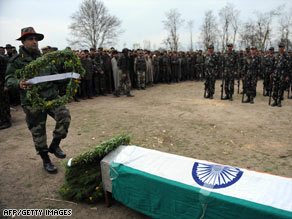
An Indian army soldier lays a wreath during the funeral of a slain soldier, northeast of Srinagar on Tuesday.New Delhi, Mar 25 - Five days of gunbattles between the Indian army and separatist militants in Indian-administered Kashmir have left at least 25 dead -- eight Indian army troopers, including one officer, and 17 militants, the Indian military said Tuesday.

An Indian army soldier lays a wreath during the funeral of a slain soldier, northeast of Srinagar on Tuesday.

Defense Minister A.K. Antony, meeting with India's military chiefs in Delhi, reviewed the situation in the Himalayan region and told the Army to deal with the situation in the Himalayan region with "utmost firmness."

Kashmir has been in the throes of a violent separatist campaign for nearly two decades during which authorities say 43,000 people have been killed. However, various NGOs and rights groups put the number of dead at twice the official count.

In Srinigar, Kashmir, Army spokesman Lt. Col. J.S. Brar told CNN the Army was moving against the militants "based on sound intelligence inputs as well as human intelligence provided by our own sources."

The battles in the Shamsbhari forests of north Kashmir Kupwara district have caused "minimum collateral damage to property," Brar said.

The spokesman denied media reports that helicopter gunships and heavy weapons had been used by the army during these operations against the militants.

This month's encounter between the Indian Army and the militants is the second longest in Kashmir this year. In January, a fierce encounter raged for seven days in the Poonch district of Jammu region of Indian-administered Kashmir. Two soldiers, a policeman and four militants were killed in that encounter.

Kashmir has been the source of bitter dispute and two wars between India and neighboring Pakistan. Both control parts of the region which is predominantly Muslim.
READ MORE - 25 dead in 5 days of battles in Kashmir

Chhattisgarh cop killed in gunbattle with Maoists

RAIPUR,Mar 25 - A constable was killed and two policemen injured Tuesday after an hour-long gunbattle with Maoist guerrillas in Chhattisgarh’s Bastar region.

Police said the exchange of bullets began early morning in a forested stretch of Narayanpur district when a 75-member police search squad was on its way to raid a Maoist hideout.

‘Armed guerrillas carried out a flash attack, but the search squad retaliated immediately. The guerrillas had to run for cover in the nearby forests,’ said Pawan Deo, deputy inspector general, police headquarters.

Constable Ashwani Kumar, 24, was killed while his colleague Ramnath and special police officer Vishnu were wounded.

Bastar region has been a Maoist stronghold since the late 1980s. On Monday, four civilians were killed in the region’s Bijapur district because they were accused of being police informers.
READ MORE - Chhattisgarh cop killed in gunbattle with Maoists

Woman Maoist killed in gunbattle in Orissa’s Kandhamal

Bhubaneswar, March 24  A woman Maoist rebel was Tuesday killed by security forces in a gunbattle in Orissa’s Kandhamal district, an official said.
Getting information that a group of Maoists had gathered in the forest near Daringbadi area of the district for a meeting, police and special operations group personnel raided the area. There was an exchange of fire after the rebels attacked the security forces and a woman Maoist was killed, district collector Krishan Kumar told IANS.
A male Maoist rebel was also arrested from the spot, he said, adding two weapons were also seized.
Kandhamal, about 200 km from here, witnessed widespread communal violence after the murder of Vishwa Hindu Parishad (VHP) leader Swami Laxmanananda Saraswati and four of his aides at his ashram Aug 23.
While the police accused Maoists for that killing, leaders of Hindu organisations blamed Christians. At least 38 people were killed in the state and more than 25,000 Christians were forced to flee their homes after their houses were attacked by rampaging mobs even though Maoists claimed responsibility for the murder.
Maoists had also gunned down a Hindu leader March 18 in the same district.
READ MORE - Woman Maoist killed in gunbattle in Orissa’s Kandhamal

Kupwara gunbattle ends, 17 militants killed

Srinagar, Mar 24 : Six more militants were killed on Tuesday taking the death toll in the fierce gunbattle between militants and security forces in Jammu and Kashmir's Kupwara district to 25 as the five-day-long stand-off ended on Tuesday evening.

Seventeen militants and eight Army personnel, including a Major, were killed in the encounter which began on March 20 on higher reaches of the Shamsabari range in Harfada forest, a defence spokesman said.

Four soldiers and five militants were killed on Monday while an ultra died a day before. On Saturday, four troops, including Major Mohit Sharma, and two insurgents, were killed. On the first day, three militants were mowed down by the security forces.
READ MORE - Kupwara gunbattle ends, 17 militants killed

Quiet Revolution in Bangladesh : Security Concerns for India

by Maloy Krishna Dhar |
Bangladesh election held under supervision of the interim government and the army has initiated the process of a fresh freedom struggle. Democracy with secular principles was wiped out with the blood of Mujibur Rahman, his family and colleagues. Intermittent democratic experimentation with bouts of army rule had not only severely mutilated the spirit of the freedom struggle and Bengali cultural nationalism. This very foundation of the nation was massacred by the Mujib killers and subsequent pro-Pak Generals and Jamait-e-Islami. There is no doubt that the junior officers who staged the brutal coup in 1975 were simply not inspired by ‘misrule of the Awami League and the BAKSAL’; they were inspirited by Pakistan and certain clandestine operators of the CIA.

Later, General Zia-ur-Rahman, after his visit to Pakistan in September 1977, and hostile ambience created by Army-insiders and the regerminated Jammait-e-Islami opted for Islamisation, allowed the Jamait-e-Islami chief to return to Bangladesh. The Jamait had collaborated with Pakistan army and had committed innumerable atrocities on Hindu and Muslim supporters of the six point autonomy movement that turned to freedom struggle. The same year he initiated the process of creating the DGFI, in the model of the ISI. Between Zia and Ershad the BNP emerged as the party of the ‘real creator of Bangladesh-Zia-ur-Rahman.’ Short of conferring upon the General the honorific of Father of the Nation, the Begum did everything to augment the process of Islamisation and offering space to the resurgent religious congregations and the jihadis, which were seeded by General Zia, nurtured by General Ershad and given political recognition by the BNP.
General Zia’s cooperation with Pakistan and the USA in recruiting mujahids from Bangladesh (15000 odd) and sending to Pakistan for training and taking part in Afghan jihad had suddenly pushed Bangladesh to the path of radical Islamisation. The democratic process was suppressed; huge Ummah and Pakistani funds were allowed to pour in for encouraging the Bengali Muslims to spread the message of jihad in every nook and corner of Bangladesh. The Jamait-e-Islami, Islamic Chhatra Shibir, Ahle-e-Hadith Movement Bangladesh, Allhar Dal, Hizbut Tehrir and HUJI etc organizations (about 30) rooted in public mind with government support. Innumerable mosques and madrasas were constructed and the message of Jihad was spread with impunity. The same trend continued during General Ershad’s tenure.

hat was the period when Indian ethnic insurgent groups were manipulated by Bangladesh and Pakistani forces (the ISI and the DGFI) and secured sanctuaries were created for them with training and arming facilities. The political tussles between Awami League, BNP of Zia-ur-Rahman, Jatiyo Party of Ershad and Jamait-e-Islami created continued ambience of uncertainty, growth of Islamic militancy and internal chaos. Corruption in public life plagued Bangladesh heavily. The 1996 election in which Hasina Wazed’s Awami League and JeI combination returned to power witnessed near-total polarization between the political forces. Policy of political negativism adopted by all the political parties, increase of jihadi activities and greater involvement of Bangladesh and Pakistan in the ethnic insurgencies in India generated serious security implications for India. This was the period when Naga, Tripura, Assam and Bodo militants were given free access, training and supplied with arms both by the DGFI and the ISI. This period coincided with increased bonds between Pakistan based jihadi tanzeems and Bangladeshi jihadi tanzeems like HUJI, JMB, Bangla Bhai, Hijbut Tehrir, Islamic Chhatra Shibir and units of Lashkar-e-Taiba and Hijbul Mujahideen and al Qaeda were found greater acceptability amongst the radicalized Muslims. It seemed that political negativism, manipulation by the DGFI and army, Pakistani influence and free flow of Ummah funds had put Bangladesh on the same footing as Pakistan developed after the Afghan jihad. Return of about 10 thousand Bangladeshi Afghan veterans, increased al Qaeda support and blatant interference by the ISI created internal turmoil with higher degree of violence and use of Bangladesh as a launching pad of operations against India in Assam and elsewhere. Several training camps were started for training malcontent Indian Muslims and the northeastern insurgent groups. Bangladesh became a highway for the jihadis and insurgents.
BNP’s bonhomie with the Jamait, other jihadi tanzeems like HUJI, Bangla Bhai, JMB etc received tremendous boost after 2001 general elections to the Jatiyo Sangsad, The table of results of 2001 Sansad election indicate the level of increase of influence of the BNP, Jamait and allied parties and erosion of pro-India forces:

BNP - 193: 41.40%
Awami League + 62: 40.02%
Jatiya Party (E) 14: 7.22 %
JeI BD 17: 4.28.
Other parties not mentioned.

The BNP and Jamait coalition with intermittent support from Ershad’s Jatiya Party did not succeed in giving a stable government. The Jamait-e-Islami took advantage of its presence in the government and systematically infiltrated the armed forces, intelligence, police and other vital government department giving fillip to pro-Pakistani and pro-jihadi forces. Politics of negativism, corruption by two sons of the PM, all pervasive siphoning of public wealth by politicians and bureaucrats was compounded by visible increase in jihadi violence inside Bangladesh. Between 2001 and 2006 more than 500 incidents of terrorist violence took place including 49 serial bomb blasts in a single day, attempt on the life of the British High Commissioner and Sheikh Hasina, by forces of HUJI, JMB and Bangla Bhai. The JMB, Ahl-e-Hadith and the Bangla Bhai were used by ruling factions to punish the Awami League, other dissenters and the minorities.

There was furour, violence and political impasse over appointment of the Caretaker Government which finally led to the distinctly visible indirect interference by the army and installation of a non-political Interim Government. The army chief wielded nearly supreme power with a view to restore some semblances of order, restoration of peace, and assurance in public mind that the new government meant business. Anti-corruption drive witnessed prolonged incineration of Begum Zia, her sons and Sheikh Hasina.
That the army chief was not insensitive to the ideals of foredoom struggle, and believed in restoration of democracy and some sanity in public life was proved by acts of banning of certain jihadi organizations, meting out death sentence on Bangla Bhai and JMB leaders and restriction of Hizbut Tehrir, Allahar Dal etc subversive organizations. Combination of various internal and international factors compelled the army chief to opt for elections in December 2008. General Moeen has not shown any personal hunger for power. The results were stunning:

Awami League + 230 : 49.0%
BNP + 30 : 33.2%
Jatiya Party (E) 16 : 07.0 %
JeI 2 : 04.6 %

The BNP and the Jamait fared well in Chattagram area, with significant performance in Noakhali, Khulna, Comilla. Pabna and Bogra. The Awami League swept almost in all the districts with Jatiya Party dominating areas of North Bangladesh, the usual stronghold of Ershad.

A study of the parties contesting the elections throws out interesting aspects both for Bangladesh and India:

Party : Number of candidates
Islamic Front Bangladesh (Pakistan funded) : 2
Islamic Movement Bangladesh (HUJI) : 266
Islami Oikya Jote (Al Qaeda Affiliate) : 4
United Citizens Movement : 11
Krishak Shramik Janata League : 46
Democratic Party : 5
People’s Front (Pro-JMB) : 14
Gano Forum : 45
Jamaat-e-Ulama Islam Bangladesh : 7
Zaker Party (Pro-Taliban) : 37
National Democratic Party (Ahl-e Hadith faction) : 2
Jatiya Party : 46
Jatiya Party-JP : 7
Jatiya Samajtantrik Dal-Jasad : 6
Jatiya Samajtantrik Dal-JSD: 44
National People’s Party (Allhar Dal) : 29
Progressive Democratic Party : 21
Freedom Party (Pro Taliban) : 2
Bangladesh Awami League : 259
Bangladesh Islamic Front (Pro-al Qaeda) : 18
Bangladesh Kalayan Party : 39
Bangladesh Khilafat Andolan (Pro Pak) : 32
Bangladesh Khilafat Majlis (pro-Pak) : 8
Bangladesh Jatiya Party : 10
Bangladesh Jatiya Party-BJP : 2
Bangladesh Nationalist Party (Pro Pak) : 256
Bangladesh Jamaat-e-Islami (Pro-Pak) : 39
Bangladesh Tarikat Federation (Pr-Hizbut Tehrir) : 31
Bangladesh National Awami Party : 14
Bangladesh National Awami Party-Bangladesh NAP : 5
Bangladesh Muslim League (Pro-Pak) : 5
Bangladesher Samajtantrik Dal : 57
Workers Party of Bangladesh : 5
Communist Party of Bangladesh : 38
Revolutionary Workers Party of Bangladesh : 5
Bangladesher Samayabadi Dal (ML) : 1
Bikalapdhara Bangladesh (Pro-Moscow) : 62
Liberal Democratic Party : 18
Independent (45 belonging to JMB) : 141
Total:1538

This would show that the HUJI after failing to register itself as a political party contested in the name of Islamic Movement Bangladesh. Almost all the jihadi parties fielded good number of candidates but failed to secure more than 02.01 % of votes. However the HUJI affiliated party managed to get nearly 3 % votes. One of the candidates was elected to Jatiyao Sangsad as independent.

Various analysts have offered scores of reasons for the stunning success of Awami League combination. Most cogent reasons have been offered are:

1.Awami League and BNP are nearly at par with their number of supporters. Awami league’s regular supporters did vote for Awami League as usual and they had no reason to love BNP - so Awami League grabbed the regular devoted votes. The BNP voters were disunited and wilted under army pressure.

2. The Swing Voters wanted to teach BNP a lesson for their corruption and had no other alternative than accepting the Mohajot as voting for BNP would have justified stinking corruption by two sons of Begum Zia and her colleagues.

3. The BNP supporters or activists were divided as to pro-change and anti-change groups; the dissenters like Bodrudouza and Mohammad Oli gave reasons to the anti-BNP lobbies reasons to ponder upon BNP’s lack of coordination and disciplined approach.

4. BNP stalwarts or the pivotal leaders were kept behind the bars until the last few days while Awami League had almost all their pivotal figures out of jail all the time.

5. Awami League had always supported the caretaker Government and had promised to legalise their unconstitutional works if voted to power. It has been insinuated that General Moeen is a pro-Mujib person and he was influenced by India and the US to favour a more democratic group.

6. Hasina had a few anti-Jamiat Islamic groups in her pocket which got the votes of anti-Jamait pro-Islamic people on their side and Hasian promised not to enact any anti-Islamic laws.

7. Ershad commands a few BNP votes and has comfortable support in northern districts.

8. New generation of voters did not have the experience of seeing Awami League’s rule as adults; rather they saw the corrupt rule of Zia which made them anti-BNP. They were not aware that Awami League always failed to control crime and had displayed ‘winner takes all’ attitude since 1971.

9. Awami League is better in price control.BNP is not good at that and owing to present price hike people could not afford to take chances with any more price hike as that would have meant playing with starvation. BNP has the bad reputation of collaboration with corrupt market manipulators.

10. Women voters were successfully convinced that BNP meant oppression on women and it encourage the Islamists. BNP regime had allowed near total control of the civil society by al Qaeda, Taliban and Pakistani elements. People had become weary of jihadi violence and growing rhetoric on Islamisation of the society.

11. Bangladesh is surrounded by Maoists and Communists and Islam was projected as an oppressive force by JMB and HUJI etc as a threat to generally democratic Bengali society. Communism and Socialism dominated the media who supported Awami League.

12. Awami League banked on the issue of bringing the Jamiat leaders to war-tribunals when BNP owing to failure of its leaders could not successfully defend the issue with a counter challenge. Moreover, the BNP was perceived as a force protecting the killers of Mujib and other Awami League leaders.

13. Hasina lobbied abroad to win international support for Awami League when BNP concentrated on domestic support only. Zia was busy begging for release of her sons and was encumbered with revelations that her sons had stacked away billions in foreign banks by robbing the common people.

14. Finally, it must be added that by purging of the DGFI and some segments of the army brass closer to the Jamait and BNP General Moeen had good ambience to ensure a smooth election, though there are allegations that Gen Moeen had favoured the Awami League combination. Certain quarters in Dhaka believe that the army chief was afraid of a coup against him by the pro-Jamait and pro-BNP Generals.

No analysis can explain the stunning victory of Obama and Hasina. The people of Bangladesh have opted for a change and it is time for Hasina to deliver.
The goodness of the cake can only be proved by eating it. Her crown is full of thorns. She has excluded several veterans from ministerial berths. They wield influence in their own pocket-Burroughs. They are watchful of the internal groupings and may not hesitate to gang up with destabilizing forces. Begum Zia is most likely to again take the parliamentary politics to the streets and adopt the old policy of ‘either I or none.” Though her vote percentage has reduced she has maintained the steady grassroots elements on her side and her core vote percentage has not diminished. Tactically she is distancing her party from the Jamait for a while but once the opposition to the war-criminal trials involving the Jamait leaders starts Zia’s forces is likely to rally behind them along with the jihadi organizations. Hasina has a poor record of controlling law and order and often buckles down under pressure of the Islamic forces.
All the senior army officers are not with General Moeen. Several pro-BNP and pro-Jamait military top brass are watching the developments. Once Hasina and party tries to prosecute some of the former army officers for war crimes they are likely to rebel and topple her. They have a better friend in Begum Zia. Hasina would require purging the DGFI and the administration of pro-Jamait elements with helps from friendly army Generals. General Moeen may agree to help her for some costs; indirect army presence in the administration. Hopefully Hasina and allies would accommodate them for better stability and longer survival.
As far as India is concerned the situation appears to be favourable. “With terrorism in the region a pressing concern, especially after the Mumbai attacks, Hasina’s victory will bring some comfort to New Delhi as she took tough steps against the anti-India militant groups when she was in power in the mid-1990s. In contrast, there was a sharp spike in militancy and Islamic fundamentalism during Zia’s tenure.” (Times of India December 30, 2008).

What are the ground realities?

Bangladesh reeks with Islamist and jihadi organizations numbering nearly 40. The main groups are: Jamait-e-Islami, Islamic Chhatra Shibir, Islami Oikya Jote, HUJI, JMB, Jagrato Muslim Janata, Sahadat-e-Alam-al-Hiqma, Ahl-e-Hadith, Hizbut Tawhid, Hizbut Tehrir, Allahar Dal, Islamic Jubo Sangha, Al-Falah A’am Unnayan Sangstha, Islami Biplobi Parishad, Biswa Islami Front, Al Jamaitul Islamiya, Al Khidmat Bahini, Al Mujahid, Al Harqat-al-Islamia, Al Mahfuz-al-Islami, Joish-e-Mustafa (affiliated to Jais-e-Mohammad of Pakistan), Muslim Guerrilla Bahini etc.

These organistaions are spread all over Bangladesh. Most of the rural areas are influenced by them and they receive liberal funding from Arabian countries and other NGOs.
The Interim Government had banned Ahl-e-Hadith, HUJI and Hizbut Tehrir. The JMB came under heavy hammers and three of its top leaders were sentenced to death. But, like Pakistan, the jihadi organizations keep on changing names and function with impunity at the grassroots level. This, however, should not give an impression that Bangladesh is a Taliban country like Pakistan. The conflict situation between pro-Pakistani forces, believers in democracy and secularism and Bengali cultural nationalists is palpably perceptible. After General Zia’s collaboration with the USA and Pakistan during Afghan jihad and return of over 7000 Bengali Afghan veterans, infiltration by al Qaeda and Taliban had changed the social and political ambience in Bangladesh. By allowing rerooting of the Jamait and by converting the country to Islamic principles Zia had helped creation of a force that thrived on Arab money, jihadi ideology and religious resurgence and fundamentalism.

By encouraging anti-India and anti-Hindu sentiments Zia, Ershad and Begum Zia had given direct and indirect support to the Islamicised jihadi forces. Between 1991 and 2000 Bangladesh created safe niche for the jihadis and forces antagonistic to India.

Pakistan’s policy of encouraging, sheltering and arming the Indian rebel groups was pursued by Zia-created DGFI, BDR and the jihadi elements that came to root in the country. Faded secular elements and cultural Bengali nationalists were pushed aside and hate-India sentiments were generated by Bangladeshi and Pakistani elements operating in political parties, bureaucracy, armed forces and segments of people Islamicised drastically. The former Muslim League elements who had taken shelter under other parties activated their anti-minority and anti-India campaign. Pakistan and China encouraged these developments.

Besides the Jamait, Ahl-e-Hadith and Tablighi Jammat which have garlanding presence in India and Pakistan as well the new elements of HUJI (created in Pakistan in 1980 and reshaped in *** in 1992), branches of Taliban and al Qaeda affiliated organizations, and the ISI created organizations like Lashkar-e-Taiba, Jais-e-Mohammad, Al Bdr etc rooted down in the country. These bodies collaborated with Pakistani organizations and agencies for spreading jihad in mainland India, facilitating Pakistani jihadis to infiltrate and carry out acts of terrorism and converting segments of Indian Muslims to the ideology of jihad and reaffirmation of the old demand of creating a bigger Bangistan (original demand of Jinnah) comprising present Bangladesh, Assam, and parts of West Bengal. Pakistan’s smoke-screen of Kashmir dispute was sculpted out as a concerted programme of creation of Bangistan in the east, Osmanistan in the south and Mughlistan in central and western India. With this objective in mind elements in Pakistan and Bangladesh created an atmosphere of near-total hostility against India.

In short, though India had liberally helped Bangladesh during the liberation war, pre-partition anti-Hindu and anti-India hate campaign created by the Muslim League pervaded even after creation of Pakistan. This was encouraged by Zia, Ershad and BNP. Pro-Pakistan and Islamist elements nearly overshadowed the secular forces. The Left forces were cruelly suppressed. Bangla involvement in Afghan jihad and Pakistan aggravated the situation. Hate Hindu and hate India sentiments still remain at the top layer of most of the people. The Awami League leaders have not been able to restore trust in India. Several irritants between the countries are exploited by pro-Pakistan and pro-Chinese forces in the army, bureaucracy and religious parties. India has to tread cautiously.

The other issues that keep haunting India’s security concerns are use of Bangladesh by northeastern insurgents groups like the NSCN (I), ULFA, NDFB, KLO, Manipuri Meitei groups and Tripura in connivance with the DGFI, ISI operatives and their jihadi spawns. This problem runs through Indo-Pak relations in East Pakistan, later Bangladesh, for over 60 years, starting from Phizo’s escape to Pakistan in 1948. There has been no waning in the situation except for a brief period between 1971 and 1975.

If we are to believe the security agencies, Indian insurgent groups are sheltered in at least 32 camps in Bangladesh, with some of the top leaders hosted by the ISI. The game of denial had improved somewhat during General Moeen’s hold on the interim government. Besides clamping down on jihadi activities inside the country he had minimized anti-India involvement of the government agencies and intelligence agencies.

India has to pay proper attention to this aspect of national security by keeping bilateral and international pressure on Bangladesh. Besides the police, paramilitary and armed forces, the political governments in Assam, West Bengal, Nagaland, Manipur and Tripura have to strengthen their vigilance, sharpen intelligence gathering and sanitizing the border areas as much as possible. According to Jane’s Intelligence Review China has replaced Cambodia and Thailand as the main supplier of weapons to insurgent groups in India’s northeast and Myanmar. In an analysis of the Asian weapons black market, the defence think-tank said that the United Wa State Army (UWSA) and rebel groups in Myanmar act as the “middleman” between Chinese arms manufacturers and insurgent groups in the Northeast, with most weapons routed through China’s Yunnan province.
Pointing out that the arms market in India is extremely lucrative; JIR said that a Chinese automatic rifle that is available for $500 in eastern Myanmar can command a price of $2,500 by the time it reaches the Northeast. Referring to an arms seizure by Myanmar authorities in 2001 that first brought out the trend, JIR said that “a consignment of several hundred Chinese assault rifles” were recovered while being transported to the Indian border at Tamu and were meant for “Manipuri UNLF and possibly other factions”. Officials in the Indian security establishment say that Chinese origin weapons are increasingly being seized from northeast insurgent groups and have even reached the illegal arms market in West Bengal, Assam and Uttar Pradesh.
Besides Chinese and Myanmar smugglers the Rohingya and Bangladesh smugglers still use the Thailand route to pump in weapons for use by the Indian insurgent groups. It is a different aspect of intelligence input as to how Pakistan and Bangladesh facilitate this arms traffic. However, continued inflow of weapons is a serious security concern. Another concern is inability of the Government of India to conclude the NSCN problem either through negotiation or military action. Same is the situation in Assam and Manipur.
The historical irritant of illegal Bangladeshi migration to Assam and rest of India is another issue that adds to demographic and security concerns.
Having had the opportunity of serving in the northeast for considerable period I have a feeling that political and administrative handling of the situation during last 60 years has been unsatisfactory and halfhearted. Vast military presence in the northeast for prolonged period has cost the nation immensely; much more than what is being spent in Kashmir. Mere military solution is a chimera but the armed forces, besides having geostrategic concerns from China, have to keep eyes on the jihadi groups and silent incursion by inimical countries with surreptitious arms supplies.
The other concern areas are: Dispute with Bangladesh over offshore oil exploitation, supply of gas to India, direct train transit route from Tripura to the rest of the country, trade balance and Indo-Myanmar agreement to open Kaladan-route to sea via Sittwe port are viewed as a potential hostile act by Pakistan, China and Bangladesh. While this route would open up trade from the northeast India, it is likely to acquire strategic-presence in the area. Not far from Cox’s Bazar and Dakhinpara in Bangladesh, Sittwe is likely to provide an additional platform for keeping an eye on coastal Bangladesh and the vital Straits of Malacca. In any future battle zone in the Bay of Bengal Indian presence in the area is also viewed adversely by the USA and the UK from their bases in the Indian Ocean.
Bangladesh as a friendly democratic and secular country can provide a mutual security shield in this part of the country. The future cannot be gazed in the crystal ball. It would require astute diplomatic, political and economic manipulations to revive the faded hopes of 1971. It is almost a new freedom struggle for Bangladesh.
The tendency of Bangladesh political parties to peddle the practice of ‘the winners take all’, severe corruption, Islamic fundamentalism and pro-Pakistan sentiments may not make the things easy for the new government. It would require bilateral and international efforts to put the restored democracy on correct rails.

India, as a political state and its agencies have to strengthen their guards against any subversion of the electoral award given by the people to their representatives for turning new pages in the history of the beleaguered country. A new stage of diplomatic and strategic relations is required towards Bangladesh to secure the eastern flank of India and stop the use of Bangladesh as a platform for spreading jihad in India and South East Asia.
READ MORE - Quiet Revolution in Bangladesh : Security Concerns for India

'Heart of the threat' to US, India at west Pakistan: Holbrooke

London, Mar 22 : The "heart of the threat" to the US and many other countries in the world including India lies at western Pakistan, a top American diplomat has said, insisting that the Afghan crisis cannot be resolved without addressing the problem of militancy in the restive tribal region.

The starting point for the Barack Obama administration's approach to the region is to treat it as an integrated whole, a single theatre of war, with very different rules on each side of the border, Richard Holbrooke, the US special representative to Afghanistan and Pakistan, told a gathering in Brussels yesterday.

"We must recognise that the heart of the threat to the United States, to the European Union, to Australia, to many other countries in the world including India and, I stress, including Pakistan itself, comes from western -- the people in western Pakistan," he said.

"The actual people who pose a direct threat to the countries represented in this room, the people who planned 9/11, who killed Benazir Bhutto, who committed the atrocities in Mumbai, who were terrorising Swat, who probably were associated with the attack on the cricket team in Lahore, who are associated with daily outrages -- they are not in Afghanistan. They're in Pakistan." He pointed out that these militants are based in western tribal areas "although it also extends down into Baluchistan." Success cannot be achieved in Afghanistan without solving the problem of western Pakistan, the envoy said.
READ MORE - 'Heart of the threat' to US, India at west Pakistan: Holbrooke

Security shadow forces IPL out of India

Mumbai: The hugely popular Twenty20 Indian Premier League (IPL) will be played outside the country because state governments have expressed their inability to provide security to the tournament as it clashes with general elections, India's cricket board announced today. There was no word on the new venue, but speculation is that the tournament could take place in England or South Africa.

The Board of Control for Cricket India (BCCI) took the decision at an emergency meeting after days of speculation about the second edition of the tournament that was originally set to take place April 10 to May 23 before the Lok Sabha elections were announced in April-May.

The BCCI frantically changed the IPL schedule thrice to meet security concerns and eventually decided to move it outside India after the government of Maharashtra, where a chunk of the matches were to be held, said no security could be provided during the elections.

A visibly disappointed BCCI president Shashank Manohar told a news conference that the board was in consultation with cricket boards of other countries and would come out with a detailed itinerary soon.

"Many cricket boards have expressed their interest (in hosting IPL) and we are in talks with them," Manohar said. He persistently refused to answer queries from journalists on the possible venue, saying the media was free to speculate.

The BCCI subsequently conveyed its decision to owners of teams taking part in the IPL, which draws players from the cricketing world.

Manohar said it was forced to take the decision because the authorities failed to give an assurance about providing security to the tournament, whose first edition last year was a huge hit among fans and players. "Earlier the governments of Maharashtra and Andhra Pradesh had said they have no problems in holding IPL matches.

But yesterday they said they are not in a position to provide security till the elections (get over). "We have been forced to move IPL outside India because of the attitude of the government, especially the Maharashtra and Andhra Pradesh governments," he said According to Manohar and IPL Commissioner Lalit Modi, there would be no changes in the timings of the matches irrespective of where they are played.

The matches were to originally take place at 4 p.m. and 8 p.m. IST. Security for the IPL became a major issue after Pakistani terrorists slaughtered over 170 people in Mumbai in November 2008 and after terrorists audaciously attacked Sri Lankan cricketers in Lahore in March.

According to the government, police and paramilitary forces would be bogged down across India during the staggered Lok Sabha elections starting April 16 and ending May 13. The votes will be counted May 16
READ MORE - Security shadow forces IPL out of India

Terrorism in eastern South Asia —by Khaled Ahmed

Armed Conflict in South Asia 2008: Growing Violence

Edited by D Suba Chandran & PR Chari
Routledge 2008
Pp280; Price Rs 695 Indian
Available in bookstores in Pakistan


The book deals with the unpleasant side of the significance of South Asia. It has two articles on Pakistan, one on sectarian violence, the other on violence in the Tribal Areas. It has one article on Afghanistan and its luckless population who has been given to understand they have never been conquered, while, looking at their suffering, one would have wished they had been.

There are two articles on India’s internal movements gone haywire and one on Bangladesh’s vulnerability to Islamic terror. Nepal nurses its communist violence and Sri Lanka struggles with its long-gestation ethnic war.

In the northeast of India, a cluster of small states (Manipur, Assam, Nagaland, Tripura, Meghalaya) have been convulsed with ‘freedom movements’ become violent. Out of the five, the first three are giving trouble still and violence there has actually increased after a ceasefire agreed by the Indian army in 1997.

If Pakistan had been watching, it would have learned that ceasefires with terrorists only give them time to regroup and form bigger armies. Also there are some other lessons that Pakistan and Afghanistan should have learned from India’s experience with terrorism since the 1950s.

One big lesson is not to glamorise the misfortunes of tribal nations gone wrong after suppression. One myth that Pakistanis are guilty of fabricating is that the Pakhtun never give up fighting and have never been conquered. They mouth this obscenity while standing in front of camps where Pakhtun women and children go through history’s worst brutalisation.

Listen to what the article Northeast: Island of Peace and Ocean of Conflict by Bibhu Prasad Routray says: ‘The Naga separatist movement, which had begun before Independence, is based on the premise that Nagas have been historically independent, unconquered by anyone and, therefore, India has no right to subjugate them’ (p.153). The rest of India should be grateful that it has been conquered.

The British had kept the tribes in the northeast as areas under special dispensation, but that arrangement became the trigger for Naga National Council (NNC) in 1947 asking for independence, greatly encouraged by a referendum in 1951 that had 99 percent of the Naga population saying that wanted to be independent under their leader AZ Phizo. New Delhi jibbed and sent in the army. Phizo fled to London never to return. After much fighting, in 1975, the Shillong Accord got the Nagas of NNC to accept the Constitution of India, but the NNC split and formed Nationalist Socialist Council of Nagaland (NSCN) to continue fighting. Later this too split and the splinters became even more radical.

Insurgency in Assam, the source of much of India’s oil and gas, began in 1979 under United Liberation Front (ULFA) demanding a sovereign socialist Assam that would stop refugees from Bangladesh from coming in and upsetting the population balance in favour of the Bodos in Assam.

After ULFA went terrorist it liaised with the Naga terrorists nextdoor, but the Indian army hit back and the ULFA leaders fled into Bangladesh where they fell under the spell of ISI and DGFI of Bangladesh and ULFA got itself well supplied materially and financially (p.155). (India got RAW to meddle in a similar ‘liberation’ movement in Balochistan as a tit for tat ‘signalling’ to Islamabad.) The Bodos too are struggling since the 1980s for Bodoland in Assam and often become nasty.

Manipur is also convulsed because the centre delayed making Manipur a state in 1947. The terrorist outfits here, including an Islamic one protecting Muslims, pose as liberators and have joined up with the rest of the north-eastern rebels. Manipur is a bad case with 20 such outfits operating. The state of Tripura, not so violent, is a victim of migration from unstable Bangladesh; and Meghalaya would be called peaceful if it wasn’t a conduit for terrorists to-ing and fro-ing into Bangladesh.

It is shocking how like Pakistan Bangladesh is when it comes to Islamic terrorism. Smruti Pattanaik in her paper “Bangladesh: Islamic Militancy and the Rise of religious Right” reveals the pattern in events that flowed from the August 17, 2007 bombings in the country. Terrorism was the work of Banglabhai in the north who wanted to create a Taliban-like state under Jagrata Muslim Janata Bangladesh (JMJB) and Sheikh Abdur Rehman of Jamiat Mujahideen Bangladesh (JMB), both erstwhile members of the student wing of Jama’at-e Islami. The Bangladesh National party (BNP) of Begum Zia took the Jamaat-produced radicals under its wing and denied they existed.

JMB’s Rehman visited Pakistan in 1999 to take training in Azad Kashmir. Banglabhai was already said to be a veteran of Afghan jihad wanting to recreate it in Bangladesh. When they began killing people, as in the case of poet Shamsur Rehman in 1995, the BNP denied it vociferously, blaming the killings on India and America. This BNP did despite the fact that Jama’at warriors had rebelled against the Jama’at acceptance of women as leaders. The other spinoff from Afghan jihad was Harkatul Mujahideen Islami (HUJI) which was funded by the Arabs whom the state allowed to have linkages with the two above rising stars of Islamic violence.

The BNP just wouldn’t own up to terrorism in the country till foreign pressure got it to catch and prosecute Banglabhai and Rehman, only to see them condemned to death by a court. Then neither of the two mainstream parties would support the call for their execution. This was somewhat like Pakistan’s parties who don’t want to even acknowledge the reality of Al Qaeda and Taliban terrorism in Pakistan. It was the caretaker government, supported by the army in 2001, that finally executed the two mass killers of Bangladesh.

BNP leader Begum Zia’s son Tariq Rehman was running his own shadow government in Dhaka and gave protection to the killers. Needless to say, the Islamic killers hated Awami League and India with equal fervour. Later some BNP leaders, including a minister Aminul Haq, were put under trial and got long sentences in jail for killing opponents through Islamists.

The money for Islamic terror comes from the Arabs in the Gulf. There are 15 local Islamic NGOs and 34 foreign Islamic NGOs in Bangladesh. They give no one any accounts, receive their money through hundi and are supposed to dispose of 200 crore takas (p.196).

London Muslim terrorists gave JMB £10,000 for killing innocent people back home; and terrorist Rehman got big money from Rabita al-Islam, Kuwait, for doing the same job (p.200). Religious leaders who run these dangerous organisations regularly visit the Middle East for Zakat and collect huge sums which they often embezzle, but their Arab benefactors don’t seem to mind that too much.

Bangladesh has actually completed the transition from being a moderate Islamic state with strong local cultural tinge of tolerance and is now more like Pakistan, strongly Deobandi and Wahhabi in its new intolerant and violent character. Like Pakistan its politicians don’t want to mess with the madrassas and mullahs and risk their lives.

Pitifully, when the people at large were asked who was doing terrorism in a country crawling with 12,000 active killers, the survey showed 80 percent saying it was an unnamed ‘neighbouring country’ (read India); and, just like Pakistan, responded unreliably according to their politically divided civil society credentials. *
READ MORE - Terrorism in eastern South Asia —by Khaled Ahmed

Indian anti-insurgency force to be equipped with more advanced weapons

NEW DELHI, March 21-- The Indian Home Ministry will arm its anti-insurgency paramilitary force, the Central Reserve Police Force (CRPF), with guerrilla warfare weapons and hi-tech equipment, after suffering heavy casualties last year, said the local newspaper Mail Today on Saturday.
    CRPF's Combat Battalion for Resolute Action commandoes, who were deployed in terrorist and insurgency-affected areas, suffered heavy casualties in their fighting with rebels last year, said the report without giving specific figures.
    The CRPF is a paramilitary security force functioning under the aegis of Ministry of Home Affairs, with its primary role lying in assisting regional police forces to maintain law and order and contain insurgency.
    The CRPF has for the first time ever invited international bidding for modern 5.6mm carbines, 24,000 bullet proof helmets, over 300 explosive detectors, and another 300 cable locator equipment to counter rebels and terrorists, said the newspaper.
    Some 700 men of the force are being trained for guerrilla combat tactics in Silchar, Assam in northeast India, and in Coimbatore in the southern state of Tamil Nadu, before being sent to the central state of Chhattisgarh and eastern state of Orissa, both troubled by insurgency problems, the newspaper said.
    Official statistics say more than 700 people were killed in clashes between left-wing rebels and government forces in India last year. Most of the clashes took place in some central and eastern states of India.
    Meanwhile, the official number of casualties from clashes between separatists and government forces in the country is unknown.
READ MORE - Indian anti-insurgency force to be equipped with more advanced weapons

India against marking sections of Taliban as 'good' or 'bad'

United Nations, Mar 21 : Cautioning against attempts to draw a line between "good" and "bad" Taliban, India has said that doubts and divergences in the fight against terrorists in Afghanistan would embolden them and weaken the collective will of nations.

Speaking at the UN Security Council, Indian Ambassador Nirupam Sen stressed the need for stability of Afghanistan in the interest of economic progress of the region and asked the international community to collectively fight the threat posed by Taliban and al Qaeda who are out to undermine the country.

"Doubts, hesitation and divergences in the international community in the fight against terrorists would only weaken the collective will and embolden them," Sen warned the Security Council.

He cautioned against attempts to distinguish between"good" and"bad" Taliban and asked the international community to get beyond the"unworkable" efforts of sifting the two.

Sen's remarks were a reference to Obama administration's indication that it might be willing to talk to the less radical elements among the Taliban, which the US and NATO forces are fighting against in Afghanistan.

" Apart from application of force wherever terrorist groups are active, we must work together to deny them safe havens, political and material sustenance in Afghanistan or across the border," Sen said in a debate.
READ MORE - India against marking sections of Taliban as 'good' or 'bad'

Terrorism should be eradicated: President

Chennai, Mar 21 : With terrorism posing a great threat to global peace, President Pratibha Patil today said the menace should be dealt with a firm determination.

"Today, terrorism poses a grave threat to global peace, stability and progress. India has been a victim of terrorist attacks. This menace has to be dealt with determinedly and eradicated,"she said speaking at the passing out parade at the Officers Training Academy (OTA) here.

She said modern warfare must necessarily incorporate measures to counter threats posed by terrorism.

Emphasising the need for the army personnel to keep abreast of latest technological advancements, she said "the modern army is a knowledge-based force and application of science and Information Technology has become an integral part of defence preparedness and warfare."

"In today's knowledge-centric era, every soldier should be technology efficient, a requirement that highlights the need for better training for increased efficiency," she added.

"The nation looks up to you as examples of selflessness and dedication. You will be called upon to deliver in the most demanding circumstances and lead your men from the front," she told the cadets, adding"your training here has equipped you very well for this challenge."
READ MORE - Terrorism should be eradicated: President

Air Marshal P V Naik to be next Air Force chief

New Delhi, Mar 20 : Air Marshal Pradeep Vasant Naik presently the Vice Chief of Air Staff has been appointed as the chief of the Indian Air Force with effect from the afternoon of May 31, 2009.

The present IAF chief, Air Chief Marshal Fali Homi Major retires from service on May 31, 2009.

Born on 22 Jul 1949, Air Marshal Naik was commissioned into the Air Force on June 21, 1969 as a fighter pilot.

During his long distinguished service spanning nearly 40 years he has served in a variety of command staff and instructional appointments.

He has the distinction of 3085 hours of flying to his credit. The Air Officer also took part in 1971 war.

Before taking over as VCAS, he was Air Officer Commanding-in-Chief of the Allahabad based Central Air Command.

Besides being a fellow of the National Defence College, New Delhi, College of Defence Management, Secundrabad and Defence Services Staff College, Wellington, he has attended a variety of courses like flying instructor Course, Jungle and Snow Survival, Junior Commanders Course.

Air Marshal Naik was decorated with Param Vishist Seva Medal (PVSM) and Vishist Seva Medal (VSM). He is one of the Honorary ADCs of the Supreme Commander.
READ MORE - Air Marshal P V Naik to be next Air Force chief

Pakistani militant arrested in Kolkata

KOLKATA - An alleged Pakistani militant, who was on his way from Bangladesh to Jammu and Kashmir, was arrested by Kolkata Police here Thursday afternoon, an official said.


‘Acting on a tip-off, the Special Task Force (STF) of the city police arrested a Pakistani terrorist, Shahbaz Ismail, from Fairlie Place (in central Kolkata) Thursday,’ Rajeev Kumar, special additional commissioner of STF, told reporters at a press conference at the police headquarters at Lalbazar.

‘Ismail came to India to conduct terrorist activities, though we are not sure if he planned to do so in Kolkata or was just using the city as a safe transit route,’ Kumar added.

Kumar said Ismail was a trooper with the paramilitary Pakistan Rangers till 2008.

‘During interrogation, Ismail said he joined Pakistan Rangers in 2005 and worked there till 2008. He was posted at Sialkot. Then, he left his job and joined a terrorist organisation, whose name we don’t want to disclose as this would hamper the investigations,’ Kumar said.

Ismail had left his Pakistani passport at Dhaka and entered West Bengal through the Malda border a few days back. He came to Kolkata Thursday morning from Murshidabad district, Kumar said.

‘Ismail was arrested while he went to buy a ticket to Jammu at the railway booking counter at Fairlie Place. We have recovered a Bangladeshi SIM card and some important documents from him,’ Kumar said.

‘We are interrogating him at Lalbazar to find more about the terrorist organisation and his purpose for visiting India,’ he added.
READ MORE - Pakistani militant arrested in Kolkata

Price of terrorism: Mega sporting events at risk


Veturi Srivatsa

Pakistan's most charismatic cricketer, Imran Khan, must be feeling let down by the gunmen who attacked the Sri Lankan team coach on its way to the Gaddafi Stadium in Lahore's upmarket Gulburg area on the third day of the second and last Test.

The former Pakistan captain has been insisting that the terrorists will never attack cricketers and implored other cricket-playing nations to visit the country without any fear. He, like many in the subcontinent, thought that cricket is like an elixir and players will not be touched by the zealots.

Cricket tours were cancelled in the past for fear of attacks, death threats, natural calamities or on grounds of racial discrimination but never were cricketers targets of terror attacks.

The 1972 Munich massacre is by far the worst case of terror in sport when 11 Israeli athletes were gunned down by Palestinians in the Olympic Village.

The Lahore attack has now put the 2011 World Cup in jeopardy. With a suicide Tamil Tiger last year killing a minister and athletes at a marathon event in Sri Lanka and the mutiny in Bangladesh, the other two co-sponsors are also jittery. India alone seems to be a safe bet though the teams will still insist on fool-proof security.

Two weeks ago, International Cricket Council (ICC) chief executive Haroon Lorgat asked the World Cup organisers that they should seriously consider shifting venues, both within and outside Pakistan if political climate there worsens.

Soon after the Lahore incident he had clearly stated that in the next couple of days some serious decisions will be taken, thereby hinting that it will be highly difficult to retain Pakistan as a co-host of the quadrennial event. Some climbdown from the position that the World Cup is still a long way to go and it is too early to be concerned about security.

Lorgat minced no words when it came to telling Pakistan that the ICC would not post match officials for a series in Pakistan unless it is satisfied with the security arrangements. Though the statement irked the Pakistanis, they know that the ICC by inference is backing its member-countries and taking their apprehensions seriously.

Pakistan have not played a Test the entire last year as country after country refused to play them in their backyard. As many as five countries - Australia, New Zealand, South Africa, England and the West Indies - declined to play there. The ICC had to postpone the Champions Trophy, which was to be held in September, and now the event has been shifted out in the face a spate of bombings and machine gun attacks. What broke Pakistan's back was India's cancellation of the tour in December.

Sri Lanka were actually playing in Pakistan to fill in for India. The island nation has also agreed to bail out the Indian board by playing a one-day series, sandwiching it between their One-Dayers and Test in Pakistan. The short visit to Sri Lanka was to compensate for the Indian board's Rs.1.2 billion loss due to cancellation of England's last two games and the subsequent Twenty20 Champions League.

If the security fears continue, then there will be only a few countries where cricket could be played. There were comparisons between what's happening in Pakistan and the terror strikes in India, but things were soon put in perspective by two of the most sensitive teams, Australia and England, going ahead with their tours. England returned to play the Test series in the aftermath of Mumbai.

The Pakistani board in sheer desperation even toyed with the idea of playing India at a neutral venue, but the move was dropped in the face of mounting public pressure in both the countries.

The ICC concern is to protect international cricket from the uncertainties of terrorist attacks. Only Australia, New Zealand, the West Indies and South Africa are free from the menace, but security concerns in Africa and the Caribbean are of different nature.

In fact, the costs of terrorism is making a lot of countries wary of hosting mega sporting events like the Olympics and the World Cup Soccer. Can sport be held in camera or stopped for ever fearing violence? The answer is: No.
READ MORE - Price of terrorism: Mega sporting events at risk