Hawala money in India directly linked to terror funding: US

Cautioning that the 'hawala' money in India is directly linked to terrorist financing, the US has suggested to New Delhi to strengthen its anti money laundering and counter terrorism-finance legislations.

It also recommended that New Delhi should work towards becoming a full-fledged member of Financial Action Task Force (FATF), an inter-governmental body for development of policies to combat money laundering and terrorist financing.

While noting that the Indian Parliament passed the Prevention of Money Laundering (Amendment) Bill, early this week, a US State Department report has suggested that India should make necessary legislative amendments to bring its anti money laundering and counter terrorism finance regime in conformity to FATF.

"Given the number of terrorist attacks in India and the fact that in India hawala is directly linked to terrorist financing, India should prioritise cooperation with international initiatives that provide increased transparency in alternative remittance systems," said the report in its section on India related to money laundering.

The report, released by Assistant US Secretary of State for International Narcotics and Law Enforcement Affairs, David T Johnson, quoted RBI estimates that remittances to India sent through legal, formal channels in 2007-2008 amounted to $42.6 billion.

According to Indian observers, the report said funds transferred through the billion dollar hawala market are equal to between 30 to 40 per cent of the formal market.

“In that case the hawala market could amount to between $13 billion to $17 billion,” the report on International Narcotics Control Strategy, said.

Given the large number of expatriates, India continues to retain its position as the leading recipient of remittances, according to the World Bank.

India’s strict foreign-exchange laws and transaction reporting requirements, combined with banking industry’s due diligence policy, makes it difficult for criminals to use formal channels to launder money, the report said.

However, large portions of illegal proceeds are often laundered through “hawala” or “hundi” networks or other informal money transfer systems.

The report appreciated the steps taken by India post 9/11 with regard to money laundering and its possible use by terrorist network. However, several key steps are still required to be taken by New Delhi, it felt.

Listing out the steps New Delhi still needs to take, the report said India should become a party to the UN Conventions against Transnational Organized Crime and Corruption.

“Also, India should pass the Foreign Contribution Regulation Bill for regulating nongovernmental organisations including charities,” it said.
READ MORE - Hawala money in India directly linked to terror funding: US

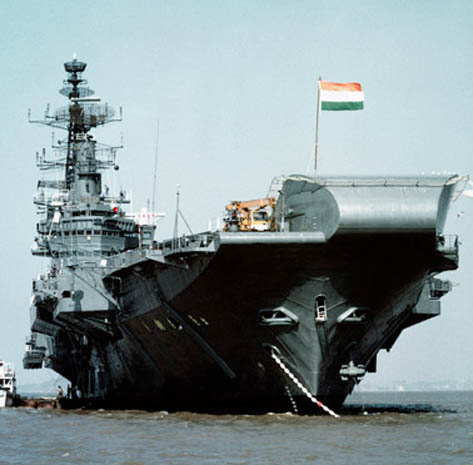
India`s 1st indigenous aircraft carrier


India`s 1st indigenous aircraft carrier


India`s 1st indigenous aircraft carrier
READ MORE - India`s 1st indigenous aircraft carrier

India overhauls coastal security, Navy gets charge

New Delhi, Feb 28 : With the Mumbai terror attacks exposing lack of coordination among security agencies, India on Saturday completely overhauled its coastal security apparatus and handed over the overall responsibility of maritime security to the Navy.

The Government also named Coast Guard (CG) chief as the head of the newly set up Coastal Command. Apart from designating the Naval commanders as Coastal Defence Commanders, the government would also provide the Navy with a 1,000-men 'Sagar Prahari Bal' for securing its installations and create a new north-western region for the CG in Gujarat.

It will also increase the number of ships, aircraft, helicopters, bases and manpower for both the Navy and the CG.

Announcing the decision in Kochi on the sidelines of India's first indigenous aircraft carrier keel laying ceremony, Defence Minister A K Antony said the 26/11 attacks had "shaken" the country and highlighted the need for strengthening the maritime security set up to safeguard the nation against threats from the sea.

"The government has approved certain important measures for strengthening maritime and coastal security against threats from the sea," he told reporters.

"Against the backdrop of multiple agencies involved in coastal security and resultant problems of coordination, the government has decided to designate the Navy as the authority responsible for overall maritime security, which includes coastal security and offshore security," Antony said.

The Navy, he said, would be assisted by Coast Guard, State Marine Police and other central and state agencies for the coastal defence of the nation.

"The Coast Guard is additionally designated as the authority responsible for coastal security in territorial waters including areas to be patrolled by the coastal police. The CG Director General will be designated as the Commander of Coastal Command," Antony said.

"The CG Director General will be responsible for overall coordination between central and state agencies in all matters relating to coastal security," he said.

For the smooth functioning of this arrangement and to prevent rogue ships going unidentified with each agency shifting the responsibility on the other, the government would set up four Joint Operations Centres (JOCs).

The JOCs would be established at Mumbai, Visakhapatnam, Kochi and Port Blair and these centres would be under the command of the existing Naval Commanders-in-Chiefs (C-in-Cs) respectively and they would be designated as the C-in-Cs of Coastal Defence.

"The JOCs will be jointly manned and operated by the Navy and CG with inputs from diverse agencies including central and state agencies," Antony said.

The government would also establish a national Command, Control, Communication and Intelligence (3CI) network for real-time maritime domain awareness linking the operations rooms of the Navy and the CG, both at the field and apex levels.

However, the Navy would control all its joint operations and those by the CG to ensure that the assets were optimally deployed and there was synergy between the two organisations.

"With these measures, the government is expecting that a new focus will be given for effectively managing threats from the sea and security for the over 7,500-km coastline," Antony said.

By establishing the new, specialised 'Sagar Prahari Bal', the government hopes for protecting naval assets and bases on both east and west coasts and island territories.

The Navy would also get 80 new Fast Interception Crafts for seafront patrolling by the Bal. The setting up of a new north-west region for the CG with responsibility to secure the Gujarat coast, sharing martime borders with Pakistan, would necessitate the creation of a new post of CG Commander for the region to look after the surveillance of the State's coast, the Defence Minister said.

With offshore security being an important component of maritime security, the government also decided to install Vessel and Air Traffic Management System for all offshore development areas, as has been done in the Western region by Petroleum Ministry.

"Along with this, the government would procure Immediate Support Vessels for offshore security by both the Petroleum Ministry and the Navy. In the interim, patrolling using hired crafts will be done," Antony said.

To strengthen the CG, the government would also set up nine additional Coast Guard stations to integrate into the 'hub and spoke concept' with coastal police stations along with manpower.

"These stations are to be located at Karwar, Ratnagiri, Vadinar, Gopalpur, Minicoy, Androth, Karaikal, Hut Bay and Nizampatnam," the Defence Minister said.

The Coast Guard would be empowered both in terms of providing assets and necessary manpower for their enhanced role in guarding the coastline. New posts of Additional Director General and three Deputy DGs were sanctioned, in addition to 20 per cent increase in ships and 30 per cent increase for shore support, Antony said.

To improve the intelligence set-up of Coast Guard, adequate manpower resources would also be given.

Antony said a new static coastal radar chain and a comprehensive network of AIS stations along the entire coastline, including islands, would be set up.

"This will be implemented by the shipping, road transport and highway ministry in coordination with Coast Guard. Further, AIS transponders on vessels below 300 tonnes are also proposed to be installed.

This work will be done by the shipping ministry in coordination with Coast Guard," Antony said. "These measures approved by the government are expected to give a new thrust for strengthening coastal security and meet the challenges of threats from the sea," he said.

Asked if the government would henceforth provide the Navy, the smallest of the three armed forces, its due, Antony said: "In the future, we have to give more support to the Navy. We have to be more careful in the seas, as 90 per cent of India's international trade is carried out through the sea route."
READ MORE - India overhauls coastal security, Navy gets charge

India clears 383 OPs on Bangla border

 NEW DELHI, Feb 28 – Asserting that tight vigil is being maintained along Indo-Bangladesh border, Union Home Minister, P Chidambaram said that Centre has cleared establishment of 383 border observation posts (BOP) along the international border with the neighbouring country. Presenting his third report after assuming charge of the Home Ministry, Chidambaram said the border has been placed under high alert and BSF asked to maintain a tight vigil. The border is totally safe, he assured, adding that security on Indo-Bangladesh border is being strengthened.

Referring to the measures taken to check illegal influx, Chidambaram said approval has been granted to construct 383 additional BOPs in addition to the 802 BOPs already in existence.

About the situation in the North-east and Assam, the Home Minister sounded a stern warning to the outfits, which have ceasefire pacts with the government, cautioning them against indulging in illegal activities.

The Ceasefire Ground Rules are being enforced strictly. The outfits, which have Suspension of Operation (SoO) with Government of India and the State Governments have been warned that grave view would be taken on violations of the ceasefire ground rules, he warned.

The Home Minister’s warning followed reports from the north eastern states about unabated extortions, abduction and even killings by militant outfits, engaged in dialogue with the Centre. The alleged involvement of NDFB cadres in the serial blasts, besides rampant extortion in North Cachar Hills by Karbi and Dimasa militants and involvement of both factions of NSCN in such illegal activities have left Chidambaram fuming.

Meanwhile, the Home Minister disclosed ceasefire with UPDS was further extended yesterday for another six months till July 31.

About the internal security scenario of the region, Chidambaram said that eight NLFT cadres have surrendered in Tripura, while 39 cadres of NDFB surrendered with weapons and hand grenades on Thursday in Assam.

Interestingly enough reports of extortions in the North-east have also led the Parliamentary Standing Committee attached to the Home Ministry to comment that in spite of decrease in number of casualties, reported instances of extortion activities and collection of levies by the outlawed groups are increasing. The Parliamentary panel asked the Home Ministry to keep a close watch on the developments and make all-efforts to foil the nefarious design of the secessionists.

In its Action Taken Report on recommendations of the Parliamentary Standing Committee attached to the Home Ministry, the Centre said it is maintaining close and continuous coordination with the State Governments in the region with a view to periodically reviewing the situation and taking further steps, as may be necessary on a continuing basis.

The State Governments have been apprised of the views of the Committee regarding instances of extortion related activities by various groups, the report tabled in the Parliament on Wednesday said.
READ MORE - India clears 383 OPs on Bangla border

Border with Bangla secure but situation serious: Officials

NEW DELHI, Feb 28 : Persistent threats to Bangladesh PM Sheikh Hasina continues to make the mutiny situation potentially explosive, but Indian officials, following the developments in Dhaka closely, said that notwithstanding the surrender by BDR rebels, the situation was "serious" because the real planners and causes still remained unclear.

What is clear is that after 50 dead and many injured in the clashes, which spread to several cities in Bangladesh on Thursday, the security implications of the BDR rebellion is only now unfolding.

In a bland response, MEA on Thursday said it was "an internal matter for Bangladesh. We are confident they will resolve the situation amicably. As regards our border (with Bangladesh), the area is safe and secure".

But the concerns are deeper than that. For starters, the Bangladesh-India porous border has been virtually unguarded for the past 24 hours, which means it's easier for terrorists to infiltrate into India from these areas, where only Indian forces are on guard, which is the chief concern of Indian security forces right now.

In the end, it took a visit by army chief Moeen U Ahmed to Sheikh Hasina's office to crystallise the official response. Hasina abandoned the political tack — where negotiations failed — and moved in tanks in the afternoon, hours after a sternly worded appeal and deadline expired.

According to Maj Gen Muniruzzaman, from the Bangladesh Institute for Peace and Security Studies, this operation must have been planned for months. "It was a huge intelligence failure and has security implications of a grave nature for Bangladesh and India." He added that for India, this event increased the threat of movement of "transnational terrorists into India".

Former security official Bhaskar Roy said, "This will seriously affect the stability of the Hasina government."

The Bangladesh government and intelligence agencies were blind-sided by the revolt, but as the rebellion spread to other parts of the country, from Cox's Bazar, Chittagong and Naikhongchari in the south, Sylhet in the northeast, Rajshahi and Naogaon in the northwest and Dinajpur, it became clearer that there was a larger, more insider design to the rebellion. The rebels were seen wearing distinctive orange-coloured bandanas, colours belonging to a UK-based Islamist organisation, Hizb-ut-Tahrir. According to terrorism analysts, Tahrir has been focused on Bangladesh for the past couple of years to turn the nation into an Islamist caliphate.

The immediate dangers for Hasina are several: first, there will certainly be short-term instability in her fledgling government specially if a concerted effort is made to weed out the rebellious elements.

Second, there is a total collapse in the command structure in BDR, specially after it's clear that at least 12 senior commanders (including the director-general and his deputy) were killed and their bodies dumped in the sewer.

But more positively, the army, under Gen Moeen Ahmed, weighed in on the side of the Hasina government. In the past few years, the army has taken great pains to cleanse its cadres of BNP loyalists, though, after Thursday, some suspect that a few of those remain. In July 2008, an internal rebellion was crushed and subsequently, many senior officers were "purged". Brigadier Amin of the DGFI was removed. General Masood, the second-in-command in the army, was also removed. Masood is a brother-in-law of Khaleda Zia's brother, and officials are now checking to see whether some of this family connection could have been used.

Indian security agencies are looking at a Pakistan ISI angle, because of a deep closeness with the BDR and DGFI. In many ways, this was a massive intelligence failure. But given the DGFI-ISI ties, could there be a different explanation, sources here wondered.

Despite amnesty to the rebels, a certain cleansing process of the armed forces will have to be conducted. That will add to the instability. On the other hand, other disaffected, pro-BNP groups could have joined the rebels, but resisted. This could benefit the army.

On Tuesday, Hasina had addressed the BDR forces and made two points which sources said, stood out -- that there should be an end to smuggling by the BDR ranks, and that her government would not tolerate moves to make Bangladesh a springboard of terrorism against India.

This, many say, could have been the immediate trigger. BDR ranks have a legitimate grouse against the army both in terms of pay and perks as well as in terms of better overseas assignments like peacekeeping operations. This makes the army a better compensated group than the paramilitary BDR. Many BDR officers killed by the rebels were on deputation from the army, hence a target of the rebels' ire.

On the other hand, over the past 6-7 years, the BDR has been stuffed with cadres from JEI-JMB and BNP, as Islamism spread inside the paramilitary outfit which guards the Indian border. In these years, Islamists have used this border to smuggle in weapons and terrorists, trained by Pakistan's ISI.
READ MORE - Border with Bangla secure but situation serious: Officials

How the Lashkar planned Mumbai massacre

Praveen Swami

NEW DELHI, Feb 28 : Sahil Pavaskar used to leave home early and return late, and appeared to have no friends or family — in other words, leading a colourless life exactly like those of hundreds of thousands of young migrants to Mumbai.

Pavaskar’s neighbours found that the young man, who had rented a one-room tenement at 98-B Batatawala Chawl on Patthe Bapurao Marg, did not encourage casual conversation. Staff at Soft Pro computers in Mumbai’s Fort area, where he attended computer classes, thought he had moved from New Delhi in search of work.

But police in several States, who had reason to get to know Pavaskar better, found he was in fact Fahim Arshad Ansari — a print worker who went on to become one of the Lashkar-e-Taiba’s key covert operatives in India.

Prosecutors have now charged Ansari and Uttar Pradesh resident Sabahuddin Ahmad with preparing the maps and videotapes that guided the Lashkar’s fidayeen to their targets in Mumbai — the first official assertion that Indians participated in the conspiracy.

Born in 1973, Ansari grew up in Mumbai’s Malad area. His parents, Mohammad Yusuf Ansari and Saleha Ansari, had migrated to the city from Uttar Pradesh. The youngest of nine siblings, Ansari passed out of the Malad Municipal Secondary School in 1989, and began to work in the family’s paper-making business at Goregaon — a business that is still run by his eldest brother, Abu Bakr Ansari.

Later, he married Yasmin Ansari, a resident of the Mominpura area — the neighbourhood where, by a quirk of fate, the founders of the Lashkar’s Indian operations first met way back in 1985.

From his teen years, Ansari had shown a deep fascination for jihadists. Osama bin Laden, he told co-workers at the Dubai printing press where he worked in 2005, was his role model. Early next year, he made contact with the Lashkar — the organisation whose theological beliefs mirrored his own faith in the neo-conservative Ahl-e-Hadis sect — and volunteered for service.

Ansari, investigators say, arrived at the Bait ul-Mujahideen, the Lashkar’s headquarters in Muzaffarabad, in February 2007. During the 10 months he was to spend at Lashkar camps in Pakistan-administered Kashmir, Ansari allegedly completed several military and intelligence training courses.

Before returning to India, the Mumbai police say, Ansari was called for a meeting with a Lashkar commander still known only by the code-name Abu Kahafa — the same man who, arrested terrorist Mohammad Ajmal Amir claims, briefed the fidayeen unit on its attack plans. Ansari was shown Google Earth maps of Mumbai, and asked to mark key locations, including several later attacked by the Lashkar’s fidayeen unit — among them, Chhatrapati Shivaji train station, the Taj Mahal Hotel, and the Colaba area in south Mumbai, where Nariman House in located.

In November 2007, Ansari flew to Kathmandu on a legitimate Pakistani passport identifying him as Hammad Hussain, and then travelled on to Mumbai. Back home, Ansari busied himself videotaping landmarks in south Mumbai.

Sabahuddin’s role The prosecutors say Ansari passed on this material to Sabahuddin Ahmad, alleged to be a ranking Lashkar commander. Ahmad, in turn, passed it on to top Lashkar leader Zaki-ur-Rahman Lakhvi, through a Pakistan-based commander known only by the code-names ‘Yusuf’ and ‘Muzammil.’ Both men were reported to have been arrested by Pakistani authorities, but have yet to be charged.

Sabahuddin’s links to the Lashkar, police sources allege, date back to 2001, when he was recruited by the Uttar Pradesh-based Islamist cleric, Mohammad Zubair — an enigmatic figure who was killed by the Jammu and Kashmir police in 2006. He dropped out of Aligarh Muslim University the following year, and is alleged to have trained at Lashkar camps in Pakistan until mid-2005. Travelling, like Ansari, through Kathmandu on a Pakistani passport, Sabahuddin set up home in Bangalore.

In December 2005, Sabahuddin and a still unidentified Lashkar fidayeen code-named ‘Hamza’ are alleged to have staged an attack on an Indian Institute of Science convention. Later, on January 1, 2008, he allegedly drew on the experience to stage a murderous assault on a Central Reserve Police Force camp in Rampur, Uttar Pradesh.

No material evidence exists to show that the tapes and photographs made by Ansari — who is separately being tried for his alleged attempt to attack the BSE — were the same used to brief the fidayeen unit. Pakistani investigators, who can settle the issue, have not been forthcoming. Interestingly, Pakistan has not sought information on Ansari and Sabahuddin — even though it has made references to the involvement of Indian nationals in the attack.

The Maharashtra prosecutors intended, instead, to rely on less conclusive evidence — among it, Amir’s testimony. Questioned on the reliability of the maps by the fidayeen unit, the police claim that Amir told them that Abu Kafaha said they had been prepared by Ansari. Lakhvi, the charge sheet states, later made the same claim.

The prosecutors may also introduce expert testimony to demonstrate that a map found on the body of a killed terrorist known by the code-name Abu Ismail was drawn in Ansari’s hand.
READ MORE - How the Lashkar planned Mumbai massacre

Anti-terrorism campaign valedictory today, attendance must for students

Government, police guarded about the prospect of another gridlock

BANGALORE, Feb 28 : Even as the city police maintain that they have granted permission only for 25,000 members to attend the valedictory of the campaign against terrorism, more than 700 colleges affiliated to Bangalore and Tumkur Universities — with a student population estimated around 10 lakh — have received orders from the Government making it mandatory for students to attend the function here on Saturday.

With the Government being the organiser and its department – the police – being the regulator, each appears to be making guarded efforts not to invite the wrath of judiciary, which had pulled up the police for improper handling of the Janata Dal (Secular) rally which threw life out of gear in the city on November 17.

Higher Education Department as well as the universities have issued separate circulars to all colleges in Bangalore Urban and Rural, Ramanagaram, Kolar and Tumkur districts making attendance mandatory at the gathering for teachers, non-teaching staff and students.

The organisers, who admit that they expect over two lakh students to attend the function, have arranged hundreds of buses, including around 600 Bangalore Metropolitan Transport Corporation (BMTC) buses.
Several colleges have said that they would be using their own transport facilities. Commissioner of Police Shankar M. Bidari said even if the numbers exceeded by a few thousands, the police could manage the show.
All roads leading to the Palace Grounds — Bellary Road, Jayamahal Road, C.V. Raman Avenue and adjoining roads — are bound to get choked, and the city is likely to witness another major gridlock.

Although the High Court had directed the police to set in motion rules to govern mega rallies having seen the plight of thousands of citizens, schoolchildren in particular after the Janata Dal (S) rally, the rules are yet to come into force.

Having ‘forced’ students and colleges to attend the rally, the authorities are keeping mum about arrangements at the venue.

This is causing concern among parents who are worried about their wards who will attend the event under the scorching sun on an open ground.

Although dignitaries are expected at the venue by noon, students have been directed to assemble at 10 a.m.
An official in the Collegiate Education Department said food packets, water packets and butter milk would be distributed to students at the venue.

He was not sure whether the supply would be sufficient, given soaring mercury levels and increasing humidity. Neither Higher Education Minister Aravind Limbavali, who once had been a student leader, nor the Government/ university circulars elaborate on the arrangements made.

A college principal, on condition of anonymity, told The Hindu that the college had been inundated with calls from parents enquiring about security arrangements. “Security is a big concern now. Also, some of our students will be dressed in western attire and we are not sure if they will be safe at the venue tomorrow,” the principal said.

He said it was “criminal” to expect students to congregate two hours before schedule.

BMTC assured Bangaloreans that they would not be inconvenienced as spare buses would be offered for the event. Still, minor problems were anticipated for commuting towards northern parts because of the large congregation on Palace Grounds, it said in a release.

Counter-protests Several student organisations on Friday staged a protest in front of Mahatma Gandhi statue.

They have urged students to boycott the valedictory programme.

The organisations submitted a memorandum to the Governor and planned to take out a counter-rally from the City Railway Station at 11.30 a.m. on Saturday.
READ MORE - Anti-terrorism campaign valedictory today, attendance must for students

Indian RAW on the Bangladesh BDR Mutiny

Bad Omens From Bangladesh

By B. Raman

"In an assessment on Bangladesh disseminated in January, 1997, this writer had observed as follows:

"There are individual officers in the Bangladesh intelligence community and in its security forces, who feel positively towards Sheikh Hasina (Prime Minister) and her father, but one cannot say the same thing of these organisations as institutions. Institutionally, they may not share with her the same enthusiasm for closer relations with India and for assisting it in dealing with the insurgency (in the North-East). It would take her and her party considerable time to understand and assess the intricacies of their working and the labyrinthine relationships which they have built up with their Pakistani counterparts during the last 21 years. She, therefore, has to move with caution."

"The savage manner in which 15 members of India's Border Security Force (BSF) were reportedly abducted, tortured, killed and their bodies mutilated beyond recognition last week shows that even after almost five years in power, Sheikh Hasina is apparently not in total command of her military and intelligence establishment, which like its counterpart in Pakistan, has been infected by the fundamentalist virus of Afghan vintage and is probably developing an agenda of its own vis-à-vis India."

Extract from my article dated 23-4-2001 titled BANGLADESH: A BENGALI ABBASI LURKING SOMEWHERE? at

The current mutiny across Bangladesh by directly-recruited junior officers and other ranks of the Bangladesh Rifles (BDR) bodes ill for the recently-elected (in December, 2008) Government headed by Sheikh Hasina. Their mutiny, which started in Dhaka on February 25, 2009, and has since spread to other parts of the country, including Chittagong, ostensibly over long-pending grievances regarding pay and allowances and food rations, is directed till now not against the political leadership but against the senior army officers----serving and retired---on deputation to the BDR.

2. The targeted Army officers occupy senior positions in the command and control of the BDR and their pay and allowances and other perks are governed by those applicable to the army officers and not by those applicable to the directly-recruited officers of the BDR. Resentment over what is perceived by the direct recruits as the step-motherly treatment meted out to them by the deputationists and re-employed officers of the Army seem to have acted as the trigger for the mutiny. The spreading mutiny, during which a number of senior army officers serving on deputation in the BDR, are reported to have been either killed or held hostage, seems to have taken the Army and political leadership by surprise.

It was the outcome of a secret conspiracy well-planned and well-executed by the junior officers and other ranks. The intelligence wing of the Bangladesh Police and the Army-dominated Directorate-General of Forces Intelligence (DGFI) seem to have been taken by surprise. If the DGFI had advance information, it would have at least tried to alert the senior army officers so that they did not become targets and victims of the mutineers. The fact that it did not do so suggests that the DGFI was not aware.

3. The fact that the mutineers were able to plan and execute this conspiracy in total secrecy with even the grass-roots political cadres of different parties not getting scent of it, speaks of a well-organised anti-army network inside the BDR. The identities of the ring leaders of the conspiracy remain unclear. A question of major concern both to the BD political and military leadership as well as to India should be - was the mutiny purely due to bread and butter issues or is there something more to it?

4. As in the case of the BD Army, in the case of the BDR too, many of the recruits at the lower levels come from the villages and quite a few of them are products of the mushrooming madrasas across the country funded by money from Saudi Arabia, Kuwait and Pakistan. The rural areas of Bangladesh and the madrasas there are the main recruiting and brainwashing grounds of the Harkat-ul-Jihad-al-Islami (HUJI-B) and other jihadi organisations. While the international community has paid considerable attention to monitoring the infiltration of the Pakistani Armed Forces by fundamentalist and jihadi elements since the days of the late Gen.Zia-ul-Haq, similar attention has not been paid to monitoring the presence of fundamentalist and jihadi elements in the BD Armed Forces and the BDR.

5. Senior officers' relationship with the junior ranks has always been the Achilles' heel of the BDR, which used to be known before the birth of BD in 1971 as the East Pakistan Rifles (EPR). The EPR consisted largely of Bengali direct recruits officered by Punjabi and Pashtun deputationists from the Pakistan Army. Resentment over the humiliating attitude of the Pakistani Army officers towards the Bengali junior ranks was an important factor, which had contributed to the desertion of large sections of the Bengali junior ranks from the EPR and their joining the freedom struggle under Sheikh Mujibur Rahman.

6. After the birth of Bangladesh those members of the EPR, who had deserted and joined the freedom struggle, were reconstituted into the hard-core of the newly-created BDR. The force at the lower and middle levels has grown around this hard core. It now has a strength of around 70,000 and its role is mainly trans-border security in times of peace. In Bangladesh territory bordering India, which has been the hotbed of the activities of the HUJI and where many of its training camps are located, the BDR is responsible for security. Its role in this regard often brings it into contact with the HUJI and other jihadi elements.

7. The unfriendly attitude of sections of the lower ranks of the BDR to India became evident from the savage manner in which 15 members of India's Border Security Force (BSF) were abducted, tortured, killed and their bodies mutilated beyond recognition by elements from the BDR in April, 2001. Sheikh Hasina, who was in power at that time too, did not or could not take action against those responsible for this savagery despite her professed friendship for India. The BD Press had quoted the then BD Foreign Secretary, Syed Muazzem Ali, as telling journalists at Dacca on April 20, 2001, as follows: "The border force has standing responsibility of protecting the frontier from any external attacks. BDR are there to repulse any attack on the country's frontier. There are some situations when decisions are taken instantly. It does not require to send file to Dhaka, get order and then start firing. It is the charter duty of BDR to protect our frontier from any attack on our border. If question of war comes, then the orders from top level may come." He thus tried to justify the action by the BDR.

8. The mutiny and the consequent confrontation between the junior elements of the BDR and the Army has placed Sheikh Hasina in a trickly situation. The Army seems determined to act against the BDR mutineers and crush their revolt by using tanks and other heavy weapons against them. It should be able to crush them in Dhaka and other big towns. Its ability to do so in the rural areas and particularly near the border with India remains to be seen. If the mutineers realise the lack of wisdom of their action and surrender without further resistance, the situation may be controlled. If they put up a resistance in the rural areas, many HUJI and other jihadi elements might join them in the hope of exploiting the situation to their benefit.

9. In the past, the BDR had remained loyal to Sheikh Hasina and other political leaders. They preferred to depend on the police and para-military forces for their personal security than on the Army, which they distrusted. Now she has no other option but to back the army in its confrontation with the mutineers and authorise it to take whatever action it considers necessary to quell the mutiny. The political fall-out of the confrontation could be unpredictable for her Government. The ultimate beneficiaries of any political instability resulting from it could be the jihadis.

10. The developing situation has to be closely watched by India and the rest of the international community.

Link
READ MORE - Indian RAW on the Bangladesh BDR Mutiny

Bangladesh’s troopers end violent revolt, four dead

Dhaka/Kolkata, Feb 25 Thousands of Bangladesh border guards ended a revolt over poor working conditions and agreed to return to the barracks Wednesday after Prime Minister Sheikh Hasina announced an amnesty, ending several hours of fierce fighting with the army in the heart of Dhaka that reportedly left at least four people dead and the country shaken.

Gunbattles raged through much of the day in the heart of the capital as the army tried to storm the headquarters of the 67,000-strong Bangladesh Rifles (BDR) after its troopers mutinied demanding better pay and an end to frequent transfers, throwing up the first major challenge to the month-old government of Sheikh Hasina.
The BDR headquarters and the area around it on Dhaka’s outskirts turned into a war zone as the troopers took on the better equipped army soldiers who encircled the complex, exchanging gun and mortar fire in the capital.
Thick smoke billowed and military helicopters hovered overhead, firing shots into the compound. Thousands of rounds of gunshots and mortar firing were heard.
At least four army officers deputed to the BDR were killed, claimed one protester. There were also reports that a rickshaw puller had been killed by a stray bullet.
Some officials believe the death toll could be much higher as the soldiers were seen firing weapons in all directions. A fire also raged at the BDR headquarters earlier in the day.
According to a television channel, heavy weapons like cannons were used to damage some buildings. Soldiers driving armoured vehicles were shooting to prevent the Rapid Action Battalion and the army from overwhelming them. The army quickly deployed anti-tank weapons outside the BDR headquarters.
The crisis that began at 7.30 a.m. continued till late in the evening when Hasina announced amnesty for the mutinous troopers and they agreed to return to the barracks, reported the Daily Star Online.
After a 14-member BDR team met the prime minister at her residence, BDR Deputy Assistant Director Touhid told reporters that they would surrender arms and go back to their barracks. “We had talks with the prime minister and we agreed to return to barracks,” he was quoted as saying.
Rebellious troopers claimed there were over 20,000 of them at the BDR headquarters. At one time, they declared that they were ready to take on the army.
“We want to tell them that we need freedom. Everybody knows how miserably we live. We cannot work independently. We don’t have a department of our own,” a trooper who was part of the delegation that met the prime minister said.
BDR, which guards over 4,400 km long border with India and Myanmar, is headed by an army general. The BDR personnel have always resented the army dominance.
The troopers said Major General Shakil Ahmed, director general of BDR, was unhurt, putting to rest rumours that he had been killed.
But before the revolt ended, there were many panicky moments.
“We are under siege, try to save us!” pleaded a BDR official to a journalist before hanging up. When another journalist called another BDR official at the headquarters, which was ringed by armed and masked BDR personnel, he did not speak, and the journalist could hear screams.
Sources inside the headquarters said the firing began in the morning when senior officers, mostly drawn from the army, were at an annual conference in which the soldiers were allowed to vent their grievances, media reports said.
But instead of just complaining, the enlisted men shouted at the army officers and held them hostage. Several hundred troopers then took control of the artillery and other heavy weapons inside the compound.
There was no inkling of the storm brewing. Only a day earlier, the prime minister had taken salute at a ceremonial parade and addressed officers and men at the BDR headquarters in Pilkhana.
An apprehensive India put its frontier guards on maximum alert along its 4,095 km border with Bangladesh.
An Indian Border Security Force (BSF) official said troops were put on high alert and additional reinforcements rushed to sensitive border areas along the northeastern states of Tripura and Assam.
“A high alert was sounded with senior officials asked to station themselves in the border outposts,” A.K. Singh, a BSF spokesperson said.
READ MORE - Bangladesh’s troopers end violent revolt, four dead

BSF on high alert along Indo-Bangladesh border

New Delhi, Feb 25 : The Border Security Force today went on high alert along the entire 4,095-km Indo-Bangladesh border following a rebellion by soldiers of Bangladesh Rifles in Dhaka.

"We are fully alert and informed. The situation at the border is perfectly normal at this time," BSF Director General M L Kumawat told PTI here.

Orders have been issued to top officials of the BSF in the five states bordering Bangladesh -- West Bengal (2,216 km), Assam (262 km), Meghalaya (443 km), Mizoram (318 km) and Tripura (856 km) to keep a close vigil along the boundary, sources said.

Kumawat spoke to senior officers based in the eastern sector including IGP (Assam and Meghalaya Frontier), Prithviraj, and discussed the prevailing situation, reports reaching here said.

The BSF DG, however, said, "There has been no additional deployment of forces in the wake of today's development in the neighbouring country." The situation arising out of the rebellion prompted West Bengal Chief Minister Buddhadev Bhattacharjee to hold a high-level meeting at Writers' Buildings, official sources in Kolkata said.
READ MORE - BSF on high alert along Indo-Bangladesh border

Curfew-like situation in Kashmir

Srinagar, Feb 25 : Curfew-like situation prevailed in the Kashmir valley on Wednesday as authorities imposed stringent restrictions on the movement of people to prevent separatists from staging protest rallies and demonstrations on the fourth day ceremony of two youths killed in the alleged Army firing last week.

Thousands of police and paramilitary forces' personnel have been deployed here and other major towns of the valley as the separatists had called for observance of a general strike to protest against the "cold-blooded" murder of two youths in Sopore town of north Kashmir on Saturday.

Mohammad Amin Tantray and Javid Ahmad were killed and another youth, Firdous Ahmad, was injured in a firing incident at Bumai-Sopore, 55 km from here, sparking off massive protest demonstrations, prompting authorities to impose curfew in the
town on Sunday.

The state government has already ordered a magisterial inquiry into the incident while Army has also ordered a court of inquiry. While locals alleged that the troops of 22 Rashtriya Rifles opened indiscriminate fire on the group of youth without any provocation, Army maintains that the two youths were killed in cross-fire between the security forces and militants.

In the wake of restrictions imposed by the administration and strike call by separatists, all shops and business establishments, government offices, banks, courts and semi-government institutions remained closed, officials said.

All modes of transport, including state road transport corporation buses, were off the roads in Srinagar and all district headquarters, including Baramulla, Kupwara, Bandipora, Budgam, Ganderbal, Anantnag, Pulwama, Shopian, Kulgam.

The hardline faction of Hurriyat Conference, led by Syed Ali Shah Geelani, had given a call for strike and peaceful protests against the killing of the two youths. The call was supported by another separatist groups.

Government employees and residents alleged that security personnel were not allowing them to come out of their houses as if curfew had been imposed.

"Police vehicles fitted with public address system made a round of the city in the wee hours asking people not to venture out of their houses as curfew has been imposed", residents claimed.

Police, however, denied any report of curfew being imposed, saying security forces have been given strict orders not to allow gathering of four or more people at any place as section 144 of the CrPC was in force.
READ MORE - Curfew-like situation in Kashmir

Bomb hoax call delays Swarna Shatabdi Express

New Delhi, Feb 25 : Two hoax calls about a bomb being planted on the New Delhi-Lucknow Swarna Shatabdi Express delayed the train for more than an hour on Wednesday at the Ghaziabad station.

"The first call was made at New Delhi Railway station at around 4 am. The train was fully checked and it was allowed to run at its schedule time at 0615 am after nothing
suspicious was found," a Northern Railway official said.

After the departure of the train here, the authorities at Ghaziabad station received another call that claimed a bomb has been planted on the train. The train was stopped at Ghaziabad. Bomb disposal and dog squads were rushed to the station to check the train.

Railway Protection Force personnel and the state police along with sniffer dogs made an extensive inspection of the compartments for more than an hour but nothing suspicious was found.

"The train left for Lucknow at about 0756 a.m," the official said.
READ MORE - Bomb hoax call delays Swarna Shatabdi Express

Pakistani forces close to securing key tribal region

By Zeeshan Haider


PESHAWAR, Pakistan (Reuters) - Pakistani forces fighting Taliban and al Qaeda insurgents expect to have the tribal region of Bajaur in control by mid-March, the general in charge of the campaign told Reuters on Monday.
Heavy fighting began in August in Bajaur, described as a "centre of gravity" for militancy in the region, but two valleys still have to be cleared, Major General Tariq Khan said.
Victory in Bajaur will provide relief for U.S. and NATO forces hard-pressed by the insurgents across the border in eastern Afghanistan.
Tribal elders involved in talks with militants, said Faqir Mohammad, the main Taliban commander in Bajaur, could offer a ceasefire imminently.
During the interview at the Frontier Corp's headquarters in historic Balahisar Fort, in the northwestern city of Peshawar,, Khan received word that his forces had taken the strategically important village of Barchina.
"It means that Charmang is now in our hands," he said, referring to one of the remaining valleys leading to eastern Afghanistan.
He foresaw the offensive continuing until mid-March, but added; "These are not deadlines, they're judgements".
He said he was forced to carry out an offensive in neighbouring Mohmand tribal area after militants launched a major attack on his forces there last month.
Khan said the attack failed but prodded him into action, and military convoys now pass safely through Mohmand.
Khan was switched to Bajaur and appointed commander of the paramilitary Frontier Corps (FC) weeks after the fighting began to hot up in the most northeasterly of Pakistan's seven semi-autonomous tribal regions.
The Frontier Corps is recruited from the ethnic Pashtun tribes of the region, and they have led the fighting in Bajaur because their presence is more acceptable to the fiercely independent tribesmen.
The government helped mobilise tribal armies, known as lashkars, to help combat the militants in Bajaur.
HAMPERED BY TENSIONS
Thick-set and bespectacled, Khan is Pashtun, and has a strong understanding of the people and tribal dynamics.
His appointment was welcomed by senior U.S. military officials, impressed by Khan's success in bottling up militants led by Pakistani Taliban leader Baitullah Mehsud in the South Waziristan tribal region.
Pakistani military officials said in October that more than 1,500 militants, including Chechans, Uzbeks and Arabs had been killed in battles in Bajaur, though there had been no independent verification of the claims.
Khan said his forces had eliminated several middle-tier militant leaders, but he regretted not having wound up the offensive sooner.
"We should have finished these operations much earlier."
The delay in completing the Bajaur campaign was a result a particularly severe winter and tensions with India in the aftermath of an attack on the Indian city of Mumbai by Pakistani militants last November.
He said "two battalions" were redeployed because of the weather and concern on the eastern border with India.
The New York Times reported on Sunday that 70 American military advisers were in Pakistan training the army and paramilitary forces, but Khan denied this, complaining at the inadequacy of U.S. support.
"Are Americans giving us any lethal assistance? Do we get any rocket launchers or bombs or aircraft (from them)? We are getting nothing actually," he said.
"What we are getting are bullet-proof jackets, helmets, water bottles ... medication, surveillance equipment and communication equipment," he said.
The United States had given close to $44 million worth of equipment to the Frontier Corps till last year, but has given billions of dollars in aid to help Pakistan fight militancy since it became an ally in 2001.
READ MORE - Pakistani forces close to securing key tribal region

India will not attend US sponsored summit

Pakistan Foreign Minister Makhdoom Shah Mahmood Qureshi (R) shakes hands with his Indian counterpart Pranab Mukherjee
India will not attend a US-sponsored Summit about the Pak-Afghan border security situation scheduled for later this week in Washington.

The United States had invited India to attend, but New Delhi decided to watch and wait before getting involved in Afghanistan's domestic politics, said the Indo-Asian News Service.

New Delhi is opposed to the perspective of allowing the Taliban insurgents to be part of the future government in Afghanistan, the news agency quoted unnamed official sources as saying.

However, such a perspective could be raised at the summit, according to the report.

The Taliban involvement would be tantamount to giving the Pakistani army carte blanche in exercising its policy, the Times of India said.

Indian Foreign Minister Pranab Mukherjee recently called the Taliban 'a threat to humanity and civilizations'.

The meeting will see high level delegations from Pakistan and Afghanistan led by the two country's foreign ministers.

US special envoy for Pakistan and Afghanistan Richard Holbrooke is expected to attend the conference.

The summit is part of a more comprehensive strategic review of President Barack Obama's policy for the troubled region.

The developments come after Obama's special envoy Richard Holbrooke visited Islamabad, Kabul and New Delhi this month to assess the security situation in the region.

The tribal regions along the shared border between Pakistan and Afghanistan have become a safe haven for Taliban and al-Qaeda militants after a US-led invasion of Afghanistan in late 2001.

India and Afghanistan have strong relationships but both have difficult ties with Pakistan.
READ MORE - India will not attend US sponsored summit

Taliban 1, Army 0

Score another win for Pakistan's extremists. Last week the Taliban extended their control into the country's heartland when the government signed a one-sided peace deal that gave in to the radicals' demands—not in the remote tribal wilds, as with most past bargains, but in the verdant Swat Valley, a onetime tourist destination only 160 kilometers from Islamabad. The government gets a ceasefire and a shaky promise of peace. The militants get the imposition of Sharia in the region.

And secular Pakistan suffers another setback.

The agreement leaves jihadist forces in control of some 70 percent of the district that once was home to 1.5 million people, ratifying gains won through a terror campaign.

Over the past year, the insurgents have killed more than 70 policemen and 150 soldiers, some of whom were beheaded. They have burned some 170 girls' schools and banned the selling of DVDs, the shaving of beards and criticizing the Taliban.

At least 1,200 civilians have also died in the fighting, and up to 500,000 locals have fled the valley. The region has also become a magnet for Taliban from neighboring tribal areas, making Swat a potential staging ground for the expansion of jihadist influence into the populous Punjab plain.

Many war-weary locals have embraced the deal, hoping for peace and justice. But the irony is that the radicals are so divided, there's no guarantee the bloodshed will end. Which means that, thanks to the government's bungling, Swat residents may end up with the worst of both worlds: a new, intolerant leadership that can't even hold up its end of the deal.

With Zahid Hussain
READ MORE - Taliban 1, Army 0

To protest against terror, refuse to be afraid: Hari Kunzru

Novelist Hari Kunzru, who is closely connected to India due to his Kashmiri ancestry (Kashmiri father, English Protestant mother), is renowned for his three books – The Impressionist, which won the Betty Trask Prize and the Somerset Maugham Award; Transmission and My Revolutions, which came out in January 2008.

Standing tall with a strong built, shaven head and a mix of oriental and occidental features, the writer was one of the most sought after writers at the Jaipur Literary Festival.

Shivangi Singh of spicezee.com, caught up with the writer, who chatted away about terror attacks, his upcoming work, Bollywood and so on…

Shivangi: You said in your books that technology has changed the way to protest against injustice. What do you think is the best way to protest against terror attacks, considering the recent events in India?

Kunzru: Well, this is a very interesting question. I would like to say is that to protest against terror, refuse to be afraid. Couple of years ago, demonstrations were used to protest but now times have changed, we can protest in so many ways. Use modern technology to protest, use webgraphics, e-mails, and illustrations to underline the message that – We are not afraid. Just refuse to be afraid.

Shivangi: How many times have you been here? What do you think are the changes in the response of the audience towards a literary festival?

Kunzru: This is the second time I am attending the festival. I must say that this festival has become really big and one of the major literary events in the world. What surprises me is the huge appetite in the audience for literary stuff. It is encouraging!

Shivangi: Your readers are eagerly waiting for your next book. Please tell us something about it?

Kunzru: Well, I can’t reveal much on that because the novel I am writing is in the early stages. It will take sometime before I complete it.

Shivangi: Your ‘My Revolutions’ did not have any Asian character. Do you have any character from this region in your upcoming book?

Kunzru: (Smiles) Yes, I have. In fact, my character is a Punjabi!

Shivangi: Tell us about your favourite Indian authors?

Kunzru: My favourite Indian authors are Salman Rushdie and Pankaj Mishra.

Shivangi: Have you read Booker winner Aravind Adiga’s ‘The White Tiger’? What is your opinion of the book?

Kunzru: I read Adiga’s ‘The White Tiger’, its tone is very angry. I liked it. However, I found his second book, ‘Between the Assassinations’, very interesting. It’s a short story book and is very good.

Shivangi: Do you watch Hindi films? Which was the last Bollywood film you saw?

Kunzru: I generally don’t watch a lot of Hindi films. But while on flight, I watched Akshay Kumar’s ‘Singh is Kinng’. It was entertaining. Akshay Kumar plays the stupid very well.

Shivangi: Please tell us about the literary influences on your life?

Kunzru: It’s very hard to answer because there are so many influences. But I can tell you about the recent good book I have read. It’s a work by Roberto Bolaño Ávalos and I tell you, it is amazing.
READ MORE - To protest against terror, refuse to be afraid: Hari Kunzru

IAF alert after LTTE's display of aerial strength

New Delhi, Feb 21 : In the wake of the LTTE displaying aerial capability in conducting surprise attacks, the Indian Air Force has adopted an extra vigilant mode.

The IAF's decision assumes significance in the wake of militant outfit LTTE' s show of aerial strength.

The IAF plans to install an Aerosat Radar capable of picking up targets at low ranges at the Southern Air Command here, considering the region's strategic importance.

Air Officer Commanding-in-Chief Air Marshal S Radhakrishnan told reporters here yesterday that "considering the region's strategic importance, an Aerosat Radar capable of picking up targets at low ranges would be installed at SAC in two years".

The press conference came hours before the LTTE carried out surprise attacks in Colombo last night, killing two persons and injuring 54 others.

Radhakrishnan also said that the control of Maritime Air Operations (MAO), now under South Western Air Command, would be handed over to the Southern Air Command in Thiruvananthapuram.

IAF sources said in New Delhi that they have already geared up air defence units by placing mobile radars all along the southern coast particularly to secure sensitive infrastructure following the first LTTE attack in 2007.

Those radars and air defence units are already in place and are keeping a round-the-clock vigil and are ready to meet any challenges rogue aerial vehicles may pose, the sources said.

After the Mumbai attacks there had been intelligence inputs that the next terror strike could be through the aerial route following which the IAF had strengthened its air defence units all across the country.
READ MORE - IAF alert after LTTE's display of aerial strength

Four killed in suicide attack in Pakistan

ISLAMABAD, Feb 21 : A suicide bomber pre-maturely blew up his explosive-laden vehicle in Pakistan's northwestern Lakki Marwat district on Saturday killing four people.

The car blew up with a loud bang at Baramkhel area in Lakki Marwat, located near Dera Ismail Khan city, where a suicide attack on Friday on a Shia funeral procession left 32 people dead.

Four passers-by were killed by the explosion, TV channels reported. Witnesses said they had seen parts of bodies lying strewn near the car, which was completely destroyed by the blast.

Police officials said the suicide attacker's vehicle had apparently blown up before he could reach his intended target.

Meanwhile, a tense calm prevailed in Dera Ismail Khan, where curfew was imposed after violent protests erupted following the suicide attack on the funeral procession. The army has also been deployed in the city.

The funeral of most of the people killed was held amidst tight security on Saturday morning. Security forces continued patrolling the city.
READ MORE - Four killed in suicide attack in Pakistan

Lashkar had 320 global terror targets, 20 in India: report

London, Feb 20 Mumbai was one of 320 global targets drawn up by the Lashkar-e-Taiba for commando-style terrorist attacks, a British paper reported Friday.

Western intelligence agencies have accessed the computer and email account of Lashkar’s communications chief, Zarar Shah, and found a list of possible targets, 20 of which were in India, the Guardian reported.


More than 170 people, including 26 foreigners, were killed in the November Mumbai attacks and two key planners - Shah and Lashkar’s operations chief Zakiur Rehman Lakhvi - are now in police custody in Pakistan.
The paper quoted an Indian official as saying:

“If the west can prosecute people for crimes against humanity in The Hague or use rendition to interrogate them in undisclosed locations then what is stopping them now? After all, (western) citizens were killed in Mumbai too.”
READ MORE - Lashkar had 320 global terror targets, 20 in India: report

Will Swat Restructure The Sub-Continent?

By Rajinder Puri

“There is virtual civil war in Afghanistan. There are three million Pashto-speaking Afghan refugees in Pakistan. If the Afghan crisis is prolonged, both Afghan and NWFP Pashto-speaking tribes might be expected to make common cause and revive the call for a Pashtunistan comprising areas of present day Afghanistan and Pakistan.

“If that happens, Sind and Baluchistan will not lag behind. Already there are incipient freedom struggles in both states.

“A war between Pakistan and Afghanistan, or even civil war within Pakistan, were it to come, would not remain confined to Afghan and Pakistani territories. Inevitably, it will spill over and involve India. In that unfortunate event, the painful process of war will confront the leaders of South Asia with the same challenge that they stubbornly refuse to face during peace: how to restructure the subcontinent and undo the legacy of a most unnatural Partition, and to establish in its place a new arrangement more natural to the character and genius of Hindustan.

Day of reckoning

“Let us understand that the day of reckoning is not far. If not by the wisdom of our leaders, then despite their follies, if not by peaceful negotiation, then by painful war, the artificially contrived and grotesquely maintained fragmentation of the subcontinent must end. Nature has already begun to re-assert itself.

“The people of India, most particularly the people of the Punjab, must prepare for the change. The best among them must work for it. Revolutionaries can create history only if they first learn to anticipate it.”

This passage was published twenty years ago in a book authored by this scribe. The intervening period condemned him to isolation, criticism and ridicule. Now, at long last, may one dare hope that the restructuring of the subcontinent has begun? Consider recent events in Pakistan. The Pakistan government has allowed the Federally Administered Tribal Areas (FATA) to be governed by Islamic law. In other words, the Pashto-speaking areas now controlled by gun-toting Taliban will be administered by laws different from those prevailing in the rest of Pakistan. There is worldwide dismay and alarm over this development. Pakistan’s Dawn columnist Murtaza Razvi has asked in his column: “How could you have two parallel justice systems running in the same country?” Good question. It needs to be followed by its logical corollary: Is Pakistan one nation? Nationhood is tested if people stay united voluntarily. That is possible only in democracy. Pakistan has yet to pass that test. The adverse reaction to developments in Pakistan could of course be hasty. The agreement was brokered by the NWFP provincial government. It was approved by President Zardari. It was announced immediately following President Obama’s envoy Richard Holbrooke’s departure from Pakistan after his talks with Zardari. The Pakistan government said that introducing Islamic law in the territory was not a concession to Taliban.

The measure would be implemented only after peace prevailed in the region. Sufi Mohammed, the mentor of the Pakistani Taliban, has expressed confidence about persuading the Taliban to abjure violence. For the world, the most urgent objective is to separate local Pashtuns from Al Qaida’s Arabs and other foreign mercenary terrorists. Bereft of ground support Al Qaida would become vulnerable.

The present agreement is about a ten-day cease-fire in the first instance. It is being hoped that it becomes perpetual. The agreement was brokered by the National Awami Party (NAP) which governs the NWFP province. Asfandiyar Wali Khan, Abdul Ghaffar Khan’s grandson, presides over NAP. In 2002 he recalled two basic lessons his grandfather taught him about the superiority of non-violence. Asfandiyar stated: “My grandfather said that violence needs less courage than non-violence.

Second, violence will always breed hatred. Non-violence breeds love.” In 2007 Asfandiyar said: “The Taliban is not the creation of Pashtun society, but the creation of the Pakistan army.”

On assuming power in NWFP the first change Asfandiyar introduced was to pass a resolution in the NWFP assembly to rename the province as ‘Pakhtunwa’. Only the national assembly can approve the name. Later, NWFP coalition partners and the opposition proposed the name ‘Afghana’ for the province. According to the 100-year unimplemented Durand Line Treaty, which lapsed in 1993, the FATA territory was to be ceded to Afghanistan. The conflict over the proposed new name for the province suggests that the Pashtuns are torn between Pakistan, Afghanistan and independence. Unless peace is restored US action against Al Qaida and the Taliban will mount. President Obama has just sanctioned 17,000 additional troops for Afghanistan. The people of the region desperately want peace. Peace is the first priority.

Liberation from a medieval lifestyle can wait. There is no quick-fix formula to modernize medieval societies. Once peace prevails, this can be accomplished gradually and democratically. The Pashtuns for the first time in over a century have been offered the prospect of legitimized self-rule based on tribal identity. They will get this if they dissociate from terrorism and Al Qaida. That is how the carrot and stick might work. Will they respond positively?

An American university suggests that Osama bin Laden’s sanctuary in NWFP has been located. If that is correct, US action to apprehend him could be imminent. Whether captured alive or killed, Osama’s defeat could polarize the Taliban between peace and terrorism. In the event, what might follow?

It is unlikely that the Pashtuns will easily surrender the prospect of their newfound tribal unity cutting across the borders of Pakistan and Afghanistan. If terrorism ends, several things could happen. The FATA area could be incorporated into a larger Afghanistan as outlined in the Durand Line Treaty. That could destroy Pakistan as we know it. Or, the Pashtun areas of Afghanistan could merge into Pakistan, leaving the Uzbeks and Tajiks in the north to merge with Uzbekistan and Tajikistan.


Pashtunistan

Afghanistan, as we know it, could then disappear. Or, there could be a sovereign, independent Pashtunistan. That would cripple both Pakistan and Afghanistan. Or, the present international borders of Pakistan and Afghanistan could remain intact as both nations arrive at a confederal arrangement that allows Pashtuns of both countries to intermingle freely and live as one people. Obviously the last would be the best arrangement. If it does emerge it could have a domino effect on the entire region to create a South Asian Union modeled on the European Union.

Like the Pashtuns, the Kashmiris are divided between India and Pakistan, the Punjabis are divided between India and Pakistan, the Bengalis are divided between India and Bangladesh, and the Tamils are divided between India and Sri Lanka. At midnight on August 15, 1947, Pandit Nehru spoke in Parliament: “Long years ago we made a tryst with destiny, and now the time comes when we shall redeem our pledge, not wholly or in full measure, but very substantially…..” After the leaders of the Congress betrayed their own commitments, their own followers and Khan Abdul Ghaffar Khan, by accepting the Partition, the Frontier Gandhi, who sought merger with India but was spurned, gave the call for an independent Pashtunistan. Today, his grandson wrestles with the crisis in NWFP.

Apart from Nehru, others too in India and Pakistan made their own trysts with destiny. Has the time come for them to redeem their pledge, not wholly or in full measure, but substantially…?

Critics may dismiss such expectations as nonsense. They could be right. But one makes a humble submission. Wait for this year to end before passing final judgment.

The author is a veteran journalist and cartoonist
READ MORE - Will Swat Restructure The Sub-Continent?

Journalist's killing shatters Pakistan-Taliban truce


New Delhi, Feb 20 : Just days after Pakistan's agreement with the Taliban to restore Sharia law in Swat Valley, a Geo TV reporter was shot at and beheaded in the region.

The Geo TV reporter, Musa Khan Khel, was covering the rally organised by extremist group Tehreek-e-Nifaz-e-Shariat Muhammadi (TNSM) in Matta, Swat when he was shot dead by unidentified gunmen.
The rally was being led by TNSM chief Sufi Mohammad which the 28-year-old Musa Khan was covering.
The killing has shown how hollow Sufi Mohammad's claims of bringing peace in the troubled North West Frontier Province are.
Musa Khan was shot dead in Matta, which is a stronghold of Maulana Fazlullah, leader of the Swat Taliban.
Unidentified killers sprayed Musa with bullets close to the spot where Swat Taliban head Maulana Fazlullah and Sufi Mohammad were to meet for peace talks. It was a gory murder as Musa Khan's throat was also slit
The Pakistan government was quick to condemn the killing, calling it an attack on journalism.
The Pakistani media has reacted strongly to the brutal killing of GEO reporter Musa Khan in Swat Valley.
"There were 32 bullets fired on Musa Khan. There were groups who wanted Musa Khan to give up journalism so that they don't come into picture. But he did not fall prey. Instead he got into aggressive reporting and exposed all of them. We are not at all going to run away from such threats. We are going to continue to do our work from Swat. Such killings are not going to slow down our spirit," Geo TV Chief Hamid Mir said on Thursday.
Pakistan journalists have called for a nationwide protest on Thursday. But this is not the first time that a journalist has been killed in Pakistan's troubled areas.
In fact, Musa Khan is the second journalist to be shot dead in Swat valley in the past three months. Dawn News reveals that Musa Khan had received death threats from the local Taliban in the past.
Violence has been reported in some areas mourning his death and it seems by killing a prominent journalist, some terror groups are trying to disrupt the new found peace in the valley
Taming the Taliban has proved to be a slippery task for the Pakistan government which has continued to be a mute spectator to the Taliban gaining ground in Swat.
Analysts say that the incident is likely to endanger the peace negotiations between the Taliban and the Pakistan government just three days back.
"The Matta region where Geo TV journalist Musa Khan was murdered is believed to be the stronghold of the Taliban in Swat. Musa Khan was in Swat to cover the peace deal between the government and the militants. Musa is being called the first martyr of the peace deal. Musa was tarvelling with Sufi Mohammad, one-time millitant who was jailed for six years after leading a jihad into Afghanistan to fight allied forces. Sufi Mohammad is seen as a moderate and the government beilieves it can work with him and is hoping he can speak with the head of Taliban - his own son-in-law - Maulana and try to convince him to lay down weapons. It is a risky strategy. Many are now beginning to believe that Swat is a safe haven for militants, Taliban and a center for spreading jihad across Pakistan. The government imposed Shariat Law in the valley and in return, the militants promised ceasefire and to end the killings."
READ MORE - Journalist's killing shatters Pakistan-Taliban truce

ULFA-HUJI terror link to be broken through regional co- operation

Guwahati, Feb 19 : Though the United Liberation Front of Assom (ULFA)’s influence in Assam is waning, people here fear that the organization has established close links with the Bangladesh-based terrorist outfit HUJI (Harkat-ul-Jihad-al Islami) and it is suspected to be involved in creating trouble in country’s northeastern states.

The Government of India is taking steps to smash the ULFA-HUJI terror link for ensuring peace and normalcy to the area through regional co-operation.

Bangladesh had become a safe haven for ULFA’s top leadership.

During bomb blasts in Assam, the finger of suspicion went towards ULFA and HUJI.

Bangladesh based HUJI, as per sources, manages several of ULFA’s training camps, especially in the Chittagong Hill Tracts, where cadres of both outfits are trained.

The Government of India is making attempts to control this menace. Such a resolution reflected in the words of External Affairs Minister Pranab Mukherjee recently, when he said: "What is more important, is the sincerity to fight against the menace of terrorism, it can be achieved if we have bilateral mechanism, regional mechanism. We have global mechanism, but if there is, inability, incapability or unwillingness to tackle with the problem of terrorism and to fight against terrorism as a global issue, then the problem comes."

Foreign minister Pranab Mukherjee’s during his recent visit to Dhaka raised issues concerning the security situation and Bangladesh providing a safe haven to militants.

Sources reveal there are about 110 militant camps in Bangladesh of which 31 are ULFA’s. The Bangaladesh government, in response to India’s concerns, has assured not to allow its country’s soil to be used for carrying out attacks against India.

"Whoever tries to use our territories to harm anyone, we will put a stop to it with vigilance. I am reassuring not just the honorable foreign minister of India, but I would like to reassure all of us that we will be vigilant and we will not let use our territories for any kind of terror activities," said Dipu Moni Mukherjee, Foreign Minister of Bangladesh.

ULFA’s links with HuJI and ’sleeper cells’ operating in Assam from across the border are a cause of concern, which analysts believe can be tackled with regional cooperation.

Assam shares around 272-kilometers long border with Bangladesh. Being porous, it makes it easy for migrants from Bangladesh to infiltrate into Assam.

"It is very important that Bangladesh helps Indian government to eradicate, to crush out the militants from the location because they are hiding in Bangladesh and taking all the irrational activities in India. So it is security threat for India to the militants of Northeast India in Bangladesh or even in Myanmar. So it is important that the government takes some initiative and hopeful that the Indian foreign minister visit to Dhaka will keep good outcome result for the people of India," said Nava Thakuria, Political observer and Journalist in Assam.

When ULFA was set up in 1980s its main aim was to raise the issue of illegal Bangladeshi migrants. However, ULFA today is now targeting the Assamese under pressure from its Bangladeshi cohorts.
READ MORE - ULFA-HUJI terror link to be broken through regional co- operation

SWAT: GROPING FOR PEACE

B.RAMAN

The Tehrik-e-Nifaz-a-Shariat-e-Mohammadi (TNSM---- the Movement for the Enforcement of Islamic Laws), founded by Sufi Mohammad, a resident of the Malakand Division of the North-West Frontier Province (NWFP) of Pakistan, came into existence in 1992 two years before the birth of the Taliban of Afghanistan, headed by Mulla Mohammad Omar. Sufi Mohammad used to be a member of the Jamaat-e-Islami (JEI) before he left it and founded the TNSM to fight for the enforcement of the Islamic laws in the entire Malakand Division, of which Swat is a part.

2. Benazir Bhutto was the Prime Minister of Pakistan in her second term (1993-96) during the period when both these organisations came into existence. Whereas the Taliban was brought into existence by Pakistan's intelligence agencies to replace the different warring Mujahideen groups of the 1980s vintage, they played little role in the birth of the TNSM. During Benazir's prime ministership, Sufi Mohammad organised huge road blocades in the Malakand Division to demand the enforcement of the Islamic laws in the area. Benazir bought peace by accepting all his demands except one. Sufi Mohammad wanted that the Islamic courts to be set up in the Malakand Division should be totally autonomous with the appellate courts in Peshawar, the capital of the NWFP, and Islamabad having no jurisdiction over them. She did not accept this demand. Her acceptance of the other demands of the TNSM was not reversed by her successor Nawaz Sharif or by Pervez Musharraf, who seized power in 1999.

3. There were allegations by Sufi Mohammad that even the demands accepted by Benazir were not properly implemented. Till 9/11, the TNSM remained essentially a religious fundamentalist organisation with close links to the Afghan Taliban, but with no pronounced anti-US or anti-Army feelings. The US military strikes in Afghanistan under Operation Enduring Freedom turned it into an anti-US and anti-Army organisation. Sufi Mohammad issued a fatwa calling upon his followers to go to Afghanistan to fight against the US troops along with the Afghan Taliban. A large number of his followers led personally by him crossed over into Afghanistan. Many of them were mowed down by US air strikes. The survivors, including Sufi Mohammad, fled back into the Pakistani territory.

4. Musharraf had Sufi Mohammad arrested and kept in preventive detention and banned the TNSM as a terrorist organisation on January 15,2002. Maulana Fazlullah, a son-in-law of Sufi Mohammad, assumed the leadership of the TNSM and resumed the struggle for the implementation of the promises made by Benazir and for abolishing the appellate jurisdiction of the courts in Peshawar and Islamabad over the Islamic courts in the Malakand Division.

5. In the elections held towards the end of 2002, Musharraf had the polls manipulated in order to have the Awami National Party (ANP), a progressive Pashtun party, which used to be led by Khan Abdul Gaffar Khan, known as the Frontier Gandhi, and the Pakistan People's Party (PPP) of Benazir Bhutto defeated. A coalition of six religious fundamentalist parties known as the Muttahida Majlis-e-Amal (MMA) came to power in Peshawar after the elections.

6. The MMA Government closed its eyes to the activities of the TNSM and Fazlullah. From a purely religious organisation, the TNSM grew into a qasi political organisation and expanded its agenda to include not only an autonomous Islamic criminal justice system, but also an Islamic system of education with girls barred from higher education and with a strict code of conduct for all Muslims. Its agenda became largely a carbon copy of the agenda of the Taliban of Afghanistan. It extended its full support to the Afghan Taliban leaders, who had taken sanctuary in Balochistan, in their preparations to strike back at the Americans in Afghanistan.

7. As a result of the inaction of the MMA Government in Peshawar and the federal Government headed by Musharraf, the TNSM became the de facto ruling power of the Swat Valley. However, despite its periodic oral condemnation of what it saw as the pro-US policies of Musharraf, it avoided any confrontation with the Pakistani Army and the para-military forces such as the Frontier Corps (FC). By the beginning of 2007, a de facto diarchy came into existence in the Swat Valley---- with Maulana Fazlullah and his Mullas running the civil administration and the criminal justice system and the army and the FC remaining in charge of internal security. The Army avoided stepping on the toes of Fazlullah.

8. This position of an uneasy co-existence between the Mulla rule of the TNSM and a limited administrative power still taking orders from Peshawar and Islamabad changed after the Army commando raid in the Lal Masjid in Islamabad in July,2007, ordered by Musharraf. The Lal Masjid had two madrasas---one for boys and the other for girls. The madrasa for boys was located outside the masjid campus and the madrasa for girls inside the campus. While the boys surrendered to the commandoes without much resistance, the girls egged on by the Mullas of the Masjid resisted the commandoes ferociously. A large number of them were killed. Many of those killed came from tribal families of the Swat Valley.

9. Angered by the alleged massacre of the girls by the commandoes, Fazlullah issued a fatwa calling for a jihad against the Army. Simultaneously, similar calls for a jihad against the Army were issued by different tribal leaders and Mullas of the Federally-Administered Tribal Areas (FATA). Among those killed in the girls' madrasa of the Lal Masjid were also children of some of the tribal families of the FATA. All these tribal leaders and Mullas decided to form the Tehrik-e-Taliban Pakistan (TTP). Baitullah Mehsud, the leader of the Mehsud tribe in South Waziristan, was designated the Amir of the TTP. The constituent units of the TTP in different areas selected their own Amirs to work under the over-all co-ordination of Baitullah. The TNSM joined the TTP.Many in Pakistan believe that the assassination of Benazir at Rawalpindi on December 27,2007, was carried out by the followers of Baitullah Mehsud in revenge for her alleged support to the commando raid in the Lal Masjid.

10. The intense anger across the Pashtin tribal belt in the FATA and in the Swat Valley over the Lal Masjid incidents led to a wave of suicide terrorism not only in the tribal areas, but also in non-tribal areas, including Islamabad, Rawalpindi and Lahore. The suicide terrorism of the TNSM was directed not only against the security forces deployed in the Swat Valley, but also against the establishments and personnel of the Armed Forces and the Inter-Services Intelligence (ISI) in the non-tribal areas of the country. Faced with this anger, Musharraf ordered the Army and the Frontier Corps to go into action against the TNSM in the Swat Valley in October,2007. The military operations initially succeeded in pushing back the TNSM cadres from the areas controlled by them.

11. The TNSM followed the same tactics as the Taliban in Afghanistan. Faced with the might of the Pakistan Army and the FC, it avoided a frontal confrontation with them. On Fazlullah's orders, his followers dispersed and went back to their villages. After the elected Government led by the PPP came to power in Islamabad in March,2008, the TNSM re-grouped and staged a spectacular come-back, pushed the army and Frontier Corps out of the areas recovered by them and re-established its control over nearly 80 per cent of the territory of Swat.

12. In the elections of February,2008, the constituent parties of the MMA did badly. The ANP and the PPP, which had been marginalised by Musharraf in 2002, recovered their lost position in the electoral map of the NWFP. The ANP, which emerged as the largest single party in the NWFP, formed a coalition Government in Peshawar along with the PPP and other like-minded groups. The ANP was, in turn, accommodated by Asif Ali Zardari in the federal coalition at Islamabad led by the PPP.

13. Even though the ANP has joined the PPP-led coalition, its views on the so-called war against terrorism have more in common with the views of the Pakistan Muslim League (PML) of Nawaz Sharif than with those of Zardari. The ANP believes, like the PML does, that the surge in terrorism in the Pashtun tribal belt was mainly due to the pro-US policies of Musharraf and that there has to be political accommodation with various units of the TTP in different tribal areas in order to restore the writ of the Government in the Swat Valley and the FATA. The ANP advocates marking a distance from the US operations in Afghanistan and entering into a dialogue with elements in the TNSM and the TTP with which, it feels, the Government can do business.

14. Zardari was hesitant to openly support the moves of the ANP lest there be any misunderstanding with the US, but did not rise any objections to the ANP entering into a dialogue not with Fazlullah, who had taken to arms against the Army, but with Sufi Mohammad, who had been released from detention in April, 2008, even when Musharraf was still the President in the hope of using him to create a split in the TNSM and undermine the position of Fazlullah.Following intense negotiations with Sufi Mohammad lasting over several weeks, the ANP-led Government in Peshawar, with a reported nod of approval from Zardari, has signed an agreement with him on February 16,2009, under which it has conceded all the demands of the TNSM relating to an autonomous Islamic criminal justice system in the Malakand Division as a whole not subject to the appellate jurisdiction of the courts in Peshawar and Islamabad. The Government is hoping that in return for its accepting the primacy of the Mullas of the TNSM in matters pertaining to criminal justice, Sufi Mohammad will be able to persuade Fazlullah and his advisers to stop confronting the security forces and withdraw into their masjids, thereby allowing the writ of the civil administration and the army in all other matters to be re-established.

15.Fazlullah has announced a 10-day ceasefire and ordered the release of a Chinese engineer, who had been kidnapped by the TNSM last year, as goodwil gesture towards the Government. It has been reported that the release of the Chinese engineer followed the release by the Government of some TNSM activists, who had been arrested under the Anti-Terrorism Act. The release of the Chinese engineer came a few days before the planned departure of Zardari to China on February 20,2009, on an official visit.

16. Whether the temporary ceasefire becomes permanent and whether Fazlullah agrees to the re-establishment of the Government writ in the Swat Valley would depend on the success of Sufi Mohammad in persuading Fazlullah to accept the agreement reached by him with the ANP-led Government and call off the fighting.

17. As mentioned earlier, the TNSM, under Sufi Mohammad, had originally a single-point agenda of enforcing the Islamic criminal justice system. Under Fazlullah's leadership, it has acquired a multi-point agenda--- enforcing an autonomous criminal justice system in the Malakand Division of the NWFP as a whole, releasing all those arrested during the commando raid in the Lal Masjid, restoring the authority of the Mullas of the masjid, re-establishment of the madrasas of the masjid, action against those responsible for the alleged massacre in the girls madrasa, recognition of the right of the Pashtuns of Pakistan to go to Afghanistan to help the Afghan Pashtuns in their fight against the US-led coalition, the discontinuance of the US Predator (unamanned aircraft) strikes in the Pakistani territory and withdrawal of the Army from the Swat Valley making the Frontier Corps , which consists largely of Pashtuns, exclusively responsible for internal security.

18. Will Fazlullah give up the other demands in return for the Government accepting the demands relating to the Islamic criminal justice system? The likelihood of the restoration of peace in the Swat Valley with the Government once again in command and control will depend upon the answer to this question. (17-2-09)

(The writer is Additional Secretary (retd), Cabinet Secretariat, Govt. of India, New Delhi, and, presently, Director, Institute For Topical Studies, Chennai. E-mail: seventyone2@gmail.com )
READ MORE - SWAT: GROPING FOR PEACE

War with Pak not a solution: Mukherjee


 NEW DELHI: Making it clear that war was not a solution to the problem of cross-border terrorism, India today asserted that business with Pakistan, however, could not be usual till perpetrators of the Mumbai attacks are brought to justice and terror infrastructure is dismantled.

TestWinding up debates in the Lok Sabha and the Rajya Sabha on the Motion of Thanks to the President's Address, External Affairs Minister Pranab Mukherjee also strongly justified government's strategy to depend on using diplomacy to put pressure on Pakistan in the wake of Mumbai attacks, saying it had paid dividends.

Suggesting that a big issue should not be made out of delay by Pakistan to respond to India's dossier on Mumbai attacks, he said it "does not mean we have to rub them on the wrong side" as India understands the "complexities".

He said India is examining the questions raised by Pakistan in response to Mumbai dossier and will share whatever information is possible. "But, please don't divert attention," he said apparently addressing Pakistan.

In his reply in both Houses on behalf of Prime Minister Manmohan Singh, Mukherjee detailed government's actions after the Mumbai carnage and other aspects of foreign policy as well as domestic issues like financial crisis.

The Motion was adopted after amendments moved by Left parties were defeated.
READ MORE - War with Pak not a solution: Mukherjee

Taliban-Pakistan truce: Why India should worry


New Delhi, Feb 18 : India intelligence agencies are worried about the peace deal between the Taliban and the Pakistani Government in the Swat Valley.

The Ministry of External Affairs (MEA) believes that it needs to convince the West that a Talibanised Pakistan with nuclear weapons would be a huge threat to the world.

On February 1, almost two weeks before the imposition of the Sharia law and the truce between the Taliban and Pakistani forces came into effect, National Security Advisor MK Narayanan has said that India was concerned about the stability of Pakistan

"As far as India is concerned as much as that we don't allow our neighbour to go under forces which will definitely be much more inimicable to India than the civilian government there," Narayanan had said.

But those words conceal a mountain of worries. India's intelligence establishment has no doubt that a Taliban takeover will inspire and encourage like-minded groups within India.

They will find safe haven and sanctuaries in Pakistan, the intensity and sophistication of terror strikes will increase and communal polarisation will grow.

So how does India measure up to the challenge of a Talibanised Pakistan?

The most obvious would involve beefing up the armed forces, upgrading counter-terror capabilities and tightening internal security.

But pre-emptive strikes of some kind or even armed conflict are seen as a risky alternative for India.

"The option for India would be either to sit back and wait for this Talibanisation to slowly creep towards us or to go to Afghanistan and help fight it," says Former MEA secretary KC Singh.

The thinking in South Block is that India needs to convince the West that a Talibanised Pakistan is a threat to the world.

Pakistan has nuclear weapons, has expertise in chemical and biological warfare and could be dangerously appealing to a Muslim diaspora in the West that has been under pressure since 9/11.

"That is the big danger and is the big threat which causes panic in the capitals of all western countries because they all believe that if there is a dirty bomb or a nuclear bomb exploded by a terrorist, the source would be Pakistan," former R&AW chief Anand Kumar Verma says.

Intelligence experts believe the West knows and understands the danger.

The US missile strikes in Pakistan's tribal territories is a small-scale war that has taken a heavy toll on Taliban capabilities.

Alongside, Indian diplomats say, the US should bring in key Pakistan allies like China and Saudi Arabia to stabilise and bring peace to Pakistan.

But in the event the Taliban are seen to be moving in on Islamabad or there is a danger of Pakistan's nuclear weapons falling into their hands. America's mini war in the tribal territories could escalate into a full-scale war with uncertain consequences.
READ MORE - Taliban-Pakistan truce: Why India should worry